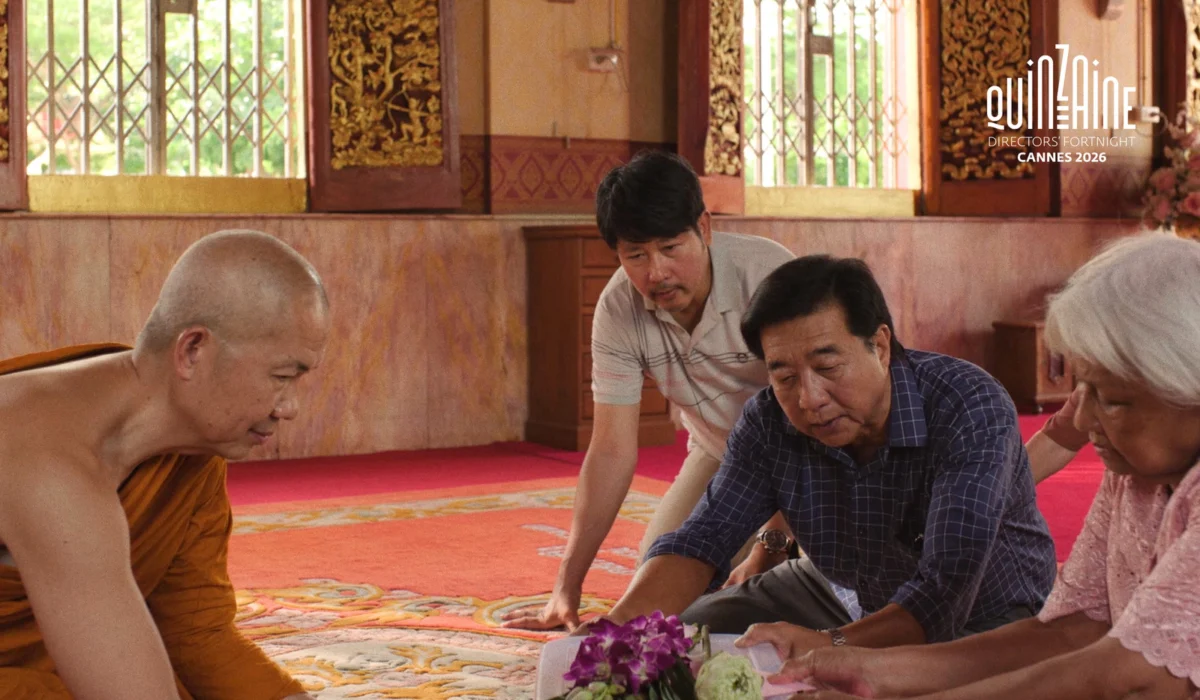
Sompot Chidgasornpongse’s debut feature film, 9 Temples to Heaven, delves into the complex interplay of faith, family dynamics, and societal evolution within contemporary Thailand. The film, a compelling blend of road movie, family drama, and comedy, not only offers a poignant reflection on the generational divide concerning religious practice but also serves as a microcosm of broader cultural shifts occurring within Thai society. At its core, it explores the tension between traditional Buddhist obligations and a more individualized, philosophical approach to spirituality, all set against the backdrop of a family pilgrimage fraught with both humor and deeply buried resentments.
The Premise: A Pilgrimage for Merit and Morality
The narrative of 9 Temples to Heaven is set in motion by a seemingly dire prophecy: Sakol (portrayed by Surachai Ningsanond) learns of his mother’s (Amara Ramnarong) impending death. Driven by a fervent desire to prolong her life and accumulate good karma for her, Sakol devises a plan to visit nine temples in a single day, an act of merit-making deeply ingrained in Thai Buddhist tradition. However, his mother, a creature of comfort attached to her television game shows and the sanctuary of her couch, is anything but enthusiastic about the arduous journey. This initial resistance sets the stage for a trip that quickly devolves from a sacred quest into a turbulent family ordeal.
Determined, Sakol marshals the entire family, renting two vans to navigate the demanding itinerary. What begins as a pious endeavor soon exposes long-standing family conflicts, resentments that simmer beneath the surface of daily life, and the inherent difficulties of intergenerational understanding. As the journey progresses, the mother’s exhaustion becomes increasingly evident, prompting her grandson, Koon (Poon Sirapob), to question the very purpose and efficacy of the pilgrimage. Koon’s skepticism, manifested by his detachment during prayers, elicits stern rebukes from Sakol, who perceives it as a lack of faith and filial support. Yet, Koon is not alone in his empathy for the elderly woman, who eventually retreats into the sanctuary of the van, refusing further participation.
Buddhism in Thailand: A Shifting Landscape
To fully appreciate the thematic depth of 9 Temples to Heaven, it is crucial to understand the historical and contemporary role of Buddhism in Thailand. For centuries, temples have been more than mere places of worship; they are fundamental institutions that anchor community life, serve as centers for education, and preserve cultural heritage. Monasteries traditionally provided shelter, schooling, and a moral compass for villagers, fostering a strong sense of communal identity rooted in Buddhist principles. The practice of "tham bun" (making merit) through donations, temple visits, and participation in rituals is a cornerstone of Thai Buddhist life, believed to accumulate positive karma and ensure well-being in this life and the next.
However, as Thailand has rapidly modernized and urbanized over the past few decades, the relationship between its citizens and these traditional institutions has begun to evolve. Director Sompot Chidgasornpongse himself reflects on this shift, noting that for his parents’ generation, temples were an undeniable cornerstone of existence, dictating social calendars and providing unwavering spiritual guidance. In contrast, his own generation, and particularly those younger, increasingly view Buddhism through a lens of personal philosophy and individual choice rather than as an immutable obligation. This transition reflects broader global trends where younger demographics often seek more personalized spiritual paths, sometimes distancing themselves from rigid institutional practices. While faith remains prevalent, its expression often adapts to contemporary lifestyles, leading to a nuanced, sometimes less ritualistic, engagement with religious traditions. This societal undercurrent forms the profound contextual backdrop against which the family drama of 9 Temples to Heaven unfolds.
The Director’s Vision: Crafting Dissonance and Dialogue
Sompot Chidgasornpongse, in his directorial debut, employs a deliberate and thoughtful cinematic approach to introduce and explore the film’s core ideas. The film’s careful audiovisual design and use of long takes are particularly effective in conveying both the serene beauty of the temples and the underlying tensions. A notable framing device depicts the preparation and conclusion of what appears to be a funeral service, a sequence that encapsulates the film’s thematic essence. Cinematographer Jonathan Ricquebourg initially captures the grandeur of the temple interiors and statuary, evoking a sense of grace and timelessness. This reverence, however, is subtly disrupted by the focus on an elderly man rehearsing a funeral oration, his words hinting at a performance rather than spontaneous grief or devotion.
This early sequence continues with a young man mechanically arranging plastic chairs for the congregation, a stark visual metaphor for the automated nature of certain religious rituals. Faith, in this context, appears to offer stability, yet the ceremony itself is revealed as a practiced performance, repeated countless times. This visual commentary suggests that, much like the characters embarking on their merit-making quest, faith can become an automated gesture, its original meaning perhaps obscured by habit, though the lingering memory of its profound significance persists beneath the surface. Chidgasornpongse repeatedly returns to this idea, questioning whether devotion is truly felt or merely performed.
Character Arcs and Thematic Resonance
The characters in 9 Temples to Heaven serve as distinct conduits for the film’s exploration of faith and generational differences. Koon, the grandson, is the most overt embodiment of skepticism, his disengagement from the rituals a clear challenge to his father’s traditional beliefs. However, the film cleverly reveals that Sakol himself harbors an underlying uncertainty regarding his own faith. Surachai Ningsanond’s performance as Sakol skillfully portrays a man torn between roles: a loving son striving to honor his mother, and a father attempting to project an image of devoutness to his children. His prayers and donations, though well-intentioned, often appear as automatic as the actions of the men in the opening funeral sequence.
Ironically, the frequent arguments between Sakol and Koon, seemingly highlighting their differences, ultimately expose their similarities. Both men exhibit moments of desperation, dissatisfaction, and even fear, pointing not just to a generational chasm but to a shared experience of spiritual emptiness or questioning in a rapidly changing world. This nuanced portrayal elevates the film beyond a simple critique of tradition, instead offering a compassionate examination of individuals grappling with their beliefs and inherited practices.
The most profound spiritual center of the family journey, unexpectedly, becomes the mother. Initially portrayed as resistant and comfort-seeking, her exhaustion and weariness gradually lead her to a detached yet deeply insightful perspective. Through her quiet responses to Sakol’s urgings and her recounted stories of the past, she emerges as a fount of wisdom. One particularly moving scene sees one of her grandchildren recording her voice on a smartphone, an act born from the realization of their limited time together and a desire to preserve her memory. This moment beautifully encapsulates the film’s philosophical depth, illustrating how love, memory, and human connection transcend rigid religious adherence. 9 Temples to Heaven masterfully navigates profound spiritual reflection without resorting to banality or sentimentality, grounding its narrative in authentic human emotion, vulnerability, and weakness.
Critical Reception and Broader Implications
Since its release, 9 Temples to Heaven has garnered significant critical acclaim, cementing its status as an excellent example of contemporary Thai cinema. Reviewers have lauded its perceptive direction, deeply humane script, and compassionate depiction of human nature. The film’s ability to expose long-suppressed family conflicts while simultaneously reaffirming the emotional bonds connecting its members resonates strongly with audiences and critics alike. Its engagement with spirituality is particularly noteworthy, offering a nuanced and respectful portrayal of the evolving relationship between Thais and their Buddhist heritage.
The film’s impact extends beyond its cinematic merits, contributing to a broader cultural dialogue about tradition and modernity in Thailand. It provides a valuable lens through which to examine how universal values of family, aging, spiritual quest, and the search for meaning manifest within a specific cultural context. By exploring the generational divide, 9 Temples to Heaven encourages introspection on how societies adapt to change, how faith is reinterpreted across generations, and what truly constitutes a meaningful spiritual life. It is a testament to Sompot Chidgasornpongse’s vision that his debut feature manages to be both culturally specific and universally resonant, offering a quiet yet powerful meditation on the human condition. Its place in the pantheon of contemporary Asian cinema underscores the region’s capacity to produce thoughtful, emotionally rich narratives that challenge and engage global audiences with profound questions about life, death, and belief.