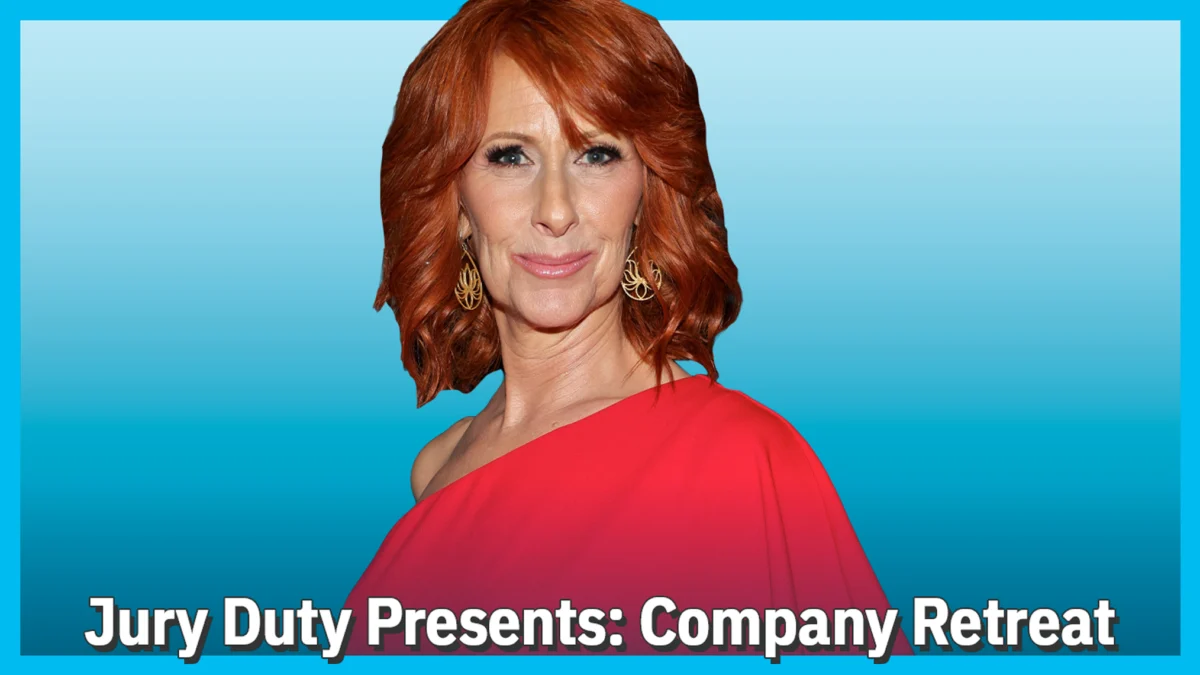
The landscape of experimental television has been fundamentally altered by the success of the genre-bending series Jury Duty, which captivated audiences by placing an ordinary individual into a meticulously constructed, entirely fictional world. Following the critical and commercial success of its debut season, which focused on a simulated trial, the production team transitioned the format to a corporate setting for its second installment, titled Jury Duty Presents: Company Retreat. In this iteration, the narrative revolves around Anthony Norman, an unsuspecting individual who believes he is participating in a standard business getaway for a brand called Rockin’ Grandma’s Hot Sauce. However, every other individual on the campus is a professional actor working from a complex, hybrid script designed to test Norman’s character, ethics, and leadership. Central to this elaborate deception was actress Wendy Braun, who portrayed the primary antagonist, Elizabeth, a high-level executive from the Triukas Group tasked with overseeing the dissolution of the small business.
The production of Jury Duty Presents: Company Retreat represents a significant logistical achievement in modern broadcasting. Unlike traditional scripted television, where actors can reset after a failed take, or reality television, where the participants are generally aware of the cameras, this format requires a "24/7" commitment to character. For Braun, the challenge was twofold: she had to maintain a convincing, often abrasive persona while navigating the unpredictable reactions of Norman, the only person not in on the joke. The role of Elizabeth was designed to be the antithesis of Braun’s actual personality, requiring her to embody a cold, corporate efficiency that placed profit over people—a dynamic that culminated in a high-stakes showdown over the fate of the fictional hot sauce company.
The Narrative Arc of the Corporate Deception
The second season’s plot was structured around the potential acquisition and subsequent dismantling of Rockin’ Grandma’s Hot Sauce by the Triukas Group, a predatory corporate entity. Anthony Norman was positioned as a key employee or stakeholder who found himself caught between the legacy of the brand and the aggressive demands of corporate restructuring. Throughout the retreat, Braun’s character, Elizabeth, served as the primary foil to Norman’s efforts to save his colleagues’ jobs.
The climax of the season centered on a final negotiation where Norman attempted to halt the dissolution of the company. According to production details, the scene was designed to be the emotional peak of the experiment, testing whether Norman would remain steadfast in his values despite intense corporate pressure. Braun’s performance during this sequence was critical; she had to push Norman to his limits without breaking the illusion. When Norman eventually succeeded in his "save," Braun’s character was scripted to exit in defeat. However, Braun revealed that the intensity of the moment led to a series of unscripted, profanity-laden outbursts as she stormed off. These improvisations were born from the genuine tension of the scene and served to solidify the character’s fury, providing Norman with a convincing "villain" to overcome.
The Psychological Mechanics of the "Trust Fall" Production
Braun has described the experience of filming the series as a "giant team-building exercise" and a "giant trust fall" involving over 100 cast and crew members. The complexity of the production cannot be overstated. Hidden cameras were positioned throughout the retreat location, and the actors had to be prepared for any direction Norman might take a conversation. This required a deep level of preparation, including extensive backstory development and rehearsals that covered various "if/then" scenarios.
Despite the scripted nature of the overarching plot, the minute-to-minute interactions were largely improvisational. Braun noted that while they rehearsed the logistical beats—such as where Norman would enter and where the actors would stand—the emotional reactions had to be authentic to the moment. For the actors, the pressure was immense; a single slip-up or a moment of "breaking character" could jeopardize the entire production and reveal the secret to Norman. This necessitated a state of constant alertness, with actors remaining in character even when they were seemingly out of Norman’s sight, as the risk of an accidental encounter was always present.
Behind the Scenes: The Release of Pressure
One of the most compelling aspects of Braun’s account is the "dual life" the actors led during production. While Elizabeth was a source of stress and conflict for Norman, Braun and her fellow actors were secretly rooting for him. Braun recounted that after intense scenes where she had to be particularly antagonistic, she and the "Triukas Group" team would be whisked away by production. Once they were out of earshot and sight of Norman, the actors would celebrate with high-fives and cheers, relieved that the scene had been successful and that Norman had responded with the integrity they hoped for.
This emotional disconnect—playing a villain while feeling immense admiration for the "victim"—is a unique byproduct of the Jury Duty format. Braun emphasized that the job was the most high-pressure and high-stakes of her career because the stakes were not just professional, but personal. The goal was to create a "hero’s journey" for Norman, and that required Braun to be a convincing enough "dragon" for him to slay.
Chronology of the Reveal and Post-Production Reflection
The "reveal" is the most critical component of the series, where the veil is finally lifted, and the non-actor is informed that their recent life experiences have been part of a television show. For Braun, this moment involved a transition from the hated Elizabeth to her true self. She described the emotional relief of finally being able to hug Norman and connect with him as a peer rather than an adversary.
However, the psychological impact on the participant often lingers. Braun revealed that in the months following the production, Norman expressed continued disbelief at the extent of the deception. Even through digital correspondence, Norman reportedly joked that he was "still not sure" about Braun, a testament to how convincingly she inhabited the role of Elizabeth. This lingering skepticism highlights the effectiveness of the production’s world-building and the skill of the actors involved.
Context and Industry Impact of the Jury Duty Franchise
The success of Jury Duty and its successor, Company Retreat, marks a shift in consumer appetite toward "kind-hearted" prank television. Unlike earlier iterations of the genre that often relied on humiliation (such as Punk’d or The Joe Schmo Show), the Jury Duty format, executive produced by David Bernad and Todd Schulman, seeks to ennoble its subject. By the end of the season, the non-actor is typically celebrated as a person of high moral character.
From a data perspective, the first season of Jury Duty was a breakout hit for Amazon’s Freevee (now integrated into Prime Video), earning several Emmy nominations, including Outstanding Comedy Series. This success provided the financial and creative mandate for Company Retreat. The move to a corporate setting allowed the producers to explore different social dynamics, such as office politics, hierarchy, and corporate greed, which are themes that resonate broadly with a global audience.
Implications for the Future of Reality Programming
The production of Jury Duty Presents: Company Retreat raises important questions about the ethics and future of "simulated reality" programming. The level of detail required to fool a participant in the age of smartphones and instant information is staggering. The production team had to ensure that every website, business card, and brand mentioned during the retreat had a plausible digital footprint in case Norman decided to investigate.
Furthermore, the role of the actor in these productions has evolved. Actors like Wendy Braun are no longer just performing a script; they are acting as "facilitators of experience." They must manage the participant’s emotions, guide the narrative toward production goals, and maintain a facade for 24 hours a day. This requires a specialized skill set that blends traditional acting with high-level improvisation and psychological intuition.
As streaming platforms continue to seek original formats that can cut through a crowded marketplace, the "hoax-doc" style pioneered by this franchise is likely to be emulated. However, the success of such shows hinges on the "casting of the mark." In both seasons, the production was fortunate to find subjects—Ronald Gladden in Season 1 and Anthony Norman in Season 2—who responded to the manufactured chaos with grace and empathy.
Conclusion: The Legacy of Elizabeth
For Wendy Braun, the role of Elizabeth serves as a milestone in a career that has spanned various genres, including her notable work on Atypical. By successfully portraying a character so diametrically opposed to her own nature, she contributed to a narrative that ultimately celebrated the human spirit. The "unscripted" fury of her exit, while appearing as a moment of corporate failure, was in reality a triumph of performance art. As the series reaches its conclusion on Prime Video, it leaves behind a blueprint for how television can create profound, authentic human moments within a framework of total artifice. The friendship between Braun and Norman, born from a weeks-long deception, stands as the ultimate proof of the show’s unique ability to blend fiction with reality to reveal deeper truths about character and connection.