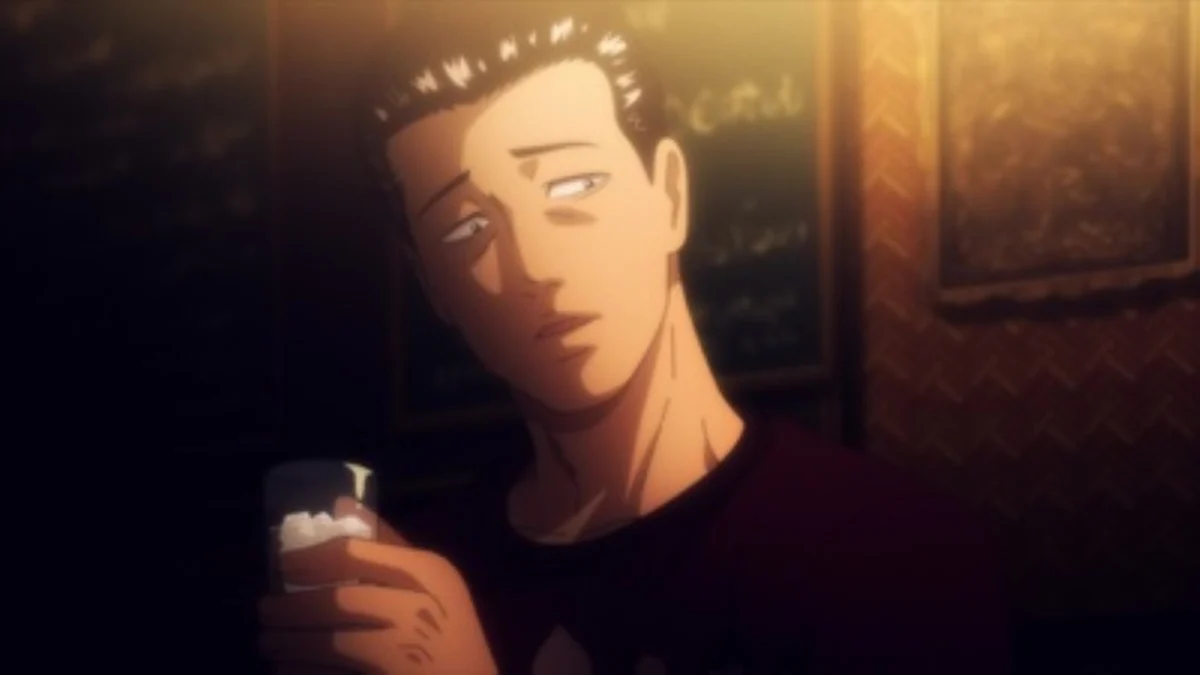
The Fable, an eagerly anticipated anime adaptation of Katsuhisa Minami’s acclaimed manga, delves into the extraordinary life of a legendary hitman forced to embrace the mundane. The series immediately distinguishes itself by reimagining the archetypal professional killer, exploring the psychological landscape of an individual whose life has been defined by cold, efficient violence. In its fourth episode, a pivotal scene unfolds as the yakuza Takeshi Ebihara confronts the protagonist, Akira Sato, with a .38 caliber gun pointed at his forehead, questioning the meaning of life. Sato, a man devoid of overt emotional capacity due to his profession, struggles to articulate an answer. This existential void, however, serves as the very launchpad for director Ryosuke Takahashi’s bold venture into the criminal underworld, where the professional assassin’s figure is meticulously deconstructed and rebuilt. Takahashi’s signature style—a relentless pursuit of plausible actions by credibly motivated characters within realistic circumstances—finds a seamless merger with the recent output of Tezuka Productions’ seinen anime catalog, promising a mature and intellectually engaging experience for viewers.
Origin and Acclaim: Katsuhisa Minami’s Vision
The foundation of "The Fable" lies in Katsuhisa Minami’s original manga, a work that has garnered significant critical acclaim since its serialization began in Kodansha’s Weekly Young Magazine in 2014. The manga quickly captivated readers with its unique blend of dark humor, gritty realism, and profound character study, setting itself apart in the crowded crime genre. Minami’s narrative prowess earned "The Fable" the prestigious 43rd Kodansha Manga Award in the General category in 2019, a testament to its widespread recognition and artistic merit. The series concluded its first run in 2019, followed by a sequel, The Fable: The Second Contact, which ran until 2023. This extensive run and critical success laid a robust groundwork for an adaptation, building a dedicated fanbase eager to see Akira Sato’s world animated. The manga’s strength lay not just in its thrilling action sequences but in its nuanced exploration of identity, belonging, and the human capacity for change, themes that the anime carefully seeks to preserve and amplify. Its portrayal of the Japanese underworld, while stylized, is grounded in a meticulous attention to detail regarding criminal operations and the psychological toll of such a life, providing rich material for a sophisticated anime production.
Tezuka Productions’ Artistic Direction
The choice of Tezuka Productions to helm "The Fable" adaptation speaks volumes about the project’s ambition. While historically celebrated for its pioneering work on classics like Astro Boy and Black Jack, Tezuka Productions has, in recent years, also diversified its portfolio, increasingly producing works aimed at a more mature, seinen demographic. This shift allows the studio to tackle complex narratives and darker themes with the necessary gravitas. Director Ryosuke Takahashi, a veteran in the anime industry known for his precise storytelling and character-driven focus, brings a wealth of experience to "The Fable." His directorial philosophy, centered on creating believable characters operating within a realistic framework, is perfectly suited for Minami’s intricate world. Takahashi’s previous works often demonstrate a meticulous approach to world-building and character psychology, ensuring that the motivations and actions of his protagonists resonate deeply with the audience. For "The Fable," this translates into an adaptation that prioritizes narrative coherence and emotional depth over superficial spectacle, aligning perfectly with the manga’s original intent. The collaborative effort between Takahashi and Tezuka Productions aims to deliver a faithful yet dynamically animated rendition that appeals to both long-time fans of the manga and newcomers alike, positioning the series as a significant entry in the contemporary seinen anime landscape.
The Premise: A Killer’s Forced Normalcy
The narrative kicks off with Akira Sato, a legendary professional hitman, completing a brutal mission with characteristic efficiency. After the execution, he retreats to a car, finding solace not in the violence he just committed but in watching a comedy show by Jackal Tomioka, highlighting an intriguing dichotomy. His mysterious female assistant and driver, Yoko Sato (though not biologically related, they operate as a pair), navigates them towards a dock for a meeting with their enigmatic boss. It is here that the dramatic shift occurs: the boss, recognizing Akira’s unparalleled skill but perhaps also the psychological stagnation inherent in his life, mandates a year-long sabbatical. The rules are unequivocal and strict: no weapons, no killing, and a complete immersion into a "normal" life. The objective is not punishment but an unconventional form of professional development, a belief that experiencing ordinary life will somehow refine his killer instincts and make him an even "better professional." This decree sets the stage for the series’ central conflict and character arc, forcing a man whose identity is entirely intertwined with violence to shed that persona and confront the unfamiliar world of everyday existence.
Navigating Osaka: New Identities and Yakuza Scrutiny
Akira and Yoko are dispatched to Osaka, a bustling metropolis, where they adopt the new identities of Akira Sato and Yoko Sato, siblings attempting to lead inconspicuous lives. Their protection is entrusted to the local yakuza group, Maguro, a decision that immediately injects tension into their forced sabbatical. Captain Takeshi Ebihara, a key figure within the Maguro group, quickly discerns the inherent social awkwardness and potential liabilities posed by the "Sato siblings." His immediate intention is to test them, to uncover their true nature and assess the threat or benefit they represent to his organization. This scrutiny from Ebihara becomes a constant undercurrent of suspense, forcing Akira to navigate social interactions with extreme caution, relying on his formidable observational skills and latent resourcefulness without resorting to violence. The Osaka setting provides a vibrant backdrop, contrasting sharply with the dark underbelly of the criminal world Akira usually inhabits, amplifying the challenges of his new, constrained existence. The interactions with the yakuza, who are ostensibly protecting them but also deeply suspicious, add layers of complexity to Akira’s attempt at normalcy, ensuring that the threat of his past profession is never truly far away.
The Evolution of Akira Sato: From Cold Precision to Spontaneity
Akira Sato’s character is initially presented as a paragon of professional killers: cold, calculating, and leaving absolutely nothing to chance. He possesses an intimate knowledge of weaponry, appreciating the aesthetics of a Nighthawk Custom pistol as much as the brutal efficiency it offers. Every movement is precise, every shot fired devoid of hesitation, reflecting a meticulousness that extends to behavioral and linguistic studies—tools to understand and exploit human nature for his grim work. However, this absolute control has come at the cost of his social skills, leaving him emotionally stunted. The sabbatical acts as a crucible, forcing him to confront this deficit. Gradually, Akira begins an unexpected transformation. He forms an unlikely bond with a parrot, a seemingly minor detail that symbolizes his opening up to spontaneous, non-lethal connections. He slowly allows unplanned experiences and people unlike himself to enter his life, leading to a profound realization: the true value of his professionalism, and indeed his self, is not found in rigid adherence to a "score" or pre-planned script, but in his capacity for improvisation and genuine response to the moment. This awakening allows him to shed the illusion that his best self is defined solely by his work, opening doors to new emotions and a genuine willingness to understand himself more deeply, fostering an identity infused with authentic human experience.
Crafting the Visual Narrative: Animation, Design, and Cinematography
The visual execution of "The Fable" is a cornerstone of its appeal, driven by the confident lines of character designers Saki Hasegawa, Junichi Hayama, and Kyuma Oshita. Their approach leans towards a realistic design, eschewing overt symbolism in favor of emphasizing detailed facial expressions and a meticulous study of the human body. This results in an "honest, unbothered visual world" that feels raw and authentic, perfectly complementing the series’ gritty themes. The action animation is well-executed, delivering impactful sequences that maintain the intensity expected from a series about a professional hitman, even when Akira is restrained. While the delivery of chiaroscuro—the use of strong contrasts between light and dark—might not always reach the emphatic levels some fans might hope for, the overall artistic ideas are conveyed with clarity.
Crucially, the series employs close-up shots with great effect. These aren’t merely stylistic choices but serve multiple narrative purposes: enhancing the expressiveness of faces, particularly in scenes without dialogue, thereby allowing subtle emotions to surface; stretching cinematic time to build suspense; and providing a canvas for voice performers to intensify psychological tension through brief, impactful inner monologues. This deliberate pacing and visual emphasis underscore the internal struggles of the characters, making the audience privy to their nuanced psychological states. The careful editing, which maintains a dynamic energy by alternating between sparkling moments of action or dark humor and slower-paced, domestic interludes, is central to the series’ rhythm. These quieter scenes, often creating a "strangely soothing atmosphere," are notably inspired by the recurring vamp from Herbie Hancock’s Cantaloupe Island, imbuing the everyday with an unexpected jazz-infused cool.
The Art of Voice Acting: Bringing Depth to Complex Characters
The brilliant cast of "The Fable" is committed to rendering the series’ world with authenticity, particularly through their convincing portrayal of the Osaka dialect, which adds a layer of regional charm and realism. Akio Otsuka’s performance as Takeshi Ebihara is a standout, transforming what could have been a one-dimensional yakuza captain into a character of considerable depth and nuance. Otsuka masterfully conveys Ebihara’s suspicion, cunning, and underlying pragmatism, making him a formidable yet understandable figure rather than a simplistic antagonist.
However, the true highlight of the voice cast is the exceptional pairing and chemistry between Miyuki Sawashiro and Kazuyuki Okitsu, who voice Yoko Sato and Akira Sato, respectively. Okitsu’s portrayal of Akira is predominantly characterized by a monotonous and flat tone, effectively conveying the hitman’s emotional detachment and social awkwardness. Yet, he introduces subtle, interesting exceptions to this flatness, hints of an awakening or genuine reaction that underscore Akira’s slow transformation. Sawashiro, in stark contrast, offers a spectrum of vocal nuances for Yoko, ensuring that no emotion—whether bold, feigned, or genuinely felt—is ever suppressed. Her performance provides a vital counterpoint to Akira’s stoicism, highlighting Yoko’s more reactive and outwardly expressive nature. Together, they form a compelling "bass-and-soprano duo" whose vocal dynamics perfectly balance and convey the complex psychological development of their characters, enriching the narrative with layers of unspoken tension and evolving understanding.
Thematic Resonance and Broader Implications
"The Fable" transcends its genre as a captivating model of comprehensive art, brought to life through excellent teamwork across its production. It masterfully engages the audience in a suspenseful journey replete with entertaining moments, but its impact extends beyond mere entertainment. The series resonates as a profound invitation to introspection: it explores the comfortable yet limiting nature of an identity solely defined by one’s profession or established routine. While taking refuge in a zone where one’s identity feels unthreatened might offer security, the series argues that such comfort simultaneously prevents true amazement, growth, and self-discovery.
The core philosophical message of "The Fable" posits that the best we can offer to life resides in that elusive part of ourselves—the aspects we have yet to discover or fully understand. It is often through deep encounters with other human beings, through unexpected connections and experiences that challenge our preconceived notions, that these hidden facets of our identity are revealed. Akira Sato’s journey from a detached killing machine to a man grappling with newfound emotions and social interactions serves as a powerful allegory for this idea.
In a broader context, "The Fable" enriches the professional killer genre by moving beyond mere spectacle to offer a nuanced character study. It demonstrates that even the most hardened individuals can undergo profound personal evolution when circumstances force them to confront their humanity. Industry analysts suggest that its success could pave the way for more psychologically complex adaptations in the anime landscape, encouraging studios to invest in narratives that prioritize character development and thematic depth alongside action. The series’ unique blend of dark humor, existential questioning, and heartfelt exploration of identity positions it as a significant cultural contribution, likely to spark discussions among viewers about the true meaning of self and the transformative power of human connection in an increasingly complex world. As such, "The Fable" stands not only as an accomplished adaptation but also as a compelling commentary on the universal human quest for understanding and authenticity.