Christian Petzold: A Distinct Voice in European Cinema
Christian Petzold stands as a preeminent figure in contemporary German cinema, widely recognized as a leading light of the "Berlin School." This informal movement, characterized by a minimalist aesthetic, precise compositions, and a keen focus on psychological realism intertwined with social critique, has profoundly influenced European arthouse filmmaking. Petzold’s oeuvre consistently explores themes of identity, memory, historical trauma, and the uncanny, often employing allegorical narratives and drawing heavily from literary and mythological sources. His interviews and post-screening Q&As have become anticipated events within the American arthouse community, celebrated for their intellectual depth, wit, and rich tapestry of cultural and historical citations. A recent retrospective of Petzold’s work at Film at Lincoln Center, for instance, saw every in-person Q&A with the director completely sold out, underscoring his significant following and the profound impact of his cinematic vision. Miroirs No. 3, currently in select theaters courtesy of 1-2 Special, exemplifies Petzold’s distinctive approach, further cementing his reputation.
Fairytale Motifs and the Fabric of Reality
Petzold frequently incorporates elements of folklore and fairytale into his cinematic narratives, a practice he acknowledges openly. Discussing Miroirs No. 3, he has described it as, in many ways, his Alice in Wonderland, with its pervasive imagery of mirrors and its journey into a metaphorical "looking glass." This approach is also evident in his 2020 film Undine, which reimagines the ancient myth of a water spirit. Petzold explains his fascination with using fantastical stories as departure points for his projects, noting a desire to imbue German reality with the kind of mystical, romantic atmosphere often associated with French Nouvelle Vague cinema. He recounts an experience in Paris, observing the Jardin du Luxembourg, a locale rich with cinematic history, and reflecting on the challenge of portraying similar depth of emotion or desire within the often starker, less romanticized landscapes of Germany.
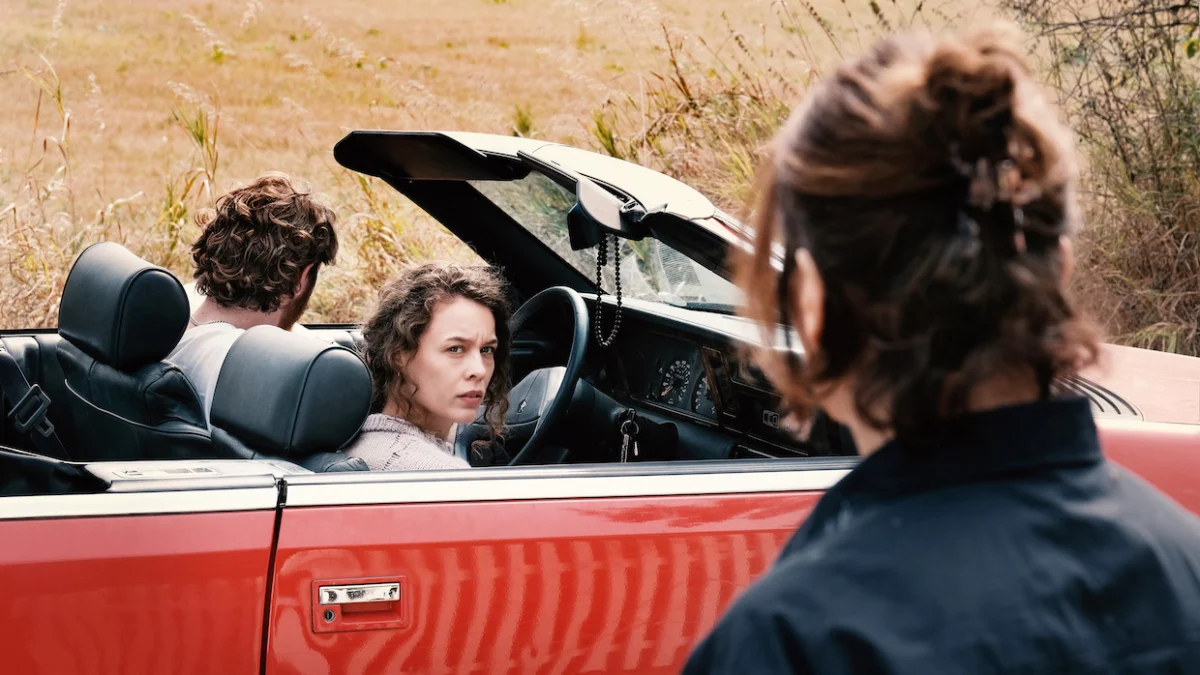
For Petzold, cinema possesses the transformative power to alter the perceived world for its characters. He draws parallels to childhood adventures in mundane surroundings—like a small forest near a highway—where a fantastical atmosphere could spontaneously arise. In films like Undine or Miroirs No. 3, the characters’ worlds undergo a profound shift, allowing the structures and logic of fairytales to seep into their reality. In Miroirs No. 3, a lost shoe from the car accident evokes the tale of Cinderella, while the red convertible itself serves as a deliberate cinematic reference, echoing iconic vehicles from Jean-Luc Godard, François Truffaut, or Dustin Hoffman’s car in The Graduate. These are not mere quotations but rather signifiers that proclaim a shift in the film’s diegetic world, inviting the audience to become "intruders," like surveillance cameras, observing events within this newly altered, heightened reality. This intertextual layering enriches the film’s psychological landscape, inviting viewers to engage with its deeper, symbolic meanings.
The Morality of the Camera: A Collaborative Vision
Petzold’s meticulous approach to filmmaking extends to his collaboration with his longtime cinematographer, Hans Fromm. Their discussions transcend technical aspects, delving into the philosophical implications of camera placement. Petzold cites Éric Rohmer and Jacques Rivette’s assertion that "the camera position is a position of morality" as a guiding principle. This philosophy leads to a deliberate rejection of handheld or shoulder-mounted camera work, which Petzold views as lacking a defined moral stance, merely "following something" in a manner akin to 1960s Direct Cinema.
Their unique process involves extensive rehearsals with the actors, often lasting several hours, without a camera present. Only after these rehearsals does Fromm observe the final run-through. This period allows Petzold and Fromm to meticulously plan storyboards and camera positions, delving into the true essence of each scene. For instance, during the making of Barbara (2012), their early discussions led them to understand the film as a study of surveillance, prompting them to question the viewer’s own position as an observer. This rigorous, reflective process ensures that every camera angle in Miroirs No. 3 is intentionally chosen, contributing to the film’s pervasive sense of unease and its carefully constructed psychological tension. The camera becomes an active participant in shaping the audience’s moral and emotional engagement with the unfolding drama, meticulously crafting moments of observation that enhance the film’s thematic resonance.
Architecture as Metaphor: Betty’s Abandoned Home
The production design of Betty’s home in Miroirs No. 3 serves as a powerful metaphor for failed aspirations and emotional ruin. Petzold reveals that the house was entirely custom-built, from the porch to the piano room and white fence, emphasizing that nothing in its dilapidated state was left to chance. During a recent discussion with director Alexander Koberidze, Petzold articulated his belief that "cinema loves abandoned places because abandoned places are projects that have failed." This sentiment profoundly informs the design of Betty’s residence.

The house, with its broken dishwasher, ruined fence, and damaged bicycle, is intended to reflect "broken minds and broken souls." Petzold envisioned it as a project undertaken by Betty and her family years prior, designed to be an open, transparent space, filled with windows and doors, allowing wind and light to flow through. This contrasts sharply with the typical German family home, which Petzold describes as often resembling a "cave," built with porches on the backside, designed to shield inhabitants from the outside world. Betty’s home, conversely, was a defiant attempt to "refresh Germany," to embrace openness and connection, a project that ultimately ended in "total defeat." Hans Fromm and Petzold meticulously chose camera positions that would emphasize these open windows and doors, allowing the audience to feel the past desire of a family striving for a fantastic life, now hauntingly present in its abandoned state. The house thus functions as a silent character, bearing witness to a history of longing and loss, mirroring the psychological landscape of its current inhabitants.
Musical Echoes and Intertextual Dialogue
The inclusion of Frankie Valli and The Four Seasons’ song “The Night” in Miroirs No. 3 is a deliberate and deeply significant musical choice, connecting Petzold’s film to a broader cinematic and cultural conversation. Petzold openly discusses his admiration for Michael Cimino’s The Deer Hunter (1978), a film he considers a powerful portrayal of the working class and the devastating impact of war when capitalism is in crisis. The Deer Hunter notably features Frankie Valli’s "Can’t Take My Eyes Off You," a song that encapsulates the vibrant energy and love of the working-class community before its channeling into the Vietnam War.
Petzold reveals that the final scene of Miroirs No. 3, where characters gather on the porch, drinking coffee and eating eggs, is a direct homage to the concluding scene of The Deer Hunter, where a traumatized group collectively sings "God Bless America." This reference underscores a shared thematic thread of collective survival and the resilience of human spirit in the face of profound trauma. Petzold’s discovery of "The Night" came via Miguel Gomes’s The Tsuga Diaries (2021), a film about artists in exile during the pandemic, where a Frankie Valli song evokes what was lost during lockdown. The director expressed astonishment that "The Night" and "Can’t Take My Eyes Off You" were from the same artist, highlighting the song’s unexpected depth and versatility. This musical intertextuality enriches Miroirs No. 3, infusing it with layers of historical and emotional resonance, connecting the film to broader narratives of societal upheaval and personal endurance.
The Evolution of a Narrative: Reshooting the Ending
One of the most compelling insights into Petzold’s creative process involves the dramatic decision to reshoot the ending of Miroirs No. 3. Petzold recounted how, six months before shooting, lead actress Paula Beer and actor Enno Trebs (who plays Max) expressed profound concerns about the original script’s conclusion. The initial ending depicted Laura returning to the family permanently, seeking to live with them as a daughter for the rest of her life—a resolution Petzold had considered "the best sentence [he’d] ever written." Despite his initial resistance, stemming from pride and a sense of authority, a subtle discomfort persisted during production.
Later, in post-production, editor Bettina Böhler echoed Beer and Trebs’s doubts, confirming that "something was wrong." This realization plunged Petzold into a four-week depression, fearing the film was irredeemably flawed. However, his producer reassured him that a single day of reshoots, costing approximately 20,000 Euros, was feasible. The reshoot occurred with Paula Beer eight months pregnant, her altered physical state adding an unforeseen layer of poignancy. The revised ending portrays Laura leaving the family, asserting her own independent life, transforming the narrative from one of adoption into a new familial structure to one of self-actualization and adult agency. This pivotal change, influenced by his collaborators, profoundly altered the film’s message, offering a more nuanced and empowering conclusion about healing and individual growth beyond the confines of inherited grief. It highlights Petzold’s ultimate willingness to evolve his vision in pursuit of artistic truth, acknowledging the invaluable contributions of his team.
Enduring Collaborations and Future Horizons
Petzold’s work is deeply marked by his enduring collaborations with a core group of actors. Miroirs No. 3 notably reunited him with Barbara Auer after 25 years, their last collaboration being The State I Am In (2000). Auer’s role as Betty, a woman who has lost a daughter and seeks to "adopt" Laura, serves as a thematic companion to her character in the earlier film, where she played a mother living underground, unable to provide a normal life for her child. Petzold notes that Auer herself recognized a "muscle memory" from her previous role, illustrating the depth of character development and the continuity within his cinematic universe. This complex interplay between roles across different films highlights Petzold’s capacity to explore evolving facets of human experience through the same actors.
Petzold also reveals ambitious plans for future projects, confirming he will work with Barbara Auer again this summer. Furthermore, he anticipates collaborating with both Paula Beer and Nina Hoss, two of his most frequent muses, on a film slated for two or three years from now. This upcoming project, for which he is currently writing the fourth draft of the script, will center on a German theater group facing closure due to encroaching capitalism. Their final performance will be Anton Chekhov’s The Cherry Orchard, a play itself a poignant reflection on societal change and the loss of traditional ways of life. In a particularly intriguing twist, Nina Hoss and Paula Beer are slated to play enemies within this theatrical ensemble, promising a rich and complex dynamic. Petzold, now 65, candidly admits to writing prolifically, stating, "When you pass 60 years of age, it’s like you’re writing many, many things to at least have something for your last years." This dedication to his craft and his consistent collaborations underscore his profound commitment to exploring the human condition through the lens of cinema, ensuring a rich legacy for years to come.