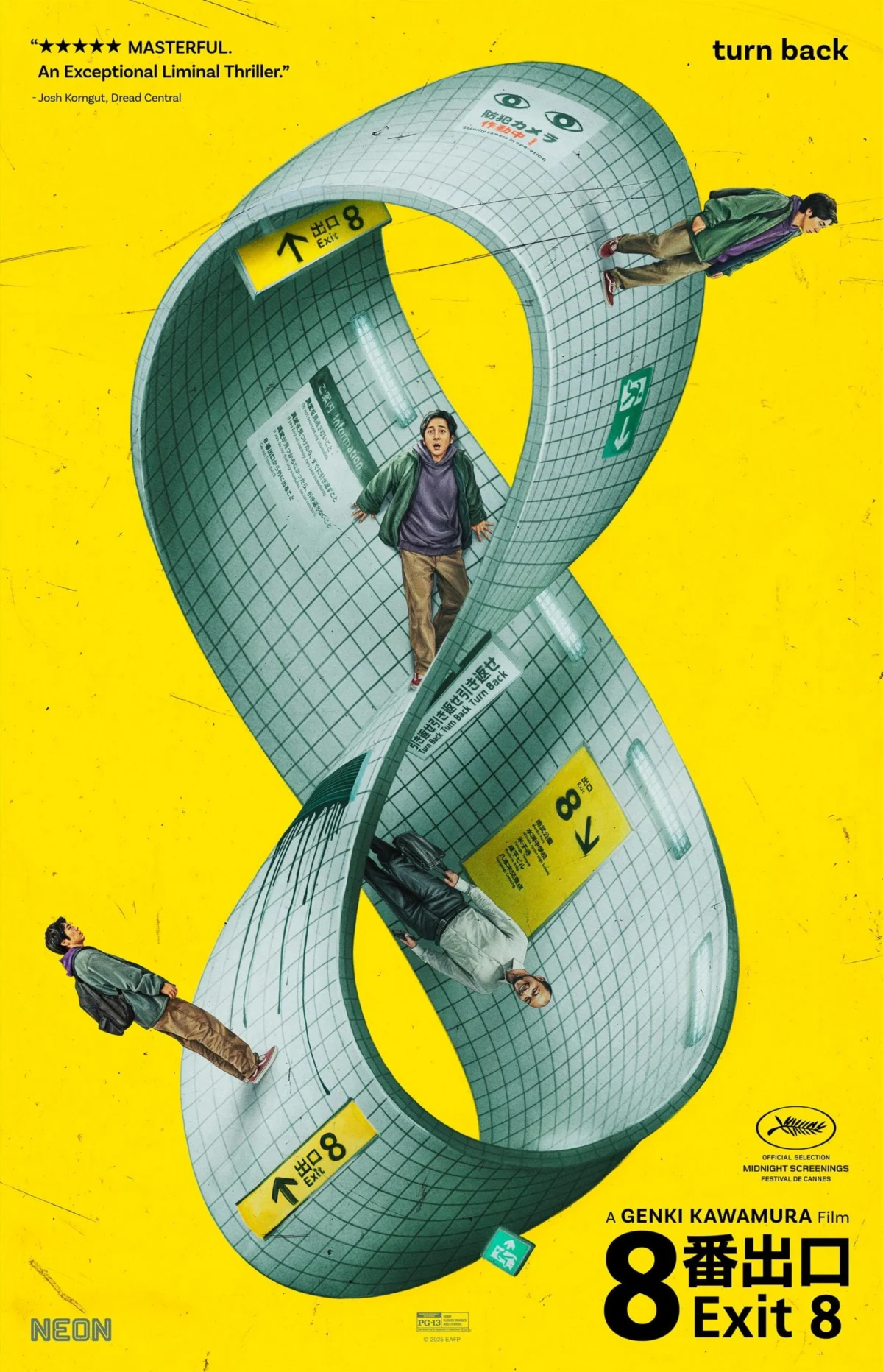
Director Genki Kawamura, celebrated for his profound explorations of existential dread and the unsettling nature of reality, is bringing his latest cinematic achievement, Exit 8, to North American theaters this Friday. Adapted from the acclaimed video game of the same name, Kawamura’s film plunges audiences into a meticulously crafted labyrinth of perception and unease, a space where the terror stems not from external threats but from the chilling realization of inescapable confinement. This narrative approach echoes the claustrophobic logic found in genre classics like Cube, Dead End, and Stanley Kubrick’s The Shining, films that masterfully trap their characters within incomprehensible systems from which escape seems impossible.
Kawamura’s adaptation, while remaining faithful to the core of its source material, elevates the narrative with a deeply existential undercurrent. The film operates as a closed loop of dread, challenging viewers to question the nature of their own perceived reality and the systems that govern it. In a candid interview for Dread Central’s April 2026 digital cover story, Kawamura delved into the thematic richness of Exit 8, discussing its connection to liminal horror, the profound implications of fatherhood, and the unsettling parallels between the film’s narrative and the often-unseen forces that shape our own lives.
Thematic Resonance: Liminal Horror and the Fragility of the Mind
At its core, Exit 8 thrives on the concept of liminality – the state of being in-between, on the threshold of something new or unsettling. This is a space Kawamura has explored before, notably in his work as a producer on films like Your Name., which dealt with themes of connection and displacement. With Exit 8, he directly confronts the psychological horror that arises from this state of uncertainty.
"I’ve long been drawn to a particular strain of horror built around existential entrapment, where the terror doesn’t come from what’s chasing you, but from the realization that there’s literally and figuratively nowhere to go," Kawamura explained. "Genre standouts like Cube, Dead End, and The Shining all operate within that suffocating logic, trapping their characters in systems they can’t fully understand, let alone escape."
![‘Exit 8’ Director Genki Kawamura on Crafting His Liminal Nightmare [Digital Cover Story]](https://www.dreadcentral.com/wp-content/uploads/2026/04/exit-8-again.jpg)
Kawamura’s approach to adapting a video game into a film is a testament to his forward-thinking vision. "On the one hand, we’re doing something very cutting edge by taking a video game and adapting it into a film," he stated. "But at the same time, I wanted to tap into a lot of our classic horror greats, which is I think what propelled this into the can and sort of the film circuit, if you will."
Echoes of The Shining and Societal Disconnection
The thematic resonance between Exit 8 and Stanley Kubrick’s The Shining is particularly striking, serving as a crucial connective tissue for Kawamura’s exploration of fatherhood and societal anxieties. Both narratives, he observes, feature protagonists who grapple with a deteriorating sense of paternal identity amidst escalating psychological turmoil.
"In both stories, the protagonist slowly loses their sense of fatherhood throughout the film, and they were both made in very uncertain times, which I think is very telling of the society we live in right now," Kawamura noted. He drew a parallel to the everyday experience of modern commuting, a scene ripe with the paradox of collective solitude. "We’re riding these subways, these trains every day. You look around you, everyone’s on their smartphones. We’re seemingly together yet at the same time, very, very isolated. And I think that this isn’t unique just to Japanese trains or subways; the world at large is kind of headed in that direction where we all seem a little lost."
This sense of pervasive isolation and the blurring of individual identity within larger, impersonal systems is a hallmark of Exit 8‘s chilling atmosphere. The film’s characters, often nameless and seemingly interchangeable, reflect this contemporary condition, prompting viewers to consider their own roles within the societal constructs they inhabit.
The Dreamlike Peril of Satoshi Kon’s Influence
The influence of visionary anime director Satoshi Kon looms large over Kawamura’s work, particularly in the way Exit 8 plays with the porous boundary between reality and illusion. Kawamura cites Kon’s Paprika as a pivotal inspiration, recognizing its potent blend of dream logic and psychological horror.
![‘Exit 8’ Director Genki Kawamura on Crafting His Liminal Nightmare [Digital Cover Story]](https://www.dreadcentral.com/cdn-cgi/image/width=788,height=444,fit=crop,quality=90,gravity=auto,sharpen=1,metadata=none,format=auto,onerror=redirect/wp-content/uploads/2026/04/exit-8-again.jpg)
"Satoshi Kon’s movie Paprika, which I would consider to be a horror film," Kawamura stated. "In the film, there’s a huge blur between what is in the dream world and what is in the real world, and this idea that you can project what is in your mind into the real world and manifest it, affecting change. To me, that idea and concept is much scarier than monsters or ghosts, really."
This philosophical undercurrent, where the subconscious can manifest tangible, often terrifying, realities, is central to Exit 8‘s unsettling impact. The film’s narrative structure, mirroring the recursive loops of a video game, further amplifies this sense of disassociation, making the audience question what is real and what is merely a construct within the protagonist’s psyche. Kon’s earlier masterpiece, Perfect Blue, also explored similar themes of fractured identity and the invasion of privacy, further solidifying the legacy of psychological horror in Japanese animation.
A Global Conversation: Remakes and Artistic Evolution
With Exit 8 already garnering significant attention in Japan and embarking on its North American release, conversations surrounding potential international remakes are naturally underway. Kawamura, however, approaches the prospect with a thoughtful perspective, acknowledging the inherent challenges and opportunities.
"Yes. There’s already been some conversation with studios in Asia, Europe, North America about some kind of potential remake," Kawamura admitted. "But I think I myself am still kind of stuck in the Japanese exudate corridors and have yet to find my own escape… so perhaps this will be a journey of me giving my blessing as well as overseeing how Exit 8 evolves over the course of time and with each sort of country, background, content, creator, film."
This measured approach suggests a desire to ensure that any future iterations of Exit 8 retain the thematic integrity of the original while adapting to new cultural contexts. The process of adaptation, for Kawamura, is not merely about translation but about reinterpretation, allowing the core anxieties of the story to resonate across diverse audiences.
![‘Exit 8’ Director Genki Kawamura on Crafting His Liminal Nightmare [Digital Cover Story]](https://www.dreadcentral.com/cdn-cgi/image/width=788,height=525,fit=crop,quality=90,gravity=auto,sharpen=1,metadata=none,format=auto,onerror=redirect/wp-content/uploads/2026/04/exit-8-father-hood.jpg)
The Unsettling Nature of Unreality: Childhood Fears and Contemporary Anxieties
Kawamura’s personal encounters with unsettling cinema during his formative years have directly informed the thematic landscape of Exit 8. The films that left an indelible mark on him were those that masterfully blurred the lines of perception, leaving him questioning the very fabric of his reality.
"The Satoshi Kon animated films Perfect Blue and Paprika because they asked the question, ‘Is the world that we live in real or not?’" Kawamura revealed. "And for me, that’s one of the scariest moments that I think I could experience or feel. And I think a lot of Japanese animators, animation directors have explored this theme quite a bit if you look at the history of Japanese animation. So taking that idea and that sort of horror, that fear, translating for a live-action audience combined with this idea of blurring the lines between the video game and the movie medium, blurring lines between the relationship and interface between humans and AI. Likewise, humans and CG, you watch the film, a lot of performances were using live-action humans, but acting in almost a very CG NPC character-like way."
This concept of humans acting in an "NPC character-like way" speaks to a broader societal trend of performance and curated identity in the digital age. The film’s exploration of this phenomenon is not just a narrative device but a commentary on the ways in which we present ourselves and interact in an increasingly mediated world.
The Individual Within the System: Embracing the NPC Experience
Kawamura’s own daily commute serves as a microcosm for the film’s central thesis on individual perception versus collective experience. He likens his own journey to that of a protagonist in a grand narrative, while acknowledging that from the perspective of others, he is merely an anonymous figure.
"I commute to the office every day via train and subway, and while I’m commuting, I think of myself as the main character of whatever story, whatever world this is I exist in. But I’m sure from anyone else’s perspective, I am just an NPC or a mob character in their story," Kawamura mused. "So in this film, no one has a name and everyone is almost like this NPC player. But at the same time, I wanted to show that even within these NPCs and reflection of what they are, that there is some kind of humanity and that they all have their own stories, which is how we arrived at this particular structure."
![‘Exit 8’ Director Genki Kawamura on Crafting His Liminal Nightmare [Digital Cover Story]](https://www.dreadcentral.com/cdn-cgi/image/width=788,height=525,fit=crop,quality=90,gravity=auto,sharpen=1,metadata=none,format=auto,onerror=redirect/wp-content/uploads/2026/03/Exit8_Still2_CourtesyOfNEON.jpg)
This nuanced portrayal of seemingly insignificant characters, imbuing them with inner lives and potential narratives, is a crucial element of Exit 8‘s empathetic core. It suggests that even within the most impersonal systems, individual humanity persists.
A Future Roar? Kawamura on the Specter of Godzilla
Given his deep understanding of atmospheric horror and his affiliation with the legendary Toho studio, the question of whether Kawamura would ever venture into the realm of Godzilla is a natural one. His admiration for the original film, particularly its masterful use of implied threat, reveals a compelling artistic sensibility.
"Well, I’m a huge fan of the very first Godzilla, and I particularly like how in a lot of the film you don’t actually see Godzilla, but the human fear of whatever Godzilla represents is ever present," Kawamura stated. "So if I were to do a Godzilla film, the extreme version of it would be you would only see the footprints of Godzilla, and it almost is like this projection of fear that the human mind created. But I know that the fans wouldn’t be satisfied by just seeing footprints, so I’m sure I’ll have to find a different way to visually express that, but that’s what I think attracts me to the franchise."
This inclination towards psychological dread over overt spectacle aligns perfectly with the existential anxieties that define Exit 8. It suggests that Kawamura’s approach to such an iconic franchise would likely focus on the primal human response to overwhelming, unseen forces, a theme that has resonated deeply throughout his career.
Exit 8 is poised to make a significant impact on the North American cinematic landscape, offering a thought-provoking and deeply unsettling exploration of reality, perception, and the human condition. As audiences step into its labyrinthine world, they are invited to confront not just the terrors on screen, but the echoes of their own existence within the systems that surround them. The film, distributed by Neon, is scheduled for release this Friday, promising an unforgettable cinematic experience.