The New Directors/New Films (ND/NF) festival, a prestigious annual collaboration between Film at Lincoln Center and the Museum of Modern Art (MoMA), is set to run from April 8 to 19. Now in its 55th iteration, ND/NF continues its legacy as a pivotal platform for discovering groundbreaking talent, showcasing the early works of filmmakers who have gone on to achieve global renown. This year’s edition promises an audacious slate of 24 features and 10 shorts, drawing largely from critical successes at major international festivals like Berlin, Busan, Cannes, Sundance, Locarno, and Venice.
A Half-Century of Cinematic Discovery
For over five decades, New Directors/New Films has played an instrumental role in shaping the landscape of international cinema. Established in 1972, the festival was conceived to introduce American audiences to innovative and independent voices often overlooked by mainstream distribution channels. Its founding mission was to highlight directors pushing the boundaries of cinematic language and storytelling, providing a crucial early stage for artists who would later become household names.
The festival’s illustrious alumni list serves as a testament to its curatorial foresight. In its formative years, ND/NF introduced audiences to the nascent careers of legendary figures such as Wim Wenders, whose meditative road movies would redefine German cinema; Theo Angelopoulos, known for his epic, poetic narratives of Greek history; the prodigious Steven Spielberg, before his blockbuster era; experimental filmmaker James Benning; and the influential feminist auteur Chantal Akerman. This tradition of identifying future masters has continued into the 21st century, with the festival having screened early works by contemporary luminaries like Yorgos Lanthimos, celebrated for his distinctive absurdist style; Academy Award-winner Laura Poitras, whose investigative documentaries have earned critical acclaim; the socially conscious Brazilian director Kleber Mendonça Filho; the subtly profound Ryûsuke Hamaguchi; and the innovative documentarian RaMell Ross.
This enduring commitment to emerging talent underscores ND/NF’s position as a barometer for the future of film. The selection process is rigorous, with curators from both Film at Lincoln Center and MoMA sifting through hundreds of submissions to identify films that embody artistic risk, originality, and a distinct directorial vision. The festival’s ability to consistently unearth and champion diverse voices from across the globe reflects its vital role in the international film ecosystem, providing a launching pad for careers and a cultural touchstone for cinephiles.
Spotlight on the 2026 Feature Film Lineup
From the compelling 2026 program, eight feature films have been particularly highlighted for their adventurous spirit and profound thematic explorations. These selections, presented roughly in their festival screening order, offer a panoramic view of contemporary global cinema, tackling themes ranging from personal transformation and familial strife to socio-political commentary and historical reckoning.
Erupcja (Pete Ohs)
Among the highest-profile offerings at this year’s ND/NF is Pete Ohs’s Erupcja, an innovative microbudget production that features pop sensation Charli XCX in a striking cinematic debut. Ohs, a prolific independent filmmaker known for his distinctive low-resource, collaborative approach, crafts approximately one film annually, often serving as his own cinematographer, sound recordist, and editor. This methodology, centered on stories developed in close collaboration with his actors, defines his unique artistic signature.
In Erupcja, Charli XCX portrays a British tourist who reconnects with an old friend during a trip to Warsaw. The film, which garnered attention at its Toronto premiere, has been lauded for its authentic performances and understated dramatization of complex interpersonal dynamics. A critic for Filmmaker magazine, Scott Macaulay, observed the inherent temptation for Ohs to scale up his production model given Charli XCX’s involvement, and for the artist to pursue a more conventional film project. However, both chose to maintain Ohs’s established, minimalist approach, a decision that proved integral to the film’s success. Macaulay highlighted Erupcja‘s "beautifully natural performances" and the "lovely chemistry" between Charli XCX and Lena Góra. The film’s strengths—its subtle portrayal of characters whose inner lives remain somewhat opaque, and its free-spirited depiction of Warsaw’s youth culture—are directly attributable to the purity of its making. The narrative skillfully explores themes of emotional expression and transformation, resonating deeply with anyone who has experienced the profound impact of travel on personal change.
Strange River (Jaume Claret Muxart)
Catalan director Jaume Claret Muxart’s debut feature, Strange River, is a lyrical and formally inventive work that premiered to acclaim at Venice before traveling to San Sebastián, Busan, Reykjavík, and Chicago. The film commences as a seemingly conventional coming-of-age narrative, immersing viewers in the naturalistic dynamics of a financially constrained Catalan family on a summer biking vacation along the Danube in Germany. For its initial 40 minutes, the film traces the journey of 16-year-old Dídac (Jan Monter), whose queer identity is depicted with the full and unequivocal support of his loving family—a significant and welcome departure from older cinematic portrayals of queer angst.
However, as Filmmaker critic Vadim Rizov noted, Strange River soon takes several unexpected turns, liberating both its protagonist and its narrative structure. Dídac separates from his family and the established plot, embarking on an unforeseen boat cruise down the Danube with a young German teen (Francesco Wenz) in pursuit of his own erotic realization. This narrative shift allows the film to explore unconventional paths, ultimately leaving a more profound and lasting impression than its initial setup suggests. Muxart’s audacious approach to storytelling, where the "initial structure disappears entirely," marks Strange River as a bold and memorable first feature that challenges audience expectations and embraces narrative fluidity.
Next Life (Tenzin Phuntsog)
Tenzin Phuntsog’s contemplative feature, Next Life, offers an intimate portrait of a Tibetan-American family grappling with the imminent death of the patriarch. Set in a middle-class Northern California suburb, the film centers on the father’s profound yearning to return to Tibet to die, a desire complicated by geopolitical realities. Phuntsog, who filmed in his family’s home and cast his own mother in the role of the matriarch, skillfully immerses the audience in the rituals and spiritual comfort of Tibetan Buddhism, even as the characters confront unbearable loss.
Next Life employs a meditative pacing that, while not universally appealing, can be deeply entrancing for receptive viewers. The film gracefully explores themes of love, death, and the enduring connection to one’s homeland. Alex Lei, reviewing the film for Filmmaker from the Maryland Film Festival, highlighted the "spiritual flow between things which Phuntsog brings out through his sparse mise-en-scene." Lei emphasized how the film articulates a "pain buried deep in the past and the literally heartbreaking absence felt by the characters who physically cannot connect with their homeland." As the son, Rigzin, navigates the bureaucratic hurdles of obtaining a visa for his father to return to Tibet, while simultaneously preparing for his passing, Phuntsog’s film beautifully and tragically examines spiritual possibilities that transcend the very bureaucracies designed to constrain human connection and longing.
If on a Winter’s Night (Sanju Surendran)

Sanju Surendran’s If on a Winter’s Night is a poignant drama that chronicles the collision of idealistic young love with the harsh realities of economic hardship. The film introduces Sarah and Abhi, a Malayali couple from Kerala who have relocated to Delhi, driven by a shared desire for creative fulfillment and, in Sarah’s case, an escape from an oppressive patriarchal family. Sarah secures employment at a film festival, while Abhi endeavors to raise funds for an exhibition of his artwork. However, a series of unfortunate decisions and mounting bad luck gradually erode the life they had envisioned.
Vadim Rizov, reviewing the film for its Busan premiere, praised the lead performers for their convincing embodiment of the "lived-in quicksilver intimacy of an infatuated couple being slowly worn down." The gradual fading of hope from their eyes is depicted with devastating effect. A crucial subtext, meticulously conveyed through subtitles that specify the language spoken, highlights the couple’s status as non-Hindus in a city increasingly gripped by Prime Minister Narendra Modi’s xenophobic and nationalistic Hindutva ideology. The prevalence of Hindi not only alienates them but signals a potential threat to their physical safety, an omnipresent hostility that begins just beyond their doorstep. Rizov acutely observed that the film explores what transpires when individuals are deprived of essential elements for human flourishing: "space (mental and physical), scope (to dream of progress towards better things) and support (from their workplace and surrounding society)."
Brand New Landscape (Yuiga Danzuka)
Yuiga Danzuka’s debut feature, Brand New Landscape, opens with a prologue set a decade in the past, revealing an ambitious architect who truncates a family vacation to pursue a significant project, leaving his wife and two young children feeling disappointed and abandoned. The narrative then leaps forward to the present, where the wife has passed away, and the now-internationally successful landscape designer father remains estranged from his grown children, who carry the weight of disappointment and abandonment in their daily lives. His return to Tokyo from abroad precipitates an attempt at reconciliation, but the profound pain he inflicted is not easily erased.
As its title suggests, Brand New Landscape meticulously frames the environments its characters inhabit, with Danzuka’s compositions evoking the urban alienation found in the works of masters like Antonioni and Edward Yang. While the film demonstrates considerable promise, it does encounter some narrative unevenness. A brief documentary interlude critiquing the father’s gentrifying designs for once-diverse neighborhoods feels somewhat forced, and a promising third-act foray into magical realism ultimately dissipates without full realization. Nevertheless, the core narrative—a broken family’s halting, emotionally charged journey toward potential reconciliation—maintains a quiet intensity that resonates long after the credits roll.
Cold Metal (Clemente Castor)
Clemente Castor’s second feature, the Mexican production Cold Metal, presents a cinematic experience that is both mystifying and intriguing. While its narrative remains largely impenetrable, the film captivates with its exploratory approach to cinematic form, punctuated by moments of striking visual beauty. The story revolves around two brothers: Mario, who awakens plagued by "images that don’t belong to him," and Óscar, who has vanished from rehab.
Castor’s film is propelled by seemingly contradictory impulses. It exhibits a documentary-like commitment to capturing the authentic voices, bodies, and gestures of its non-professional actors, along with the everyday reality of its setting in the working-class Mexico City suburb of Iztapalapa. Concurrently, it imposes a heavily aestheticized style, characterized by non-linear editing, disquietingly off-kilter sound design, and a fluid mixture of film stocks and shooting techniques. After viewing Cold Metal at FIDMarseille, Cici Peng described Castor’s work as "aggressively opaque," driven by a "seemingly haphazard editing logic that deliberately short-circuits narrative momentum." The film drifts between non-fiction, epistolary voiceover, gestural performance, and the supernatural, creating a disorienting yet captivating experience. Peng confessed that while full comprehension eluded her, she was deeply struck by the sensation of "being adrift, teleporting between ever-shifting film textures and terrains," finding herself, like Mario, "clinging to signs, grasping at symbols, trying to decode meaning from disorder in an almost schizophrenic mode before suspending any desire for formal cohesion."
Memory (Vladlena Sandu)
Vladlena Sandu’s Memory is a hybrid documentary unlike any other, offering a deeply personal yet universally resonant exploration of trauma, history, and the reconstructive power of memory. Born in Crimea, Sandu was sent to live with her grandparents in Chechnya after her parents’ separation when she was six. Her film reconstructs her childhood and adolescence during the brutal Chechen Wars of the 1990s and early 2000s, a period when Russia fought to regain control following the dissolution of the Soviet Union.
Sandu’s narrative is delivered through two distinct yet interwoven channels. The adult Sandu’s voice recounts her experiences with dispassionate clarity, providing a factual framework for the harrowing events. Simultaneously, the film visually presents the child Vladlena’s version of these same events—candy-colored, fantastical, and dreamlike. Day-long treks for bread, streets littered with dead bodies, and bombs falling from the sky are rendered with an almost storybook quality, reminiscent of Wes Anderson’s meticulously composed worlds or Sergei Parajanov’s The Color of Pomegranates. These exquisite childhood memory tableaux are punctuated by jarring intercuts of family photos and stark news footage of the war, serving as "rude eruptions of reality breaking through the perfectly composed frames." Central to the narrative is Sandu’s complex relationship with her abusive grandfather, a man who embodies pettiness and prejudice. While the young Sandu feared and hated him, the older narrator, through an act of profound intergenerational empathy, traces his cruelty back to his own childhood traumas. This understanding becomes central to the film’s theme of innocence lost and its potential redemption through compassionate insight, making Memory a singularly powerful cinematic autobiography and war film.
Variations on a Theme (Jason Jacobs & Devon Delmar)
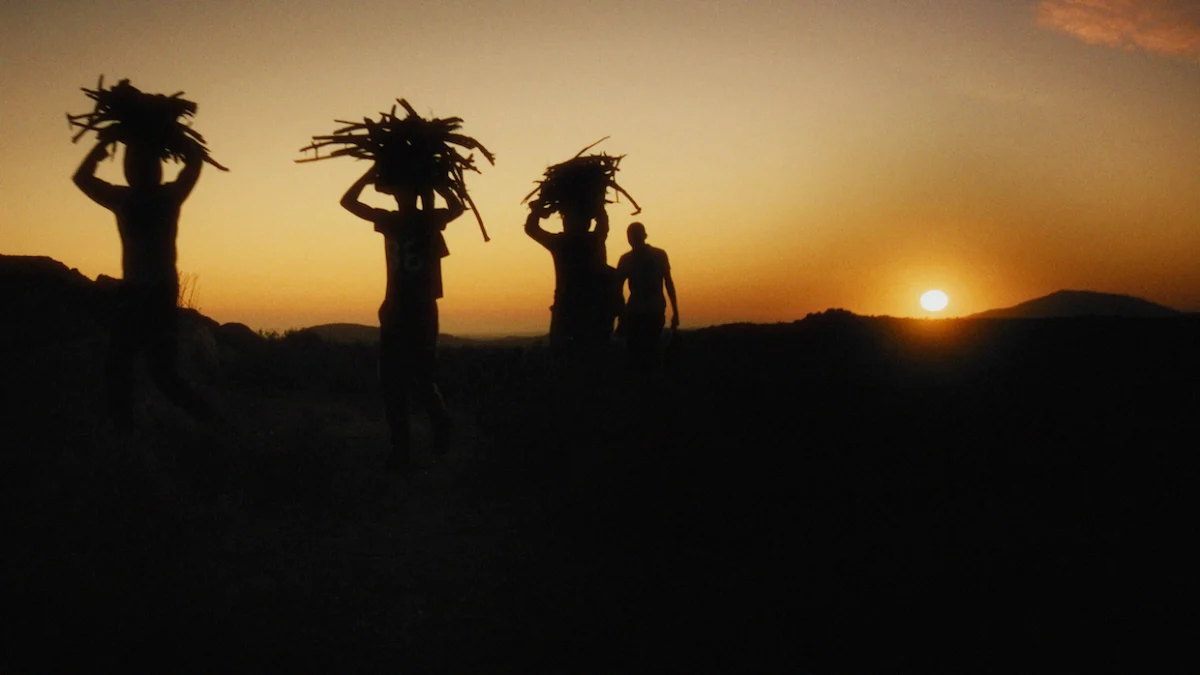
Jason Jacobs and Devon Delmar co-wrote and co-directed Variations on a Theme, a hybrid documentary that earned the top prize at Rotterdam for its innovative storytelling and profound social commentary. The film’s central figure is Jacobs’s grandmother, Hettie Farmer, an elderly goat herder residing in a rural South African village. The narrative delves into a deeply ingrained historical injustice: Farmer’s father was among thousands of Black South Africans conscripted to fight in World War II, yet upon completing his service, he received only a bicycle and a pair of boots, a stark contrast to the land and cash reparations granted to white veterans.
This grave inequity, compounded over decades and generations, continues to shape the memories and strained living conditions of the Black veterans’ descendants. The film powerfully illustrates how history repeats itself, as these descendants become vulnerable to scam artists who promise reparation payments from the government in exchange for small administrative fees. Thus, the villagers find themselves waiting in vain for justice for their ancestors while simultaneously falling victim to present-day injustices. Despite these sobering realities, the 65-minute runtime of Variations on a Theme is imbued with moments of wonder, kindness, and the palpable strength of family and community bonds. Jacobs and Delmar collaborated extensively with the villagers, who play themselves or fictionalized versions, to develop the film’s multiple plotlines. The result is a richly textured tapestry of short stories, collectively narrating the enduring spirit of a people. The directors employ wide-open frames that capture the stunning mountain landscape, with compositions repeating themselves with subtle variations across the film’s five days of story time. This structural device subtly conveys both the villagers’ persistent hope for better days and their resigned awareness that fundamental change remains elusive.
Broader Implications and the Future of Cinema
The 55th edition of New Directors/New Films reaffirms the festival’s critical role as a bellwether for the future of independent cinema. As observed by a previous Filmmaker review, ND/NF is inherently "a festival for audiences willing to let directors try things out." While not every selection may achieve immediate masterpiece status, the consistent reward lies in encountering films that are "almost always interesting and worthwhile experiments." This spirit of ambitious exploration is evident in films like Brand New Landscape and Cold Metal, which, despite their perceived imperfections, undeniably excite with their makers’ audacious vision and willingness to push the boundaries of the medium.
However, the 2026 slate also features works that transcend experimentation, offering fully realized artistic visions. Memory and Variations on a Theme, both hybrid documentaries, stand out for their enchanting and original use of fiction-making techniques to interrogate history, politics, and the human endeavor to comprehend the world. These films not only showcase mature artists at the height of their craft but also demonstrate the increasing fluidity between documentary and fiction, a trend indicative of contemporary cinema’s evolving expressive capabilities.
The festival’s selections collectively highlight several significant trends in global filmmaking: the continued rise of microbudget and collaborative production models, the nuanced exploration of diverse cultural identities and social injustices, and the innovative blending of genres and forms to address complex historical traumas and personal narratives. By spotlighting these emerging voices and their bold cinematic expressions, New Directors/New Films remains an indispensable institution, not just for film enthusiasts but for anyone interested in the evolving dialogue between art, society, and the human condition. It serves as a vital reminder that true innovation often springs from the fringes, challenging established norms and offering fresh perspectives that ultimately enrich the entire cinematic landscape.