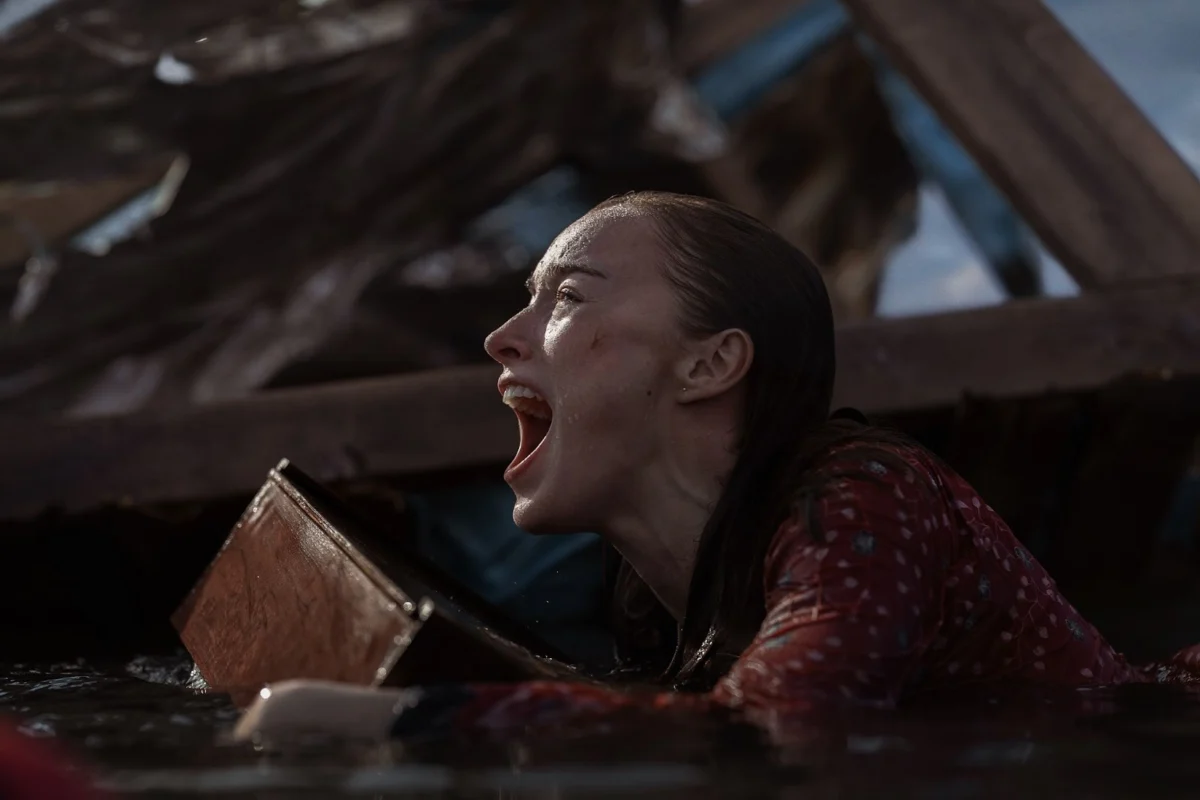
The latest survival thriller from Netflix, Thrash, directed by Tommy Wirkola, attempts to blend the catastrophic environmental terror of a Category 5 hurricane with the visceral, predatory threat of sharks displaced by a massive storm surge. Clocking in at a lean 83 minutes, the film positions itself within the "eco-horror" subgenre, a category of cinema that explores the intersection of human vulnerability and natural disasters. Produced with a focus on high-tension sequences and technical precision, the film stars Phoebe Dynevor, Whitney Peak, and Djimon Hounsou, presenting a narrative that navigates the flooded landscapes of a coastal South Carolina town under siege by both the elements and apex predators.
Narrative Overview and Chronology of Events
The plot of Thrash unfolds over a condensed timeline, mirroring the rapid escalation of a tropical cyclone as it transitions from a looming threat to a catastrophic landfall. The story begins with a series of disparate character introductions, establishing the specific psychological and physical vulnerabilities that will define their survival efforts.
The chronology begins with the approach of a Category 5 hurricane, the highest designation on the Saffir-Simpson Hurricane Wind Scale. In the coastal town of South Carolina, the local population is urged to evacuate, but several individuals remain behind for varying reasons. Lisa, portrayed by Phoebe Dynevor, is a woman in the late stages of pregnancy who finds herself trapped as the interstate highways are decommissioned and the rising tide cuts off exit routes. Simultaneously, the narrative introduces Dakota (Whitney Peak), a young woman struggling with severe agoraphobia, and her uncle Dale (Djimon Hounsou), a marine biologist whose professional knowledge of aquatic predators becomes a central plot device.
A secondary narrative thread involves a group of foster siblings—Dee, Ron, and Will—who are living under the care of a neglectful guardian, Mr. Olson. Olson’s dismissal of the storm as a "bit of weather" serves as the catalyst for their entrapment. As the eye of the storm nears, the storm surge—a coastal flood of rising water commonly associated with low-pressure weather systems—breaches the town’s defenses. This surge brings with it several large sharks, effectively turning the flooded residential streets and homes into a hunting ground.
The middle act of the film focuses on the convergence of these characters as they fight to reach higher ground. The survival mechanics involve navigating attic spaces, submerged living rooms, and crumbling infrastructure. The climax of the film centers on the dual pressure of Lisa going into labor while being pursued by sharks within a rapidly filling structure, forcing the survivors to utilize their limited resources to outmaneuver the predators.
Technical Execution and Production Value
Director Tommy Wirkola, known for his work on Violent Night and the Dead Snow franchise, employs a technical approach that prioritizes atmosphere and sensory immersion. One of the film’s most cited strengths is its sound design. The production team utilized complex foley work to simulate the "monstrous growl" of shifting residential structures and the explosive force of cracking cement levees. This auditory layer is designed to heighten the audience’s perception of the storm’s power, making the environment feel like a sentient antagonist.
Cinematographically, the film relies on murky underwater photography to generate tension. By limiting the visibility within the floodwaters, the filmmakers utilize a "less is more" approach to the creature reveals, a technique popularized by Steven Spielberg in the 1975 classic Jaws. The 83-minute runtime necessitates a brisk pace, leaving little room for extraneous dialogue, though this has led to critiques regarding the depth of the character development.
Environmental Context and Scientific Basis
Thrash grounds its fictional horror in contemporary environmental data. The film opens with clinical text noting a 250% increase in hurricane intensity since 1980. This statistic aligns with real-world climate data provided by organizations such as the National Oceanic and Atmospheric Administration (NOAA) and the Intergovernmental Panel on Climate Change (IPCC). Scientific research suggests that while the total number of tropical cyclones may not be increasing, the proportion of storms that reach Category 4 and 5 intensity has risen due to warmer ocean temperatures providing more energy for storm development.
The concept of "storm surge" is also a critical factual component of the film. In a Category 5 hurricane, storm surges can exceed 18 feet, capable of sweeping marine life miles inland. While the presence of multiple aggressive sharks in a residential setting is a dramatization for the sake of the thriller genre, there have been documented instances of marine life, including small sharks and alligators, being discovered in flooded urban areas following major hurricanes like Katrina, Ian, and Helene.
Cast Profiles and Performance Analysis
The ensemble cast brings a level of prestige to the production that is often absent from "creature features." Phoebe Dynevor, following her acclaimed performance in the Netflix corporate thriller Fair Play, takes on a more physical role here. Her portrayal of Lisa is tasked with carrying the emotional weight of a mother-to-be facing an impossible survival scenario.
Whitney Peak, known for her roles in the Gossip Girl revival and Hocus Pocus 2, explores the psychological dimensions of agoraphobia. Her character’s arc—moving from a state of paralysis caused by the fear of the "outside" to a forced confrontation with a lethal environment—serves as one of the film’s primary internal conflicts.
Djimon Hounsou, a two-time Academy Award nominee, provides the film’s authoritative voice. As Dale, the marine biologist, Hounsou is responsible for the "exposition dumps" that explain the behavior of the sharks. Industry analysts have noted that Hounsou’s involvement elevates the material, though critical reception has suggested that his talents are somewhat underutilized by a script that prioritizes action over dialogue.
Comparative Analysis: Thrash vs. Fair Play
A significant point of discussion among critics has been the comparison between Thrash and Phoebe Dynevor’s previous collaboration with Netflix, Fair Play. Directed by Chloe Domont, Fair Play was a psychological thriller that relied on a slow-burn script to explore power dynamics and intimacy. In contrast, Thrash is an externalized thriller that relies on visceral threats.
Where Fair Play succeeded in creating a "volcanic heat" through its screenplay and character interactions, Thrash is seen by some as a "vessel with no meat on its bones." The film’s reliance on "dumb characters making dumb decisions"—a common trope in the horror genre—often clashes with the sophisticated technical world Wirkola builds. For instance, characters dismissing evacuation orders until the interstate closes is a narrative convenience that facilitates the plot but can occasionally undermine the film’s grounded, scientific opening.
Genre Implications and Broader Impact
The release of Thrash contributes to a growing trend of "climate-anxiety cinema." As extreme weather events become more frequent in the real world, the film industry has seen a resurgence in disaster movies that incorporate biological threats. Thrash follows in the footsteps of the 2019 film Crawl, which featured alligators in a Florida hurricane, and the 2016 film The Shallows.
These films serve as a reflection of modern societal fears regarding the environment. However, Thrash also highlights the challenges of balancing human drama with genre thrills. The inclusion of foster children in a broken system and a pregnant woman in labor are intended to provide "emotional weight," yet in an 83-minute format, these elements often feel like checkboxes rather than fully realized themes.
Conclusion and Market Reception
As a Netflix original, Thrash is designed for high-volume streaming engagement, utilizing its "sharks in a hurricane" premise to attract a broad international audience. While it may not achieve the legendary status of Jaws, it provides a technically proficient addition to the survival thriller catalog. The film’s success is likely to be measured by its "completion rate" on the streaming platform—a metric that tracks how many viewers watch the film from start to finish—rather than traditional box office returns.
Ultimately, the film stands as a testament to Tommy Wirkola’s ability to craft tense, visually striking sequences, even when working with a "thin" script. For audiences seeking a quick, intense survival story, Thrash delivers the requisite thrills, even if it leaves some viewers "hungry for a story with actual depth to its waters." The film serves as a reminder of the potent, if sometimes formulaic, power of the creature feature in the age of streaming.