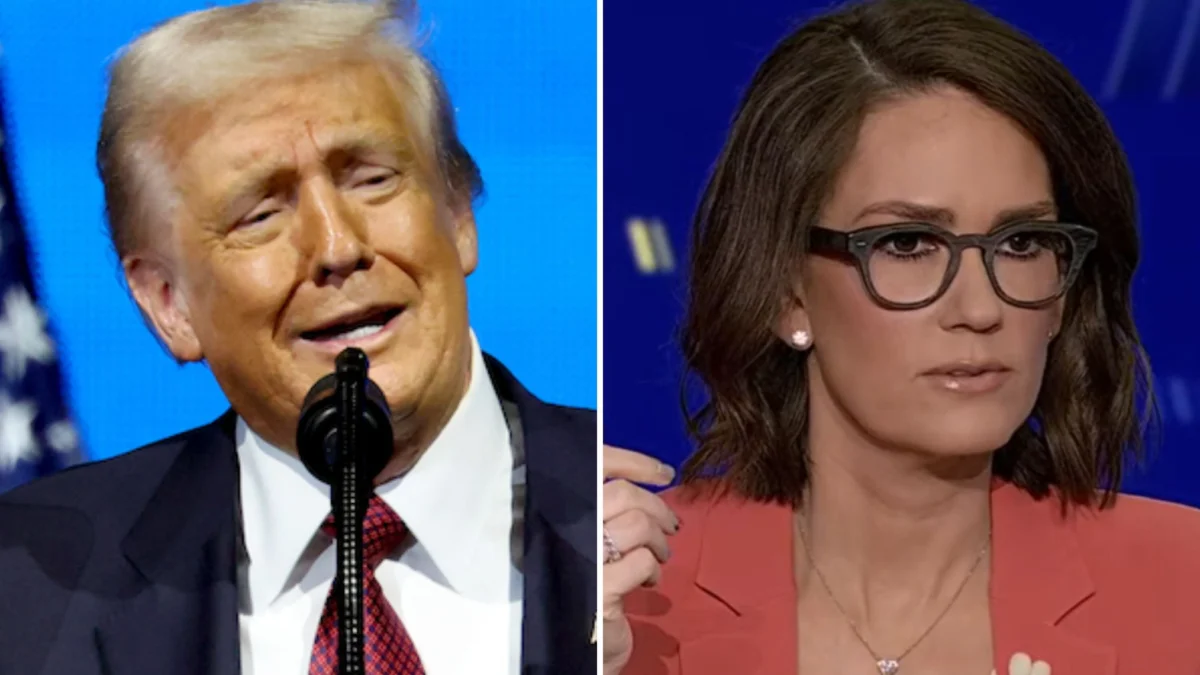
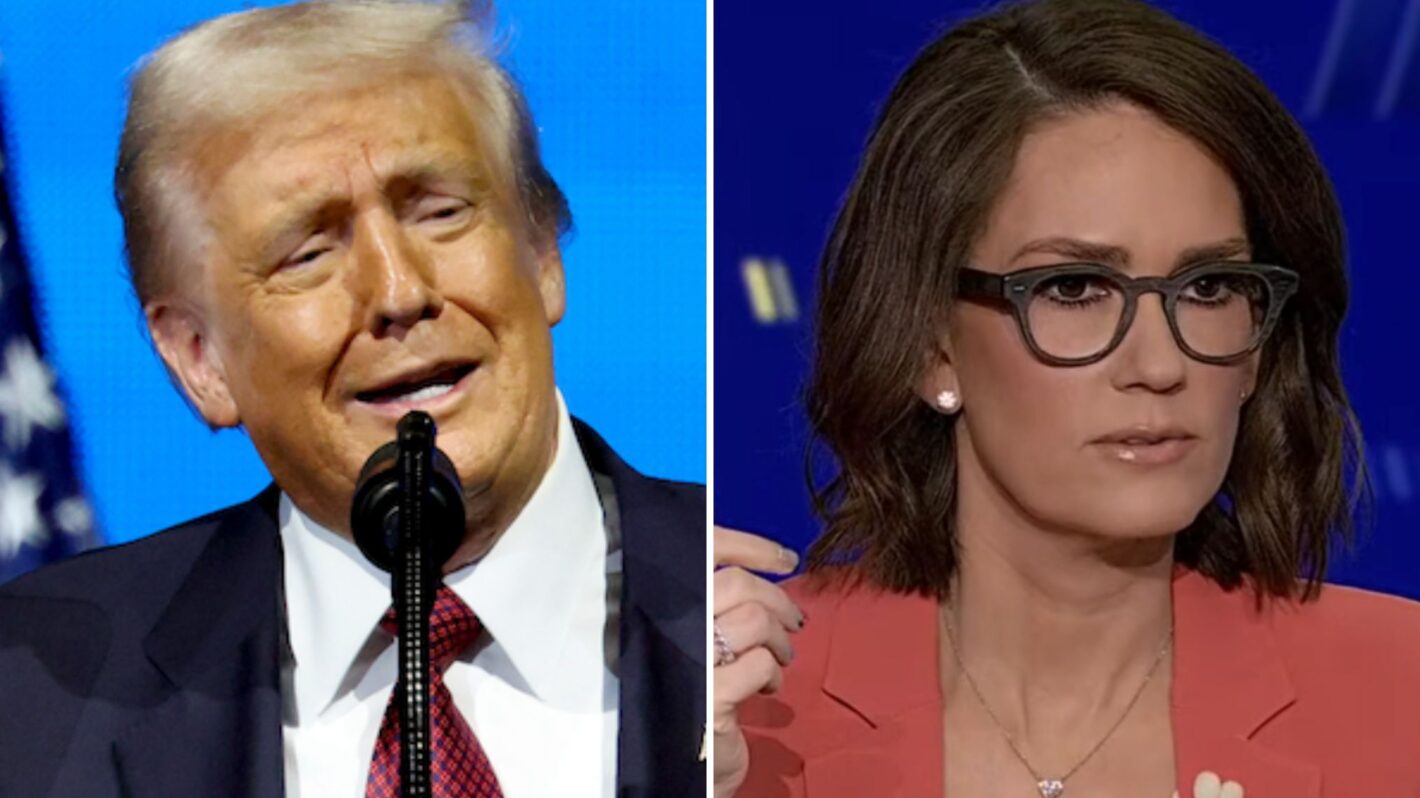
The intersection of cable news commentary and presidential rhetoric reached a new point of friction on Thursday, April 16, when Donald Trump engaged in a public verbal altercation with Jessica Tarlov, a co-host of Fox News’ highly-rated program, The Five. The confrontation, which played out across social media platforms following a live broadcast, highlighted the ongoing tensions between the former president and the media figures who challenge his narrative, even within the confines of a network traditionally viewed as friendly to conservative interests.
The incident began while Trump was traveling aboard Air Force One. According to his own social media activity, the former president was tuned into the late-afternoon broadcast of The Five, where Tarlov serves as the primary Democratic voice on a panel otherwise dominated by conservative perspectives. During the segment, Tarlov cited specific polling data regarding Trump’s approval ratings, particularly in the context of escalating geopolitical tensions involving Iran. Her assertion that Trump’s popularity was flagging—citing a 35% approval rating in several mainstream polls—triggered an immediate and personal response from the former president.
The Nature of the Personal Attacks
Taking to his proprietary social media platform, Truth Social, Trump issued a multi-paragraph critique that focused less on the substance of Tarlov’s policy arguments and more on her physical appearance, vocal delivery, and professional competence. In a post that quickly circulated across various news cycles, Trump characterized Tarlov as "one of the Least Attractive and Talented People on all of Television."
He further criticized her presentation style, stating, "Her voice is so grating and terrible, I had to ‘turn her off!’ Her Democrat soundbites are FAKE. She makes up ‘Poll Numbers,’ and nobody challenges her, because she is so boring." The former president’s rhetoric aligns with a long-standing pattern of utilizing personal invective against female journalists and commentators who present data or opinions contrary to his administration’s or campaign’s messaging.
Beyond the personal insults directed at Tarlov, Trump’s post included a demand for her termination, asserting that she is "BAD FOR OUR COUNTRY" and urging Fox News to "GET HER OFF THE AIR." This call for censorship of a dissenting voice on a panel show designed for debate underscores the volatile relationship between Trump and the "liberal" representatives on Fox News, who are often the target of his ire despite the network’s overall editorial leanings.
Disputed Data and the Polling Conflict
A central component of the dispute involves the accuracy of the polling numbers cited during the broadcast. Tarlov noted on air that Trump maintained a "35% approval rating in most polls," a figure she linked to public sentiment regarding his handling of international conflicts. Trump vehemently contested this, claiming his numbers were among the highest he has ever recorded.
"I have among the best Poll Numbers I have ever had, and why shouldn’t I, ALL THE COUNTRY DOES IS WIN," Trump wrote. He went on to make a specific claim regarding CNN’s coverage, alleging that the network had him at "100%" and that they "never saw that before."
Fact-checking these claims reveals a significant disparity between the former president’s rhetoric and documented data. While Trump has occasionally seen high approval ratings among Republican primary voters, no credible national poll from a major outlet like CNN has ever recorded a 100% approval rating for any modern political figure. Conversely, Tarlov’s citation of a 35% approval rating, while on the lower end of the spectrum, aligns with various aggregate polls that have historically tracked Trump’s favorability during periods of heightened controversy or economic uncertainty.
Tarlov’s Response and Strategic Counter-Programming
Rather than retreating from the criticism, Jessica Tarlov utilized her social media presence on X (formerly Twitter) to double down on her assertions. In a concise rebuttal, she defended the integrity of her data. "Guess I’ll take this opportunity to mention that my numbers are far from fake—Trump really is that unpopular," Tarlov wrote.
In a move described by media analysts as a masterclass in "turning a crisis into a commercial opportunity," Tarlov leveraged the massive influx of traffic to her social media profile to promote her upcoming book, I Disagree: Winning Arguments Without Losing Friends. The book, which became available for preorder the same day as the spat, focuses on maintaining values and finding common ground in a polarized political climate—a theme that stands in stark contrast to the nature of the insults she received.
The book is scheduled for a September release and aims to provide readers with strategies for communicating with confidence across political and social divides. By pivoting from a personal attack to a professional milestone, Tarlov effectively redirected the narrative, framing herself as a resilient professional in the face of executive-level hostility.
Broader Attacks on Conservative Media Figures
The Truth Social post was notable not only for its attack on Tarlov but also for its inclusion of several high-profile conservative figures. Trump took the opportunity to disparage Megyn Kelly, Tucker Carlson, and Candace Owens, claiming their influence was waning.
"I hear Megyn Kelly, Tucker Carlson, and Candace Owens are dying fast," Trump wrote. "Their numbers are terrible. Nobody believes them anymore. They were FAKE MAGA, and now they’ve been exposed!"
This broader critique highlights a growing schism within the conservative media ecosystem. Kelly and Carlson, both former Fox News anchors, have had complex relationships with Trump, oscillating between support and critique. Owens, a prominent conservative commentator, has also faced recent friction within right-leaning circles. By labeling these figures "FAKE MAGA," Trump appears to be signaling a narrowing definition of loyalty, where even long-time allies can be cast out if they deviate from his specific agenda or narrative.
The Role of The Five in Political Discourse
To understand the impact of this feud, one must look at the significance of The Five. Since its inception in 2011, the show has become one of the most-watched programs in cable news, frequently outperforming primetime slots. Its format—four conservatives and one liberal—is designed to simulate a dinner-table debate.
Tarlov, who joined the show as a regular co-host in early 2022 following the departure of Juan Williams, occupies a difficult position. She is tasked with representing the Democratic platform to an audience that is overwhelmingly Republican. Her presence is a key component of the show’s "fair and balanced" branding, yet it frequently makes her a lightning rod for criticism from viewers and, as evidenced this week, from the highest levels of the political establishment.
Media analysts suggest that Trump’s fixation on Tarlov is a testament to the show’s influence. By watching the program on Air Force One, Trump acknowledges the show’s role in shaping the opinions of his base. However, his reaction also suggests a low tolerance for the very debate the show is intended to foster.
Chronology of the Dispute
The timeline of the event illustrates how quickly modern political conflicts escalate:
- Late Afternoon, April 16: The Five airs on Fox News. Jessica Tarlov discusses Trump’s approval ratings, citing a 35% figure in the context of the war in Iran.
- Evening, April 16: While traveling on Air Force One, Donald Trump watches the broadcast and prepares a response.
- Post-Broadcast: Trump publishes a lengthy attack on Truth Social, targeting Tarlov’s appearance, voice, and talent, while also attacking Kelly, Carlson, and Owens.
- Late Evening, April 16: Tarlov responds on X, standing by her polling data and announcing the preorder availability of her new book.
- April 17: The exchange becomes a trending topic across social media, with supporters on both sides debating the appropriateness of the former president’s comments and the accuracy of the polling in question.
Implications for Political Rhetoric and Gender in Media
The incident has reignited discussions regarding the treatment of women in political journalism. Trump’s focus on Tarlov being "least attractive" and having a "grating voice" is viewed by critics as a gendered attack intended to diminish her professional standing by focusing on physical attributes.
"When the argument shifts from the validity of the 35% approval rating to the pitch of a woman’s voice, the substance of the political debate is lost," noted one media ethics professor. "It is a tactic designed to distract from the data by attacking the messenger."
Furthermore, the demand for Tarlov to be "removed from the air" raises questions about the pressure placed on news organizations by political leaders. Fox News has historically defended its talent against outside pressure, and the network has not issued a formal statement indicating any changes to Tarlov’s status on The Five.
Conclusion: The Persistence of Polarized Media
The clash between Donald Trump and Jessica Tarlov serves as a microcosm of the current American political and media landscape. It features the hallmark elements of the era: the use of social media as a direct line of attack, the disputation of empirical data (polling), and the blurring of lines between personal insult and political critique.
As Tarlov prepares for the launch of her book on "winning arguments without losing friends," the irony of the situation remains clear. In an environment where a sitting or former president uses his platform to call a journalist "boring" and "unattractive," the prospect of finding common ground seems increasingly distant. Nevertheless, the high ratings of The Five and the viral nature of this confrontation suggest that the American public remains deeply engaged in—if not addicted to—this brand of high-stakes political theater.