In the realm of cinematic fantasy, the 1980s stand as a unique and often peculiar epoch. This era produced a spate of imaginative films that, while perhaps less polished than their 2000s descendants, possessed a distinct brand of weirdness and earnest charm. This series revisits these canonical works, exploring their creation, impact, and lasting legacies. Following previous installments on Dragonslayer and The Last Unicorn, this article delves into Jim Henson’s 1986 masterpiece, Labyrinth, a film that continues to captivate audiences with its blend of dark fairytale, musical fantasy, and unforgettable performances.
A Family Favorite Forged in VHS and Imagination
For many who grew up in the late 1980s and early 1990s, Labyrinth was not a fleeting cinematic experience but a beloved fixture of home video collections. The film, released theatrically in 1986, found a significant portion of its audience through repeated viewings on VHS. This format allowed families to immerse themselves in its fantastical world at their own pace, fostering a deep connection that transcended initial box office performance. Labyrinth, alongside other family-friendly fantasy epics like Willow, became a staple for repeated viewings, embedding its characters and narrative into the cultural fabric of a generation.
The Genesis of a Goblin Kingdom
The creation of Labyrinth was a testament to the collaborative genius of its creative team. The screenplay, primarily penned by Monty Python alumnus Terry Jones, underwent significant contributions from uncredited writers, including the celebrated Elaine May. Director Jim Henson, renowned for his groundbreaking work with the Muppets, envisioned a departure into a more adult-oriented fairytale, working in close collaboration with legendary fantasy illustrator Brian Froud. Froud’s distinctive artistic vision was integral to shaping the film’s unique visual identity, defining the look and feel of its fantastical inhabitants and their otherworldly realm.
The narrative centers on Sarah, a sixteen-year-old girl portrayed by a young Jennifer Connelly. Burdened by familial responsibilities, including babysitting her infant half-brother Toby (played by Toby Froud, Brian Froud’s son), Sarah finds herself overwhelmed and frustrated. In a moment of childish pique, she wishes the Goblin King would take Toby away, a wish that is chillingly granted. This sets Sarah on a perilous journey into Jareth’s subterranean kingdom, a fantastical labyrinth filled with surreal challenges and bizarre creatures. Her quest: to rescue Toby before thirteen hours elapse, or he will be lost to her forever.
Navigating the labyrinthine twists and turns of Jareth’s realm, Sarah is aided by a cast of memorable characters. Among them are Hoggle, a gruff and initially unhelpful dwarf; Ludo, a colossal, gentle beast with a surprisingly powerful roar; and Sir Didymus, a diminutive knightly fox who rides his steed Ambrosius. As Sarah faces the labyrinth’s puzzles and illusions, she also grapples with her own burgeoning fascination and complex feelings towards the enigmatic Goblin King, Jareth, brought to life by the inimitable David Bowie.
The film culminates in a confrontation with Jareth in a M.C. Escher-inspired, mind-bending space. Sarah ultimately reclaims her brother by reciting an incantation from her acting book, a symbol of her growth and self-discovery. The film concludes with a touching scene where many of the fantastical characters appear in Sarah’s room, offering her their enduring friendship and support.
Critical Reception and Home Video Triumph
Upon its 1986 release, Labyrinth received a decidedly mixed critical reception. While some critics recognized its artistic merits, others were less impressed, with some reviews being notably harsh. Despite its modest box office performance, the film found a devoted following through its release on home video and subsequent international theatrical re-releases. This trajectory, from a moderate theatrical debut to a cult classic phenomenon, is a common narrative for many films from this era that prioritized imaginative vision over immediate commercial appeal. Today, Labyrinth is widely regarded as one of Jim Henson’s most significant achievements outside of his Muppet creations, and a notable contribution to Lucasfilm’s speculative fiction catalog under executive producer George Lucas.
A Timeless Appeal: Design, Performance, and Magic
Forty years after its debut, Labyrinth undeniably holds up, its appeal undiminished. The film’s enduring success can be attributed to a confluence of factors: Brian Froud’s extraordinary creature designs, Jim Henson’s mastery of practical effects, Terry Jones’s sharp wit, and David Bowie’s captivating, larger-than-life performance. These elements coalesce to create a film that is both visually stunning and emotionally resonant.
The richness of Froud’s designs is evident in every frame. The creatures, brought to life through Henson’s puppetry and Froud’s conceptual artistry, are a testament to imaginative character creation. Even the seemingly minor goblins are imbued with personality, often delivering laugh-out-loud moments. Many of these characters were voiced by veteran Muppet performers, including Steve Whitmire, Brian Henson, and Frank Oz, adding another layer of familiar warmth and comedic timing. One particular detail, discovered by attentive viewers with the advent of subtitles, highlights the film’s playful humor: a tiny goblin is heard exclaiming, "Your mother is a fragging aardvark!"
Visually, Labyrinth is a feast for the eyes. While it may lack the outright dread of Henson and Froud’s earlier collaboration, The Dark Crystal (1982), it compensates with an abundance of whimsy and charm. The film’s color palette, a rich tapestry of lush greens and deep ochres, transports viewers to a world that feels both ancient and vibrantly alive. The goblin characters, while often grotesque, are never unappealing. Hoggle, for instance, is a physically unlovely creature who possesses the swagger and cantankerous spirit reminiscent of a seasoned character actor. Ludo, a hybrid of ape and giant sloth, offers a unique blend of imposing presence and endearing vulnerability, a creature that could be described as a kawaii-filtered Balrog. The film masterfully walks the line between the hideous and the incredibly cute, a hallmark of Froud’s designs.
However, the film is not without its flaws. A few dated elements, such as racial stereotypes embodied by armored goblins with stereotypical East Asian accents voiced by white actors, stand out as unfortunate missteps. The pacing in the second half can feel slightly drawn out at times. Furthermore, the scene featuring the Fireys, with their head-juggling and limb-swapping antics, while intended to be unsettling, is accompanied by the film’s arguably weakest song, the reggae-inspired "Chilly Down." Notably, this is one of the few musical numbers not performed by David Bowie.
David Bowie: The Goblin King’s Undeniable Charisma
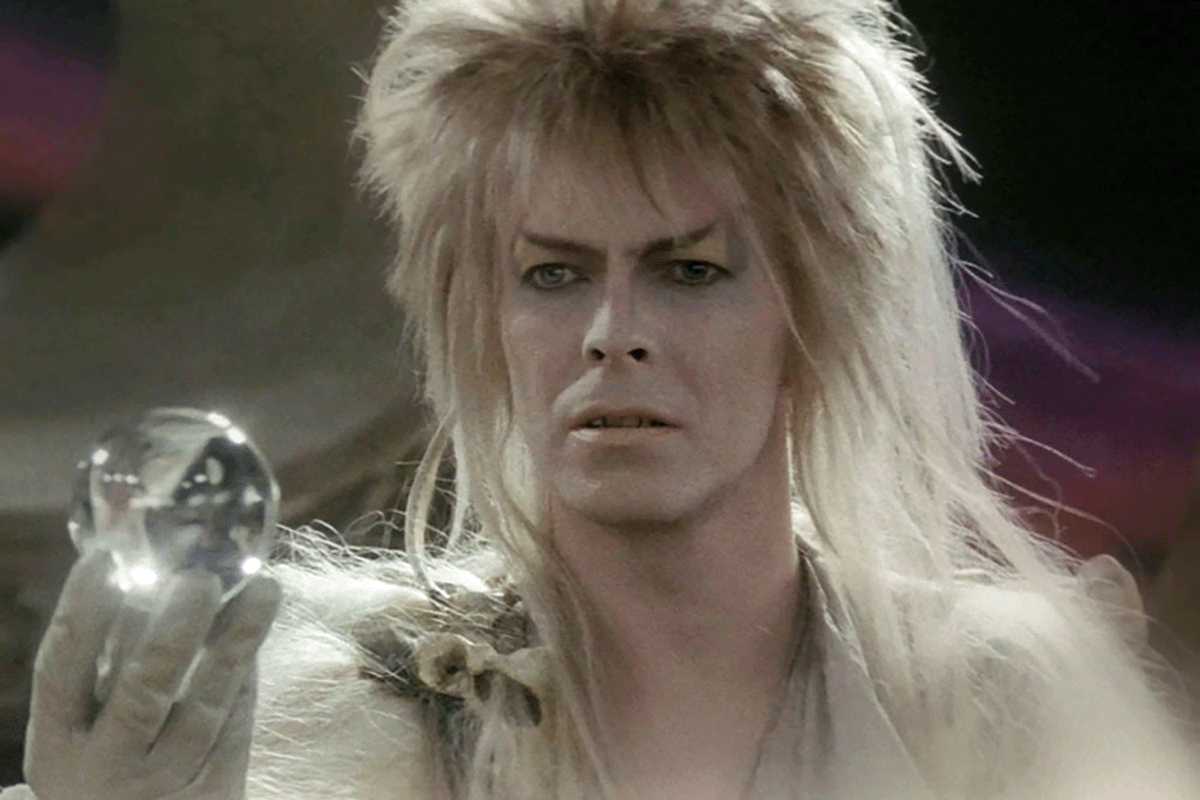
The performance of David Bowie as Jareth, the Goblin King, is unequivocally the linchpin of Labyrinth‘s success. The casting process reportedly considered a slate of other high-profile musicians, including Sting, Mick Jagger, Prince, and Michael Jackson, alongside actor Kevin Kline. However, it is difficult to imagine any of them embodying the character with the same unique blend of menace, allure, and theatricality that Bowie brought to the role.
Bowie’s Jareth is captivatingly strange without being off-putting. He projects an aura of ominous power, yet never feels overtly threatening in a way that would alienate younger viewers. His portrayal deftly navigates a complex queerness, avoiding the pitfalls of overtly villainous queer-coded characters while leveraging his status as a bi icon to create a believable, albeit unconventional, chemistry with Jennifer Connelly’s Sarah. Bowie masterfully masks Jareth’s obsessive desires beneath a veneer of exaggerated disinterest. And then, of course, there are the tights. The revealing silver costume, and particularly Bowie’s prominent bulge, became a subject of much discussion and fan interpretation over the years. Within the context of the film, this element serves as a subtle, seductive enticement, a piece of visual allure carefully calibrated to remain within the bounds of a family film without sacrificing its potent, otherworldly charm.
Sarah’s Journey: A Relatable Teenager
One of Labyrinth‘s greatest strengths lies in its serious treatment of Sarah. She is a character who is profoundly relatable in her adolescent struggles yet, at times, undeniably unlikable. Her rudeness to her stepmother, her dramatic overreactions to her father’s attempts at communication, and her initial complaints about her predicament in the labyrinth paint a picture of a realistic, flawed teenager. These are not presented as flaws of the film or Connelly’s performance, but rather as authentic teenage behaviors. The film never trivializes Sarah’s feelings, even as it makes her entitlement and occasional bad behavior clear.
Sarah’s arc is not simply about growing up; it’s about the right to retain elements of childhood and imagination even as life demands greater responsibility. Unlike narratives where the protagonist must shed their childishness to become an adult, Labyrinth suggests that it is possible to integrate the wonder of childhood into the complexities of adulthood.
The Masquerade Ball: Desire, Fear, and the Threshold of Adulthood
The film’s most powerful scene is arguably Jareth’s masquerade ball. Sarah finds herself transported to a decadent, dreamlike setting, adorned in a stunning gown, surrounded by swirling, sophisticated couples. Feeling out of place, she searches for Jareth, her emotions a complex mix of desire and apprehension. Their dance together is imbued with a palpable sense of unease. Jareth is never explicitly depicted as predatory; rather, he appears as a projection of Sarah’s own burgeoning desires and anxieties about the adult world, a world she is both drawn to and unprepared for. This is subtly hinted at early in the film when her stepmother comments on her being a late bloomer.
This scene encapsulates the universal experience of being on the cusp of adulthood, desiring entry into its rituals and complexities while lacking the emotional preparedness. It echoes themes found in other coming-of-age fantasies, like Legend, another film that explored the transition from childhood to adulthood. However, where Legend emphasizes the adult world’s inevitability in stripping away childhood, Labyrinth, by centering on children, suggests that the adult world of sexual desire can be intimidating, yet crucially, it frames the stakes as Sarah’s emotional experience rather than her physical safety.
Ironically, the "Labyrinth of Jareth Masquerade Ball," a real-world event that has taken place for decades, often leans heavily into the sexual awakening and forbidden desires aspects of this scene. While a popular and fun event within the cosplay and convention circuit, it arguably misses the nuanced psychological point of the original cinematic moment.
Enduring Legacy and Cultural Impact
Labyrinth has achieved the rare status of a cult classic that has largely permeated mainstream consciousness. Its influence can be seen across various media and cultural spheres. Over the past four decades, numerous art books have been published, and a Commodore 64 and Apple II video game adaptation was released in 1986. The film’s aesthetic has also inspired pinball games, comic books, short stories, and even a planned graphic novel prequel that never materialized. Rumors of a sequel or remake have persisted since 2016, with acclaimed horror director Robert Eggers reportedly attached to a potential new iteration.
Beyond direct adaptations, Labyrinth‘s legacy is multifaceted. It has played a significant role in keeping David Bowie relevant to subsequent generations. His iconic Goblin King look – the Tina Turner-esque wig, the puffy shirt, the black leather vest, and the daringly revealing silver tights – is as indelible as any of his prior personas. For many younger audiences, Bowie is perhaps more readily recognized as Jareth than as Ziggy Stardust. Labyrinth arguably stands as the crowning achievement of Bowie’s film career, eclipsing his memorable roles in films like The Hunger and The Prestige.
Furthermore, the film’s distinctive visual style has profoundly influenced contemporary filmmakers. Guillermo del Toro, whose own works are consistently lauded for their production design, costuming, and makeup, has openly acknowledged the impact of Labyrinth and Brian Froud’s work. His 2006 film, Pan’s Labyrinth (El Laberinto del Fauno), directly references the concept and imagery of a labyrinth in both its title and narrative. The film’s influence is also visible in the enduring popularity of Labyrinth-inspired costumes at fan conventions and Renaissance Faires.
Labyrinth also occupies a significant place in the lineage of stories about girls entering fantastical realms, a trope that includes classics like Christina Rossetti’s "Goblin Market," Alice in Wonderland, Peter Pan, and The Wizard of Oz. The film helped revitalize this narrative structure, influencing a new wave of fantasy authors, including Terri Windling, Pamela Dean, Charles de Lint, and Seanan McGuire, who have built entire genres upon such foundations.
As this series continues, the next installment will pivot from one of Henson’s triumphs to a more challenging project, The Dark Crystal, exploring its own unique place in the pantheon of eighties fantasy cinema. The enduring spell of Labyrinth, however, remains a testament to the power of imaginative storytelling, groundbreaking design, and unforgettable performances that continue to resonate across generations.