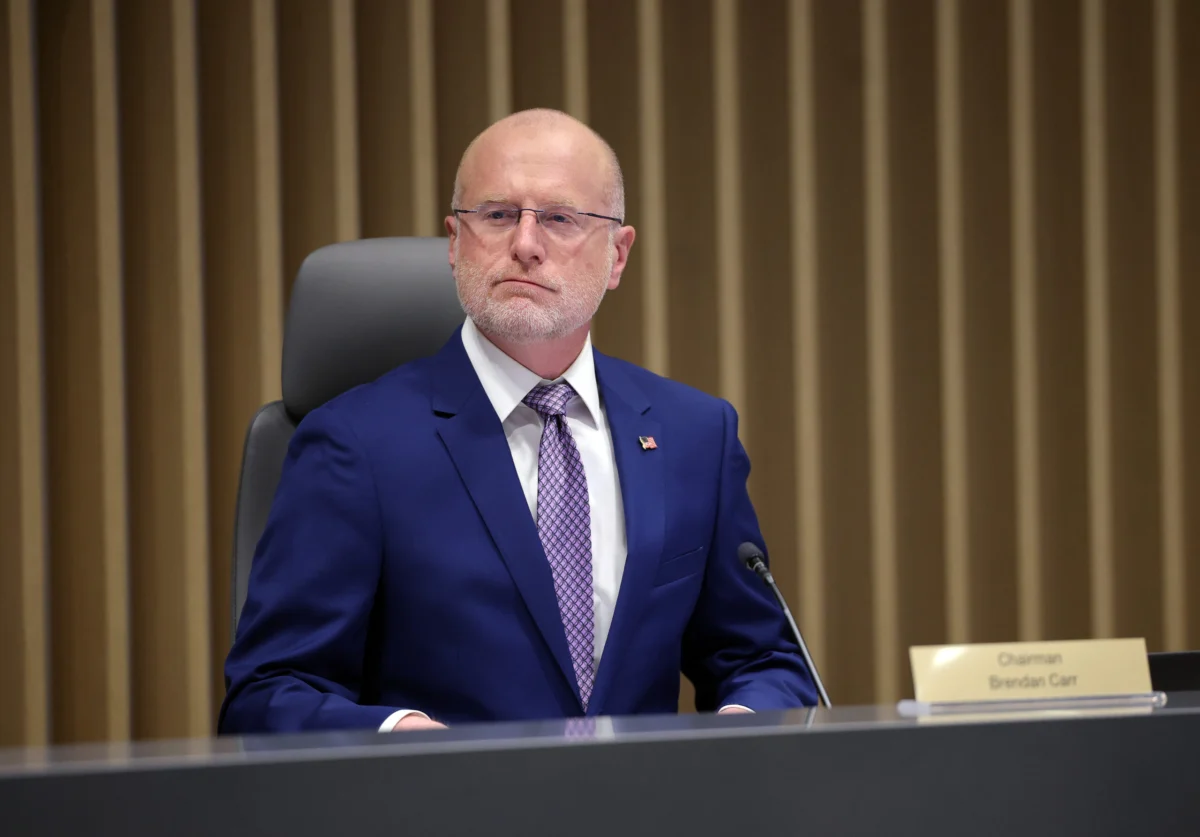
Federal Communications Commission (FCC) Chairman Brendan Carr on Thursday robustly defended the agency’s recent decision to call in the broadcast licenses of The Walt Disney Company for early renewal, asserting that the move is the culmination of a year-long investigation into the company’s Diversity, Equity, and Inclusion (DEI) practices rather than a retaliatory strike against ABC late-night host Jimmy Kimmel. Speaking at the FCC’s April open meeting, Carr addressed the swirling controversy that has positioned the regulatory body at the intersection of administrative enforcement and high-profile political warfare. The Chairman’s remarks come at a sensitive juncture, as critics and fellow commissioners suggest the timing of the FCC’s action aligns too closely with public demands from former President Donald Trump for the dismissal of Kimmel, whose monologues have frequently targeted the former administration.
The core of the dispute involves the FCC’s authority to oversee broadcast licenses, which are typically granted for eight-year terms. By calling for an "early renewal," the FCC is effectively requiring Disney—the parent company of the ABC television network—to prove it remains a fit steward of the public airwaves before its current license term has expired. Carr maintained that the decision was predicated on Disney’s alleged failure to provide sufficient documentation regarding its internal hiring and promotion policies, which the Chairman characterized as potentially discriminatory. "It felt to us like they were playing rope-a-dope and weren’t being entirely forthcoming with the production," Carr stated during the livestreamed session, utilizing a boxing metaphor to describe Disney’s perceived legal stalling tactics.
The Regulatory Framework and DEI Investigations
To understand the weight of the FCC’s current inquiry, one must look at the specific regulatory obligations imposed on broadcasters. Under the Communications Act of 1934, the FCC is mandated to ensure that broadcast licensees operate in the "public interest, convenience, and necessity." A critical component of this mandate is the Equal Employment Opportunity (EEO) rules, which prohibit broadcasters from discriminating in hiring on the basis of race, color, religion, national origin, or sex.
The investigation into Disney reportedly began over 14 months ago. According to Carr, the commission received evidence suggesting that Disney’s DEI initiatives may have crossed the line from aspirational diversity goals into "invidious forms of discrimination." Specifically, the FCC is examining whether Disney implemented quotas or exclusionary practices that violate federal non-discrimination standards. Carr emphasized that the agency’s rules are clear: "You can’t discriminate based on race and gender, and there was evidence that had been submitted that that’s what Disney was doing."
The Chairman’s insistence on the "temporal moment" of the decision is a direct rebuttal to claims that the FCC is acting as a political arm of the Trump campaign. Carr argued that had Disney met its original document production deadlines in 2023, the enforcement action would have concluded long before the recent flare-up between Donald Trump and Jimmy Kimmel. "If they produced the documents on the original deadline, I don’t think we’d be in the same temporal moment as we are right now," Carr explained.
The Intersection of Regulatory Action and Political Rhetoric
The controversy gained significant momentum following a series of public statements from former President Donald Trump and former First Lady Melania Trump. The former President has repeatedly called for the firing of Jimmy Kimmel, citing the comedian’s sharp-tongued critiques and his performance as the host of the Academy Awards. This public pressure created a perception that the FCC’s scrutiny of Disney’s licenses was a direct response to these political demands.
When pressed by reporters on whether external pressure influenced the commission, Carr was unequivocal. "There was no pressure from the outside. There was no suggestion from the outside. There was no call for agency action from the outside," he asserted. While acknowledging that both the former President and First Lady have "expressed their views," Carr maintained that the agency’s internal enforcement proceedings operate independently of the news cycle. However, he did note that many citizens share the former President’s concerns regarding the content and perceived bias of certain broadcast programs.
Despite Carr’s denials, the internal divide within the FCC was laid bare by Democratic Commissioner Anna Gomez. Gomez, who has frequently clashed with Carr on issues of regulatory overreach, dismissed the DEI explanation as a "pretext." In a sharp rebuke to the Chairman’s narrative, Gomez told reporters, "I mean, give me a break. This is clearly a pretext. This is just another part of the pattern of harassment and retaliation in order to bend Disney to this administration’s will."
A Chronology of the Dispute
The escalation of the FCC’s scrutiny of Disney can be traced through a series of regulatory and political milestones over the past two years:
- Early 2023: The FCC initiates a broad inquiry into the EEO compliance of major media conglomerates, including Disney and Comcast.
- Summer 2023: The FCC issues formal requests for production (RFPs) to Disney, seeking internal communications and data regarding DEI hiring practices.
- Late 2023: Disney reportedly requests multiple extensions for document production, leading to internal frustration within the FCC’s enforcement bureau.
- March 2024: Donald Trump intensifies public criticism of ABC and Jimmy Kimmel following the 96th Academy Awards.
- April 2024: The FCC officially notifies Disney that it is calling in several of its primary broadcast licenses for early renewal, citing a lack of transparency in the ongoing investigation.
- April 18, 2024: Chairman Carr publicly defends the move, citing "invidious DEI discrimination" as the primary driver.
Broader Implications for the Media Industry
The FCC’s focus on DEI practices is not limited to Disney. Carr confirmed that NBC owner Comcast is also under investigation for similar concerns. This suggests a broader regulatory shift where the FCC, under its current leadership, is prioritizing the scrutiny of corporate diversity programs. Carr noted that as various corporate deals and mergers come before the commission, the agency has been requiring companies to re-evaluate their policies to ensure they do not harbor "invidious forms of DEI."
This approach has drawn the attention of prominent legislators, including Senator Ted Cruz, the ranking member of the Senate Commerce Committee. Cruz has long argued that the FCC should not act as a "speech police," a sentiment that Carr echoed on Thursday. "I agree with Senator Cruz that the FCC shouldn’t be in the business of being the speech police," Carr said. He argued that the DEI investigation is a matter of administrative law and labor compliance, which he views as "unrelated to speech."
However, legal experts suggest that the line between "conduct" (hiring practices) and "speech" (editorial direction) can be thin in the world of broadcasting. If the FCC uses license renewals as a tool to punish or reward companies based on their internal social policies, it could set a precedent that future administrations might use to influence media content. The "public interest" standard is famously broad, and critics argue its ambiguity allows it to be weaponized for political ends.
Analysis of Potential Outcomes
For Disney, the "early renewal" process introduces significant legal and financial uncertainty. While it is rare for the FCC to actually revoke a license, the process of renewal involves a period of public comment where advocacy groups and political opponents can file "petitions to deny." This provides a platform for critics to challenge Disney’s fitness as a licensee on various grounds, ranging from its DEI policies to the content of its news and entertainment programming.
Furthermore, the document production demand puts Disney in a difficult position. If the company produces internal documents that reveal specific hiring quotas, it could face private litigation under civil rights laws. If it continues to withhold documents, it risks further regulatory sanctions from the FCC, including substantial fines or the non-renewal of its licenses.
The wider media landscape is watching the Disney case as a bellwether for how regulatory agencies will handle the backlash against DEI initiatives. In recent years, several high-profile companies have scaled back their diversity programs in the face of legal threats and political pressure. The FCC’s aggressive stance signals that the era of "voluntary" DEI reporting may be giving way to a period of mandatory, and potentially punitive, federal oversight.
As the investigation continues, the FCC’s internal partisan divide is likely to deepen. With Commissioner Gomez labeling the move as "harassment," the legitimacy of the agency’s findings will undoubtedly be challenged in the courts. For now, Disney remains in the regulatory crosshairs, caught between its internal corporate culture and a federal agency determined to enforce a strict interpretation of non-discrimination rules. The outcome of this "rope-a-dope" legal battle will likely define the boundaries of the FCC’s power for years to come.