Nearly twenty-five years after the conclusion of the cult seven-season, 144-episode series starring Sarah Michelle Gellar, which itself spun off from a quirky 1992 film featuring Kristy Swanson, certain moments that encapsulate the physical and emotional fortitude of the vampire-slaying protagonist remain indelibly etched in the collective consciousness of pop culture. These enduring images showcase Buffy’s resilience: a tearful Buffy driving a sword through the man she loves to prevent a demon from consuming the world; her leap from scaffolding into a dimensional rift, a sacrifice to save both the world and her sister; and her steely-eyed gaze from behind a rocket launcher after dispatching a demon, hair perfect, lips glossed. Each antagonist, whether demon, vampire, school principal, or a boorish frat boy, underestimates her. Their sneers betray their misjudgment: this seemingly slight, "dumb blonde" girl could not possibly possess the strength to thwart their nefarious schemes.
This dynamic was precisely what resonated so profoundly with the show’s legion of outcast fans, particularly the girls, gays, and non-binary individuals who saw their own feelings of otherness reflected in her. Witnessing Buffy decisively vanquish those who underestimated her, often with a witty retort and impeccable style, was profoundly empowering. Her struggles and triumphs affirmed that if Buffy was not helpless, neither were they.
The Unraveling of a Slayer: "Helpless" Episode and Its Significance
The series’ capacity to explore vulnerability was starkly illustrated in the twelfth episode of its third season, titled "Helpless," written by David Fury and originally airing on January 19, 1999. This singular episode depicted Buffy Summers losing her Slayer powers, a devastating turn of events orchestrated by her Watcher, Giles, under the directive of the male-dominated Watchers Council. The narrative presented Buffy in a state of profound weakness and doubt, at the mercy of petty tyrants. She endured the aggression of an entitled jock assaulting a friend and felt abandoned by her father figures. Viewers witnessed her fleeing from vampires she would have effortlessly vanquished just days prior, her desperate cries for help underscoring her newfound vulnerability.

This exploration of powerlessness gains poignant relevance in the wake of Hulu’s recent decision to cancel the planned "Buffy: New Sunnydale" revival. The cancellation, described by some as a "stake to the heart," arrived despite a promising creative team. Oscar-winning filmmaker Chloé Zhao was slated to direct and produce, while Nora and Lilla Zuckerman, known for their work on "Power Face," were set to serve as writers, executive producers, and showrunners. Sarah Michelle Gellar had initially announced the project in February 2025, expressing her commitment to ensuring its quality, stating, "I promise you, we will only make this show if we know we can do it right. And I will tell you that we are on the path there." Notably absent from the revival’s leadership was the series’ original creator, Joss Whedon. Years prior, numerous credible reports surfaced detailing his alleged abusive and toxic behavior on the set of "Buffy" and other projects, leaving fans conflicted about a beloved series. The revival had been perceived by many as an opportunity for "Buffy" to continue and thrive independently of this problematic legacy.
Gellar’s years-long hesitation to revisit the "Buffy" universe, in contrast to the proliferation of franchise revivals, had been a source of hope. This caution echoed themes from the season five episode "Forever," where Buffy’s sister Dawn, in a desperate attempt to resurrect their deceased mother, performs a spell that Buffy warns could go "wrong." Gellar’s apprehension about a potentially flawed continuation mirrored this sentiment, suggesting she recognized the risk of a "zombified version" of the show. The proposed revival offered a chance to finally "do it right."
Questioning the Chosen One: The Core Tenets of "Helpless"
The episode "Helpless" was chilling upon its initial broadcast and has become even more so with later revelations about the origins of the Slayer lineage. It stands as a pivotal installment that profoundly questions the series’ central premise: "In every generation there is a Chosen One. She alone will stand against the vampires, the demons, and the forces of darkness. She is the Slayer." The episode prompts a critical inquiry: Chosen by whom?
The narrative unfolds with Buffy and her on-again, off-again boyfriend, Angel, engaged in a sparring session filled with palpable sexual tension. Buffy’s birthday weekend looms, a time she anticipates for a cherished tradition with her largely absent father: attending an ice-skating show. Her desire for "a little fun" is, however, deferred. Giles, her surrogate father figure and true protector, insists on a training session in the Sunnydale High library, involving the study of "vibratory stones." Later, while on patrol, Buffy effortlessly dispatches a vampire, but the encounter leaves her dazed and disoriented. The vamp manages to overpower her, nearly impaling her with her own stake before a shaken Buffy ultimately prevails.

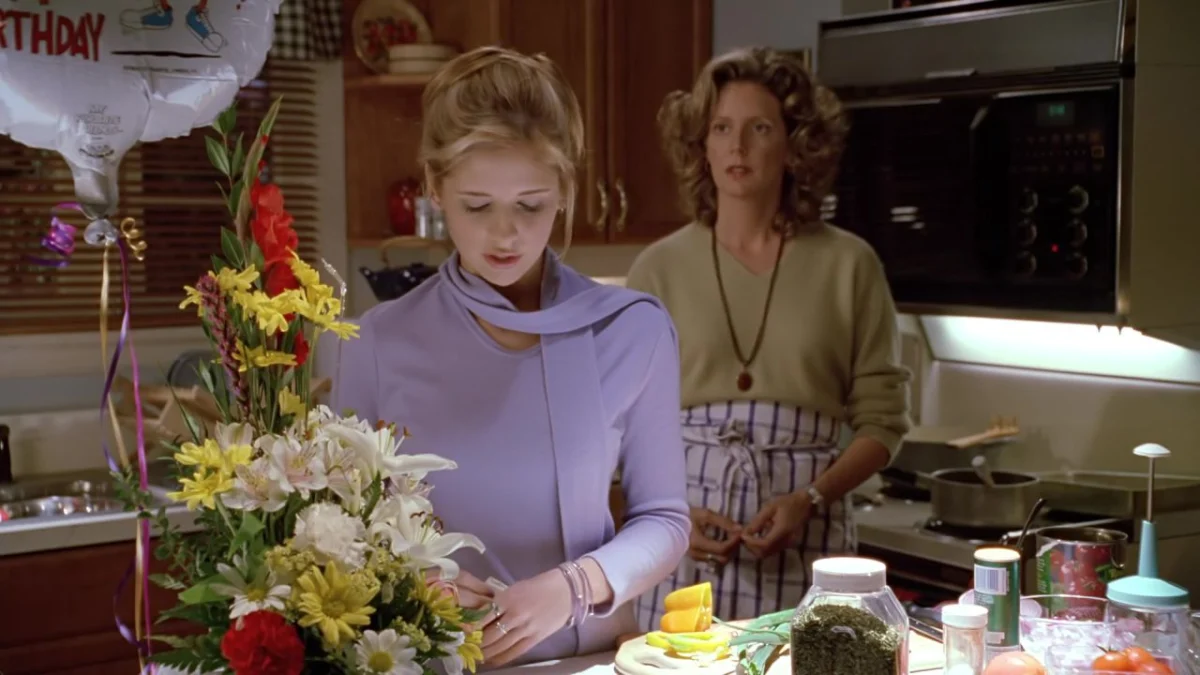
The following morning, Buffy’s struggle to maintain her edge is evident as she repeatedly misses her target while practicing knife throwing. Giles dismisses her concerns, attributing her off-game performance to a "bad flu bug." Buffy, however, is distraught, as canceling her birthday plans would deeply disappoint her father. The emotional weight of this potential disappointment is compounded by the news that her father will indeed not be coming, citing work commitments, though he sends flowers and ice show tickets along with a letter that Buffy crumples in her hand. Her mother’s concern is brushed aside as Buffy claims she wanted a quiet birthday.
The Cruciamentum: A Test of Strength and Trust
The seemingly mundane disappointment of a canceled birthday tradition takes a sinister turn with the introduction of ominous figures lurking in the shadows of an abandoned boarding house. The leader of these men, later revealed as Quentin Travers, head of the Watchers Council, declares, "We’re getting very close. The Slayer’s preparation is nearly complete."
Buffy’s training continues that evening in the library, focusing on the vibratory crystals. During a trance-like state induced by a large blue crystal, Giles injects a unresponsive Buffy with a hypodermic needle filled with a yellow liquid. He then dismisses her, his demeanor pensive.
In the subsequent scenes, Buffy’s decline is palpable. She attempts to intervene when a jock assaults Cordelia, only to be easily knocked to the ground. She walks past street harassers, ignoring them when previously she would have confronted them forcefully, her newfound weakness making her vulnerable to their physical threats. She flees from vampires, desperately flagging down cars for help. A visibly bruised Buffy panics, seeking reassurance from Giles, who repeatedly dismisses her distress, attributing it to a temporary "flu" that will pass.

The truth is gradually revealed: the yellow liquid injected by Giles was a potent cocktail of muscle relaxers and adrenal suppressors, specifically designed to incapacitate Buffy. This was part of a ritual known as the "Cruciamentum," a test administered to Slayers on their eighteenth birthday. The Cruciamentum involves depowering the Slayer and confining her with a vampire, forcing her to rely solely on her wit for survival. The Latin translation of "Cruciamentum" as "torture" or "pain" foreshadows the brutal nature of this ordeal.
The Watchers Council and the Abuse of Power
Quentin Travers (Harris Yulin), the leader of the clandestine group of men, is revealed to be the head of the Watchers Council. This organization, primarily composed of men, has historically been portrayed as scholarly researchers guiding Slayers and safeguarding supernatural knowledge. Travers is present to oversee Buffy’s trial. Giles vehemently protests the Cruciamentum, labeling it an "antiquated exercise in cruelty." His complicity in hypnotizing and injecting Buffy, presumably for days, underscores the depth of his betrayal.
Travers dismisses Giles’s concerns, calling the Cruciamentum a "time-honored rite of passage." Yulin’s portrayal of Travers captures the bored disdain of a man whose professed desire to help women is contradicted by his actions – a character trait resonant with contemporary figures in politics and media. The episode implicitly questions how "time-honored" this rite is for the Slayers subjected to such "cruciamentum."
The episode culminates with Giles rescuing a powerless Buffy from vampires and informing her about the Cruciamentum. The vampire she is meant to face, Kralik, is described as a misogynistic monster who tortured and killed numerous women in his human life. He is contained within a large box, with the Watchers seemingly confident in their control of the situation.

Buffy confronts Giles with her anguish over his betrayal, his prolonged deception, and his failure to speak out. As Giles attempts to justify his actions with protocol and duty, a crumbling Buffy questions his identity and his capacity to inflict such pain.
Breaking the Chains of Control
The episode proceeds with familiar "monster-of-the-week" tropes. Giles informs Buffy that the Cruciamentum will not proceed since he revealed it to her. He advises her to lie low until her strength returns. However, Kralik escapes, kidnaps Buffy’s mother, and lures Buffy to the abandoned boarding house. Buffy, despite her lack of powers, confronts Kralik, outwitting him and delivering a meta-commentary as he perishes: "If I had the Slayer’s power, I’d be punning right about now." Giles is subsequently fired from the Watchers Council, and Buffy finds herself at odds with them, a conflict that continues for several seasons.
The library scene, where Giles betrays Buffy, is a particularly poignant moment, ranking alongside iconic episodes like "The Body" and "Hush." The betrayal by Giles, who has been Buffy’s steadfast surrogate father, comforting her through personal crises and reinforcing her identity during moments of doubt, strikes at the core of the show. "Helpless" deconstructs the comforting lie that power structures exist for protection. It reveals that a Watcher, guided by centuries of knowledge and secrets, can betray the Slayer, prioritizing the Council’s agenda over her well-being. The narrative suggests that Slayers are viewed as weapons in a war against darkness, and the Cruciamentum might serve as a pretext for the Council to eliminate a willful Slayer and replace her with one they can control.
The episode challenges the show’s central conceit: a powerful woman. It introduces the unsettling possibility that her power is fragile and can be revoked. Questions arise about the origin of her abilities, her "chosen" status, and the accountability of the Watchers Council. These questions linger until the final season, when Buffy discovers the origins of her powers and the Slayer line. To defeat the First Evil, an ancient entity seeking to eradicate the Slayer line, Buffy enters a spiritual portal where the Shadowmen, the progenitors of the Watchers Council, offer her enhanced power. This power is metaphorically depicted as being chained and infused with the spirit of a demon, a visual parallel to sexual assault. Buffy rejects this tainted power, denouncing the Shadowmen for their weakness and their exploitation of the first Slayer.

Buffy is not weak, even without the compromised power offered by the Shadowmen, who eventually formed the Watchers Council. The notion that "She alone is the Slayer" is presented as another "time-honored rite," akin to the Cruciamentum, which Buffy is destined to dismantle. The series concludes with Buffy magically activating the latent Slayer power within all Potential Slayers globally, empowering them to collectively fight the forces of darkness. This climactic scene continues to evoke awe, symbolizing women and girls discovering their own strength and the capacity to break free from oppressive systems. With Buffy at the forefront, this army of Slayers pushes back against the darkness. They are "Chosen," and suddenly, no longer "helpless."
The Promise and Demise of the Revival
The potential of the "Buffy" revival held a beautiful promise: the opportunity to continue a narrative centered on a woman and her friends liberating themselves from patriarchal control by reclaiming and sharing power. It was hoped that the revival would disregard the problematic elements of the comic book continuation. The prospect of an adult Buffy mentoring a new generation of Slayers, fostering their strength rather than controlling them like a Watcher, was compelling. The show could have explored contemporary challenges faced by adolescents, such as demon attack drills in schools, bureaucratic indifference to supernatural threats, or the insidious influence of technology. The idea of oligarchs constructing a datacenter that is secretly a temple to a banished dark god, or other analogous modern-day hellmouths, presented fertile ground for storytelling, especially with a creative team that understood the original show’s power.
The recent cancellation by Hulu, however, casts a shadow over these possibilities. Reports detailing internal disagreements over creative direction and alleged executive disinterest in the original series have surfaced. One executive, reportedly proud of never having watched "Buffy," consistently reminded the production team that the show was "not for him." This sentiment, as Gellar highlighted, presented an "uphill battle" from the outset. The timing of the cancellation, coinciding with Gellar’s promotion for a film produced by a Disney-owned subsidiary (like Hulu), and Chloé Zhao’s proximity to the Oscars for her critically acclaimed film, adds layers of irony. The simultaneous announcement of an animated "Firefly" reboot, with the blessing of Joss Whedon, further fuels the perception of a status quo being maintained, echoing Travers’s pronouncement, "It’s been done this way for a dozen centuries."
During its initial run, "Buffy" was often relegated to being analyzed through metaphor, with critics and adults framing it as an allegory for adolescence rather than appreciating its direct engagement with supernatural themes. This critical lens sometimes overshadowed its groundbreaking portrayal of a powerful female protagonist. The current situation can be viewed through a similar lens: a male executive of a global conglomerate attempting to keep "Buffy" in the dark, mirroring the show’s antagonists like The Master, The Mayor, and the Watchers Council. The cancellation is perceived by some as a move to maintain control, reminiscent of how the Council historically managed Slayers.

The decision to cancel the revival, especially after significant investment in a pilot, raises questions about the process and priorities of media conglomerates. Hulu’s ownership by Disney, which in turn is influenced by major investment firms, places it within a broader ecosystem where corporate interests and a perceived desire to control narratives can overshadow creative vision. The political climate, with its challenges to inclusive storytelling and the marginalization of women’s voices, adds another layer of complexity. The parallels drawn to the show’s thematic concerns – the fight against oppressive power structures and the empowerment of historically excluded communities – make the cancellation feel particularly resonant.
The inherent promise of the "Buffy" revival lay in its timely relevance. The world, it seemed, needed Buffy’s strength and her ability to confront formidable "demons." The cancellation, therefore, feels like a missed opportunity to engage with contemporary societal issues through the lens of a beloved and empowering narrative. The author’s analogy of a "middle-aged gay dude at his computer screaming into the widening maw of a Hellmouth that is 2026" captures the sense of helplessness that many feel in the face of current global challenges, and the desire for an escape into a fantasy world that offers resilience and hope.
Ultimately, the narrative of "Buffy" has always been about challenging the status quo. As Giles once told Buffy, "You’ll be yourself again in a few days." The series demonstrated that even when stripped of power, Buffy’s inherent strength and will to protect others allowed her to overcome adversity and prevent further apocalypses. The potential for a revival to explore these themes of resilience and the reclamation of power, especially in the current socio-political landscape, represented a beacon of hope that has now been extinguished, at least for the time being.