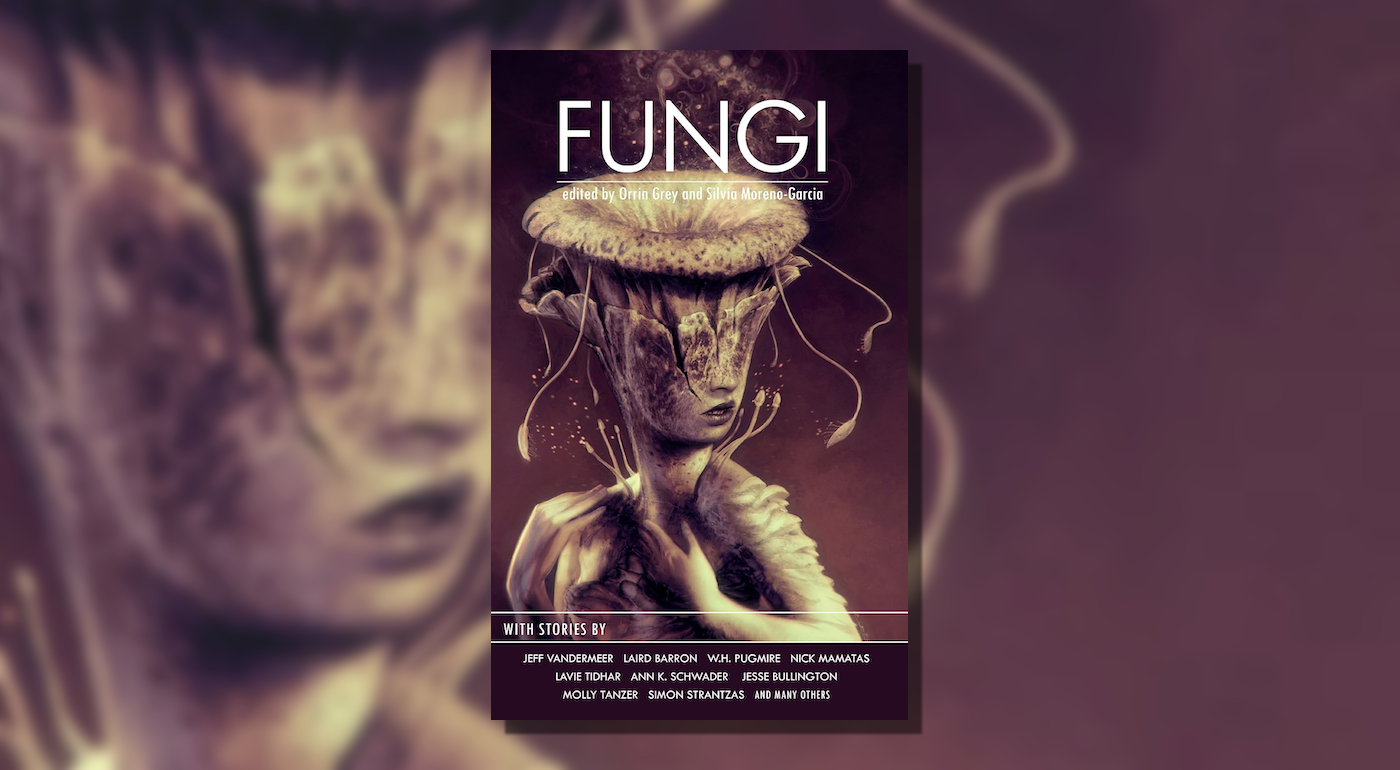
The peculiar narrative of Jeff VanderMeer’s "Corpse Mouth and Spore Nose," first published in 2004 and later anthologized in Fungi (2012), presents a surreal and unsettling tableau, deeply rooted in the traditions of weird fiction and cosmic horror. The story plunges the reader into the rain-soaked, mud-caked reality of a nameless detective, emerging from the murky depths of the River Moth as dawn bleeds across the sky. This grim awakening in the city of Ambergris, a place now dominated by the subterranean "grey caps" after their reconquest, sets a tone of oppressive atmosphere and encroaching dread.
The detective’s immediate surroundings are described with a palpable sense of decay and unease. The scent of mud clings to him, a physical manifestation of the pervasive miasma that characterizes Ambergris. The city itself is a labyrinth of narrow streets and "crazy and up-ended buildings," perpetually shrouded in a mist that blurs the edges of reality, rendering it a "blank slate waiting for his imagination to transform it." This description immediately establishes Ambergris not merely as a setting, but as a character in its own right, a place where the physical and the psychological are inextricably intertwined.
The narrative quickly introduces a heightened sense of peril, amplified by the detective’s awareness of the grey caps’ omnipresent surveillance, facilitated by their "microscopic fungal cameras." This detail underscores the story’s engagement with themes of biological invasion and technological infiltration, common tropes in speculative fiction that explore the erosion of privacy and autonomy.
Emergence of the Uncanny
As the mist recedes, a colossal, "great head" looms into view, described as the "unexpected prow of a ship." This monumental statue is revealed to be Voss Bender, a figure of historical significance, celebrated for his music even five centuries after his death. The statue, though marred by mold, retains an imperious air, its features amplified by the ravages of time and the elements. Bender’s stony gaze directs the detective’s attention to a colossal mushroom, a bizarre botanical anomaly towering over a signpost. The mushroom’s immense scale—a stem six feet around, a "half-moon" cap streaked with vibrant colors, and tendril-like "roots" cracking the pavement—immediately signals a departure from the natural world into the realm of the grotesque and the fantastic. The detective’s perception of a breathing sound emanating from the mushroom further blurs the line between the organic and the animate.
The Cryptic Proclamation
The signpost bears a large "A" and a cryptic inscription, a four-line verse that speaks of a "holy city," a plea for it to "arise, emerge from your sleeping years," and a promise of restoration "with mercy and grace." This verse, presented in a communal "We," suggests an organized entity with a restorative agenda, yet its context within the decaying, mist-shrouded Ambergris creates a chilling dissonance. The promise of mercy and grace, juxtaposed with the pervasive sense of dread and the uncanny, hints at a potentially sinister subtext, a hallmark of cosmic horror where salvation may come at an unimaginable cost.
A Symbiotic Horror
The source of the breathing sound is revealed to be a supine man, his lower body merging with a mushroom "root." This figure, unnervingly pale and hairless, exhibits a profound biological transformation. His genitals are replaced by a "frozen-blue" fungal knob, and his fingertips sprout fungal tendrils. The description of his face as a "rubbery white mask" with features that have "given way to an over-ripe fullness" paints a picture of a being undergoing a radical, terrifying metamorphosis. Despite this grotesque alteration, the man is undeniably alive, breathing, and seemingly conscious.
Confrontation and Revelation
The detective’s immediate reaction is to draw his weapon, a pragmatic response to an inexplicable and horrifying phenomenon. He recognizes that his original mission—to solve "the True Case, the True Crime"—is being overshadowed by a cascade of bewildering mysteries. His attempt to rouse the mushroom-man with a tap of his gun elicits a terrifying response: eyes that open to reveal "limitless black, across which tiny insects glided and fell, an entire world trapped on [their] surface." This vision of a miniature, self-contained universe within the man’s eyes is a powerful metaphor for the vast, unknowable horrors that lurk beneath the surface of reality.
The climax of this encounter is the mushroom-man’s mouth opening to disgorge an impossible number of miniature corpses. These diminutive figures, described as "naked, doll-like things," some headless, gilled, or winged, with single or many eyes, represent a horrifying tableau of life and death in miniature, engaged in a "stumbling decay." The sheer volume of these corpses, spilling onto the ground around the detective, signifies a profound biological and existential horror.
The Detective’s Crisis of Faith
The narrative then delves into the detective’s internal struggle. The allure of succumbing to the grotesque spectacle, of shedding his identity and merging with the fungal entity, is palpable. However, the thought of Alison, the missing girl whose disappearance is the catalyst for his investigation, breaks the trance. His declaration, "this isn’t right," and his subsequent action—pressing his gun to the man’s head—represent a desperate attempt to impose order on chaos, to assert his will against the overwhelming tide of the uncanny. His final pronouncement, "I. Do. Not. Believe. In. You," is a direct challenge to the existence of this monstrous manifestation, a rejection of the reality it represents.
The Fungal Embrace
The shot that follows is not a resolution, but a catalyst for a new horror. The mushroom-man’s head explodes, releasing a cloud of "snow-white spores" that drift on the breeze. The detective stands, momentarily stunned by his act, contemplating the sheer impossibility of maintaining focus on a single case in Ambergris. Yet, as he prepares to resume his mission, a spore enters his nose, burrowing into his flesh and sliding down his throat. The ensuing pain and the inability to dislodge it signify the irreversible nature of the fungal invasion. The spores, now within him, seem to mock him with the very verse he encountered: "We shall restore you with mercy and grace."
Transformation and Loss of Self
The spores’ relentless invasion triggers a "great Nothing" in the detective’s mind, obliterating thought, memory, and identity. He surges upright, transformed into something new, something that has "hijacked" his body. He bellows the name "Odessa Bliss" and proclaims, "I. Am. Odessa. Bliss!" This newfound identity, characterized by "sheer and unrelieved stupidity" and a "joy of freedom," marks the complete loss of his former self. His original mission, his client, and even his own mind are gone, replaced by the "mumbles and half-formed thoughts" of Odessa Bliss, forever haunted by the refrain, "We shall restore you with mercy and grace." The story concludes with this transformed entity running into the city, embracing a "new perspective on everything," a chilling testament to the power of the fungal contagion.
Weirdbuilding: The Pervasive Influence of Fungi
The narrative’s reliance on fungal imagery is not arbitrary. Cosmic horror, particularly within the Lovecraftian tradition, has a long-standing fascination with fungi as agents of mind control and existential threat. Stories such as H.P. Lovecraft’s "The Colour Out of Space" and his collaborators’ works often explore the insidious ways in which alien or terrestrial biological entities can subvert human consciousness and physical form. This recurring motif highlights a deep-seated unease with biological processes that can usurp control and transform the familiar into the alien. The inclusion of links to related articles, such as those concerning mind control and "The Shunned House," further emphasizes this connection and provides readers with contextual background on the genre’s exploration of such themes.
Madness Takes Its Toll: The Erosion of Sanity
The story masterfully illustrates how external horrors can lead to internal collapse. The detective’s descent into amnesia, or a more profound loss of self, serves as a stark reminder that in the face of overwhelming cosmic or biological threats, the human mind is a fragile entity. His inability to focus on his original "Case" and his ultimate transformation underscore the narrative’s exploration of the psychological toll exacted by encounters with the inexplicable and the terrifying.
Anne’s Commentary: The Dual Nature of Fungi
Anne’s commentary provides a fascinating counterpoint to the story’s dark themes, highlighting the multifaceted role of fungi in both life and death. She acknowledges the vital ecological functions of fungi, their role in decomposition, and their contributions to human sustenance and industry, from edible mushrooms and truffles to leavened breads and fermented beverages. This section even touches upon the genetic proximity of fungi to animals, a detail that subtly reinforces the story’s theme of fungal metamorphosis.
However, Anne also addresses the darker side of the fungal kingdom, citing contemporary scientific reports on the rise of deadly fungal infections like Aspergillus and Candida auris, exacerbated by climate change and antibiotic resistance. The mention of Valley Fever and the northward spread of Coccidiodes further illustrates the real-world threats posed by fungi. This grounding in current events amplifies the unsettling resonance of VanderMeer’s fictional narrative, suggesting that the story’s themes are not entirely divorced from contemporary anxieties. The reference to Cordyceps and "zombie fungus" directly connects to the "mushroom man" in the story, drawing a clear parallel between fictional horror and observed biological phenomena.
Anne’s analysis of VanderMeer’s narrative style as an "atmospheric vignette with some action thrown in" accurately captures the story’s immersive yet abrupt nature. The "Who, What, When, Where, Why, and How" framework she applies provides a structured approach to deconstructing the narrative’s enigmatic elements, treating the story as a detective puzzle, albeit one with deeply surreal answers.
Ruthanna’s Commentary: Ambergris and the Unknowable
Ruthanna’s commentary offers a broader context for "Corpse Mouth and Spore Nose" within Jeff VanderMeer’s larger Ambergris series. She describes Ambergris as a city where humans have displaced mushroom people, establishing a history of conflict and ecological imbalance. The concept of ambergris itself, a substance valued for its beauty yet derived from the exploitation of a creature’s biological processes, serves as a potent metaphor for the human relationship with nature.
Ruthanna’s observation that "The Detective" is deliberately unnamed emphasizes his role as an archetype, a cipher within the noir genre, tasked with uncovering mysteries. His lack of identity, washed away by his immersion in the River Moth, mirrors the story’s theme of lost self. His mission to solve the "True Case" is contrasted with the overwhelming nested mysteries he encounters, a reflection of the genre’s tendency to deconstruct its own conventions.
The commentary also touches upon the story’s potential inspiration for the "You cannot kill me in a way that matters" meme, a fascinating connection that highlights the enduring power of certain narrative elements to transcend their original context. Ruthanna’s analysis of the mushroom-man’s invincibility and the detective’s disastrous decision to shoot him underscores the story’s central theme: the futility of imposing human logic and violence on forces that operate on entirely different principles. The "new perspective" offered by the fungal invasion is a chilling prospect, suggesting a fundamental shift in understanding that may come at the cost of one’s very being.
The narrative of "Corpse Mouth and Spore Nose" is more than a simple horror story; it is an exploration of the boundaries between life and death, sanity and madness, and the profound implications of a world where the very definition of existence is subject to fungal transformation. Its power lies in its ability to evoke a deep sense of cosmic dread, reminding readers of the vast, unknowable forces that lie just beyond the periphery of human comprehension.