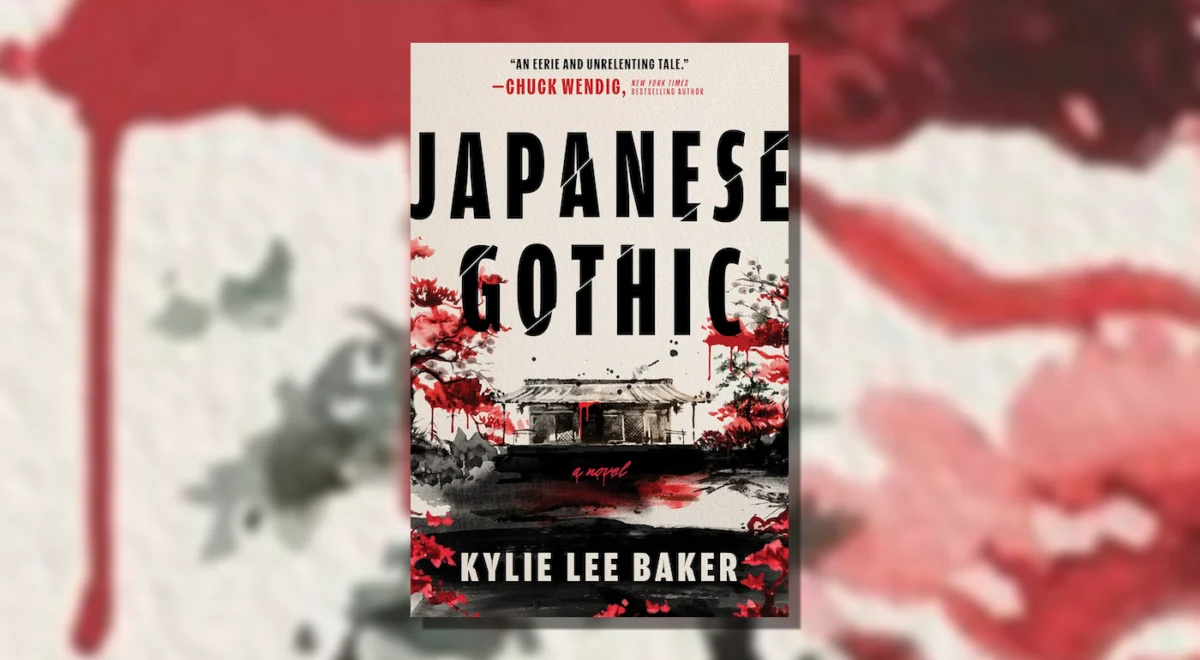
Hanover Square Press is set to release Kylie Lee Baker’s new horror novel, Japanese Gothic, on April 14th, a work that promises to weave a chilling narrative through the intricate tapestry of Japanese mythology. The novel delves into dual timelines, presenting two protagonists grappling with profound trauma and unsettling supernatural occurrences. An excerpt from the book offers a glimpse into these interconnected mysteries, hinting at a dark history intertwined with a secluded house in Japan.
The narrative unfolds across two distinct temporal planes, each introducing a character ensnared by inexplicable dread. In October 2026, Lee Turner finds himself fleeing New York City, haunted by fragmented, violent memories of killing his college roommate. His only perceived sanctuary is his estranged father’s new home in Japan, a secluded property shielded by dense sword ferns and wild ginger. However, the idyllic setting is marred by an palpable wrongness: the absence of animal life, a bedroom window that shifts from solid pane to an unsettling void, and the spectral appearance of a sword-wielding woman under the cloak of night.
Concurrently, in October 1877, Sen, a young samurai in exile, seeks refuge in a similar hidden dwelling, also ensconced by sword ferns. Her plight is rooted in a terrifying transformation: a monster has returned home wearing her father’s face. Driven by a desperate need for paternal approval, Sen has already committed unspeakable acts, including turning her blade against her own mother. Her precarious existence is further threatened by the appearance of a foreign young man outside her window, a sighting she interprets as a dire omen presaging the imminent slaughter of her entire family by imperial soldiers.
The author’s premise suggests a profound connection between these two seemingly disparate accounts, stating that "One of these people is a ghost, and one of these stories is a lie." This duality immediately raises questions about the nature of reality within the novel, the reliability of the narrators, and the spectral or deceptive forces at play. The overarching mystery centers on what lies "beneath the house of sword ferns," a revelation that Lee and Sen will evidently come to regret unearthing.
The Shadow of Disappearance: Lee’s Trauma
Chapter 4, narrated from Lee’s perspective, delves into the genesis of his psychological torment, tracing it back to the inexplicable disappearance of his mother when he was twelve. Though he claims to have slept through the event, the details manifest in his dreams with nightmarish clarity. He recounts a dream where his mother diminishes, becoming insubstantial before being folded and packed away into a suitcase by a faceless man. This recurring vision fuels his unsettling theory that his mother may have become lost within his own dreams, unable to escape.
The memory of his mother’s last known moments is anchored to a family trip to Cambodia during summer break. They were staying in a tranquil bungalow surrounded by a lush tropical garden. Lee recalls vivid sensory details: the intense fuchsia of the flowers, the imposing scale of giant taro leaves, and the sweet tang of guava accessible from the second-floor balcony. He describes a state of jet lag, a disorienting haze that blurred the lines between reality and dream. It was during this liminal state that his mother opened the sliding door, a seemingly innocuous action that Lee now regards as her final, fatal mistake.
He describes watching her from his bed, perched in the open doorway with her feet on the sandy porch, gazing out at a blindingly bright, deceptively perfect seascape. Her long brown hair, illuminated by the sun, silhouetted her form, rendering her face invisible—a recurring motif of her overwhelming radiance. Her instruction to "take a nap" and the promise of dinner upon waking now echo with a chilling finality. Lee’s childhood recollection is tinged with a sense of wonder about a tire swing, his mother’s encouragement to swing higher, and the fleeting thought of touching the sun.
When he awoke, the scene had transformed. The tropical warmth had surrendered to a biting cold, the sand bathed in an eerie, moon-like blue. His calls for his mother were swallowed by the breeze. At twelve, Lee held a naive belief in the permanence of his parents’ presence, an unwavering certainty that no force could sever their bond. He occupied himself with reading, the door left ajar in anticipation of his mother’s return.
The return of his father from a scuba diving trip, an activity Lee was too young to join, marked the beginning of the true unraveling. His father’s attempts to contact his mother, followed by the involvement of the police, failed to penetrate Lee’s childlike understanding of the situation. He remained fixated on the open door, convinced of her imminent reappearance. While intellectually aware of death, the concept of outright disappearance remained incomprehensible.
The subsequent police investigation, encompassing both the forest and the sea, concluded with the theory of drowning. However, Lee’s mother had instilled in him a strict adherence to the rule of never swimming alone, making this hypothesis seem improbable. Furthermore, her departure with the door left open while he slept struck him as an act entirely out of character.
It was Lee who first noticed the unusual tracks in the sand – curved lines resembling two snakes slithering towards the forest. He initially withheld this observation, uncertain of its significance. Later, a policeman identified them as the tracks of a large suitcase. This detail starkly mirrored Lee’s dream, the image of his mother being folded and packed away resurfacing with disturbing relevance. The disconnect between the perceived normalcy of a suitcase and the horrific implications of its contents fractured Lee’s understanding of the world. He grappled with the logic: how could a person be so easily concealed, and why would he, a child, not have been taken as well?
The Scars of Abandonment: Sen’s Ordeal
The narrative shifts to Sen’s harrowing experience in Chapter 7. Her trauma begins at the tender age of seven, when her father entombs her in a wooden crate, abandoning her to face death. This crate, previously used for rice sacks, was just large enough for Sen to contort herself within. Her father led her outside at night, placed her in the box, and instructed her to "make herself small."
Initially, Sen perceived this as a game, mimicking the small snails she observed near the river. She embraced her knees, held her breath, and attempted to become invisible to please her father. However, the game turned sinister when her father nailed the box shut, the sound echoing ominously near her ears. He then buried the crate, piling wet earth until the sky was obscured. The poorly constructed box offered no perfect seal, allowing dirt, worms, and beetles to infiltrate, their wriggling across her bare toes a visceral horror. Her father’s parting words, "You will know what it’s like to be dead," cemented the terror.
The darkness within the box was absolute, a stark contrast to the starlit skies or dim bedrooms of her childhood. It was an all-consuming void, a crushing weight accompanied by the sounds of growing roots and scurrying insects. A dull ache in her neck escalated into sharp pain. Despite the overwhelming fear, a desperate belief persisted: "Chichiue won’t let me die. It’s a game, and he’ll come back for me."

Time in this subterranean prison distorted, stretching and thinning until its strands frayed. Sen spent years solely focused on breathing. Hunger gnawed at her, and her mouth grew parched. As seasons passed, the realization dawned that her father would not return. His long-standing desire for sons, often expressed to her mother, meant Sen was surplus to his aspirations. She was no longer needed, much like her presumed predecessor, Kura. The worms and beetles continued their crawl, yet Sen remained paralyzed, the box constricting her bones under the earth’s weight. She felt herself becoming a decaying corpse, merging with the soil.
It was in this profound darkness that a faint voice emerged, whispering, "Sata? Sugar." The utterance conjured memories of sugarcane in Kura’s small hands, her smile adorned with fibrous remnants. A small, white hand then parted the darkness, reaching for Sen. Kura’s face remained obscured, but Sen felt her stringy hair brush against her legs, her jagged nails on Sen’s calves, and her cold hand grip Sen’s arm. Sen whispered, "Kura, Chichiue has left me to die."
Kura’s grip tightened. "Why would he do that?"
"Because I’m worthless," Sen choked out, inhaling damp earth. "Because I’m weak."
Kura’s fingers dug into Sen’s arm. "He does this because you’re strong," Kura declared. "He does this to show you what you will become if you give in to your weakness." Kura then positioned her hands on Sen’s knees, leaning closer, pushing aside the darkness like a silk curtain.
Kura’s appearance was skeletal, her skin taut and gray against her skull, wrinkled like aged leather. Her baby teeth hung precariously, jingling like wind chimes. Maggots emerged from her ears and nose, their minuscule fangs leaving scars. Her eyes were clouded, lost in a perpetual fog. Kura repeatedly whispered, "Sata. Sata Sata Sata." Sen could only cling to her fractured self, waiting.
After what felt like an eternity, her father returned, unearthed the box, removed the lid, and pulled Sen out. "Thank you, Chichiue," Sen said, her legs unsteady. "Thank you for showing me this."
"And what have I shown you?" her father inquired.
Recalling Kura’s jingling teeth and bloody drool, Sen responded, "That life and death are one and the same. That I exist because I am strong, and if I give in to fear, I will no longer exist." Her father nodded and gestured for her to follow, instructing her to "Wipe your face. We have work to do." Sen scrubbed her face with her muddy sleeves, her last act of weeping. The Sen who had tasted death remained in the dirt; the rest followed her father, forever changed.
Intertwined Pasts, Unsettling Futures
The novel’s dual narratives, separated by decades, explore themes of abandonment, trauma, and the pervasive nature of fear. Lee’s experience with his mother’s disappearance, framed by the chilling possibility of human trafficking and the visceral imagery of being packed away, resonates with Sen’s profound betrayal by her father and her own literal entombment. Both characters are marked by a fundamental loss of security and a confrontation with the fragility of existence.
The recurring motif of being confined to or imagined within containers—suitcases, boxes, tight spaces—serves as a potent symbol of their shared psychological states. Lee’s deliberate self-imposed confinement beneath his bed or within a suitcase mirrors Sen’s forced imprisonment. These acts suggest a desperate attempt to reclaim agency or to find a semblance of control in worlds that have rendered them powerless.
The introduction of supernatural elements—the shifting window, the sword-wielding woman, and the ominous omen of the foreign man—suggests that the horrors faced by Lee and Sen are not solely psychological but also have an external, possibly spectral, origin. The house of sword ferns, a seemingly tranquil yet isolated location, becomes a nexus for these disturbing phenomena, implying that the past traumas are not merely personal but are interwoven with a deeper, more ancient malevolence.
Kylie Lee Baker’s Japanese Gothic promises a narrative that challenges conventional horror tropes by delving into the psychological depths of its characters and grounding its terrors in the rich, often dark, folklore of Japan. The juxtaposition of Lee’s modern-day flight from justice and Sen’s historical struggle for survival within the same haunted locale sets the stage for a climactic convergence, where the secrets buried beneath the sword ferns will inevitably surface, forcing both protagonists to confront the true nature of their nightmares. The release of the novel is anticipated to offer a unique and unsettling exploration of inherited trauma and the enduring power of the past.