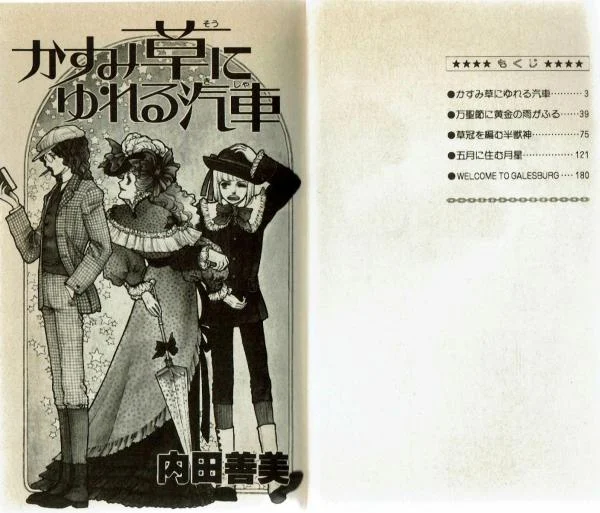
Yoshimi Uchida’s collection of short stories, "Kasumisou ni yureru kisha" (literally "Steam Train Swaying in Gypsophila"), though often categorized as one of her minor works, stands as a profound testament to her distinctive artistic philosophy within the realm of shoujo manga. Published during a pivotal era for the genre, this volume encapsulates Uchida’s innovative approach, pushing thematic and stylistic boundaries that resonated with an expanding readership. Far from being a mere footnote in her extensive career, the collection serves as a microcosm of Uchida’s enduring influence, showcasing her ability to weave intricate psychological narratives into seemingly idyllic settings.
The Enduring Legacy of Yoshimi Uchida in Shoujo Manga
Yoshimi Uchida emerged as a significant figure in the shoujo manga landscape during the 1970s and 1980s, a period marked by profound artistic and thematic evolution within the genre. While not conventionally grouped with the renowned "Year 24 Group" (or "Hana no Nijuuyonengumi"), a collective of female manga artists who revolutionized shoujo manga in the early 1970s by introducing complex narratives, psychological depth, and unconventional themes, Uchida nonetheless played a comparable role in broadening its scope. The Year 24 Group, including luminaries like Riyoko Ikeda, Moto Hagio, and Keiko Takemiya, famously moved shoujo manga beyond simplistic romantic tales for young girls, exploring topics such as gender identity, philosophy, and socio-political issues. Uchida, while perhaps operating with a slightly different stylistic vocabulary, shared their commitment to infusing shoujo with a newfound intellectual and emotional gravitas. Her works, including "Kasumisou ni yureru kisha," contributed significantly to this paradigm shift, attracting a more mature audience beyond elementary school students and into young adulthood. This expansion was critical for the genre’s long-term artistic legitimacy and commercial viability.
"Kasumisou ni yureru kisha": A Collection Defined by Transition
The collection, "Kasumisou ni yureru kisha," is a masterclass in evoking nostalgia while simultaneously confronting the bittersweet realities of growth and disillusionment. Its unifying theme is the loss of innocence, portrayed through the individual journeys of its young protagonists in a world on the cusp of change. This thematic depth is characteristic of Uchida’s oeuvre, which frequently delves into the complexities of human emotion and the often-painful transition from childhood to adulthood. The 1980s, when this work was published, saw a flourishing of diverse narratives in shoujo, moving beyond the traditional Cinderella archetypes to explore more nuanced character development and challenging life experiences. Uchida’s work fit perfectly into this trend, offering readers not just escapism, but also reflection.
The stories are set in the idyllic, idealized past of a Western nation, a common aesthetic trend in Japanese comic books of the 1980s. This choice of setting allowed mangaka to explore themes of romance, adventure, and personal growth against a backdrop that felt both familiar and exotic to Japanese readers, unburdened by the specific socio-political realities of contemporary Japan. This approach can be seen in other seminal shoujo works, such as Riyoko Ikeda’s "The Rose of Versailles," which reimagines the French Revolution, or Moto Hagio’s "The Heart of Thomas," set in a German boys’ boarding school. While the specific location for "Kasumisou ni yureru kisha" is Galesburg, Illinois – an actual city in the United States – Uchida’s depiction, much like Ikeda’s Paris or Hagio’s Germany, is not strictly bound by historical accuracy. Instead, it functions as a romanticized stage upon which universal human dramas unfold, allowing for a focus on emotional truth rather than factual precision.
Narrative Threads: Tales of Innocence Lost
The collection opens with its eponymous work, "Kasumisou ni yureru kisha." Here, young Oscar finds himself reluctantly aiding his crush, Sophie, in her pursuit of Mr. McDougall, an ambitious but untalented journalist. Oscar’s journey is one of nascent heartbreak and the dawning realization of his place in the adult world – a poignant acceptance that he is still a child, navigating emotions far beyond his years. This narrative deftly captures the feeling of being an outsider looking in on the complexities of adult relationships, a common and relatable experience for many adolescents.
The second story, "Banseisetsu ni kogane no ame ga furu" (A Golden Shower on All Saints’ Day), introduces Leon, a wandering traveler who finally reunites with his long-lost sister, Alice. However, their reunion is tinged with peril, as Leon must make the ultimate sacrifice to shield Alice from a mysterious Halloween curse. This tale delves into themes of familial duty, protection, and the profound weight of responsibility, culminating in a heroic act that signifies Leon’s transition from a solitary wanderer to a guardian. His loss of innocence comes with the acceptance of a profound, self-sacrificing love.
"Kusakanmuri wo amu hanjuushin" (The Faunus Weaving Flower Crowns) follows a group of friends on a perilous expedition to explore ancient Native American ruins. This adventure serves as a crucible, forcing them to confront their own vulnerabilities and the transient nature of youth and good health. The story cleverly foreshadows the future, where their carefree days of exploration will give way to the somber call of higher studies and, ultimately, the harsh realities of a distant war. Their journey into the ruins symbolizes their passage into a more dangerous, less innocent world, where the value of their present youth becomes starkly apparent.
Finally, "Gogatsu ni sumu tsukiboshi" (Moon and Stars in May) introduces Giuseppe, a fearless barnstormer aviator. His stop in Galesburg for preparations to fly across the Atlantic brings him face-to-face with his first love, who has remained in Galesburg. Her unwavering belief that Giuseppe would never return, and her subsequent decision to embark on her own journey into adulthood without him, forces Giuseppe to confront the consequences of his ambition and the path not taken. His loss of innocence is tied to the realization that life moves on, and promises, even those unspoken, can be broken, leaving behind the bitter taste of unfulfilled dreams and lost connections.
Across these diverse narratives, Uchida skillfully weaves a tapestry of experiences that, while fictional, resonate deeply with universal human emotions. Each story, in its unique way, portrays a moment of transition, a realization that the world is more complex, and often more painful, than one imagined in childhood.
Artistic Vision: Pre-Raphaelite Echoes and Cinematic Depth
Uchida’s distinctive artistic style is a crucial element in the enduring appeal of "Kasumisou ni yureru kisha." Her character designs are reminiscent of the "golden age of shoujo," featuring the genre’s characteristic large, sparkling eyes and often androgynous demeanors. This aesthetic was widely popular throughout the 1970s and 80s, creating a visual language that was instantly recognizable to shoujo readers. However, Uchida distinguishes herself through the subtle yet profound influence of Pre-Raphaelite painters. This influence is particularly evident in the illustrated covers that preface each story, which exude a delicate, almost ethereal quality.
The Pre-Raphaelite Brotherhood, a group of English painters, poets, and art critics founded in 1848, sought to reform art by rejecting the conventions of their time and drawing inspiration from early Italian Renaissance art, particularly from before Raphael. Their characteristics included intense detail, vibrant colors, a focus on naturalism, and a strong emphasis on literary or mythological themes. They frequently depicted scenes of romanticism, chivalry, and intense emotionality, often featuring melancholic or ethereal female figures. Uchida’s work subtly mirrors these qualities: the meticulous rendering of flowers, the dreamy atmosphere, and the often pensive expressions of her characters evoke the aesthetic sensibilities of artists like John Everett Millais, Dante Gabriel Rossetti, and William Holman Hunt. This infusion of fine art influences elevates her manga beyond typical comic book illustration, lending it a timeless, artistic elegance.
Furthermore, Uchida’s representation of male leads sometimes diverges from the purely feminine features prevalent in shoujo, incorporating more dramatic, marked strokes that emphasize their physique and introduce a sense of ruggedness or intensity. This stylistic choice creates a compelling contrast, enhancing the visual dynamism of her work and contributing to its appeal to a more mature audience.
Beyond visual art, Uchida’s artistic depth is further enriched by her homages to arthouse cinema. The most prominent reference cited is Luchino Visconti’s "Death in Venice" (1971). Visconti’s film, based on Thomas Mann’s novella, is a poignant exploration of beauty, desire, aging, and the melancholic pursuit of an unattainable ideal. Set against the backdrop of a decaying Venice, it is renowned for its lush cinematography, profound psychological insight, and themes of aestheticism and mortality. The parallels between Visconti’s work and Uchida’s "Kasumisou ni yureru kisha" are striking. Both explore the bittersweet nature of beauty, the fleetingness of youth, and the quiet despair that can accompany unfulfilled longing or the realization of life’s limitations. Uchida’s ability to embed such sophisticated cinematic and art historical references within her manga demonstrates her profound understanding of diverse artistic mediums and her ambition to elevate the narrative and emotional resonance of shoujo manga.
Uchida’s Unique Contribution to Shoujo Manga
Yoshimi Uchida’s distinct contribution to shoujo manga lies not merely in her exquisite visuals, but in her masterful integration of complex themes within seemingly simple, pastoral settings. The bucolic backdrop of "Kasumisou ni yureru kisha" serves as a deliberate contrast to the emotional turmoil and loss of innocence experienced by its characters. This juxtaposition amplifies the impact of their journeys, making the transition from idyllic childhood to the harsher realities of adulthood all the more poignant. Her narratives consistently challenge the notion of a perpetually happy ending, instead embracing the bittersweet complexities of life, love, and growth.
This thematic sophistication, combined with her unique artistic influences, allowed Uchida to carve out a distinct niche for herself. While the Year 24 Group pioneered psychological depth and diverse themes, Uchida offered a unique blend of delicate artistry and profound emotional realism. Her narratives often explore the quiet moments of introspection, the unspoken desires, and the subtle shifts in human relationships that define personal growth. This nuanced approach distinguished her from peers who might have focused on more dramatic or fantastical plotlines.
Expanding Horizons: The Evolution of Shoujo Readership
Uchida’s work, including "Kasumisou ni yureru kisha," played a crucial role in expanding the demographic reach of shoujo manga. By embedding sophisticated psychological narratives and drawing on classical artistic and cinematic influences, she created content that appealed to readers beyond the traditional pre-teen and early-teen female demographic. The themes of unfulfilled dreams, lost love, and the painful yet necessary transition to adulthood resonated deeply with young adults grappling with similar experiences. This helped solidify shoujo manga’s position as a genre capable of addressing mature themes and attracting a broader, more discerning audience.
The 1980s was a period of significant diversification in the manga industry, with shonen, seinen, and shoujo genres all evolving to cater to increasingly segmented audiences. Uchida’s contribution to shoujo’s thematic maturation was vital in demonstrating its versatility and artistic potential. Her work showed that shoujo could be both beautiful and intellectually stimulating, offering nuanced explorations of the human condition that transcended age and gender boundaries. This expanded readership was not merely a commercial success but a testament to the genre’s growing artistic credibility.
Conclusion: A Timeless Reflection on Growth and Nostalgia
"Kasumisou ni yureru kisha" by Yoshimi Uchida is more than just a collection of short stories; it is a meticulously crafted exploration of human transition, the delicate balance between dreams and reality, and the indelible mark of lost innocence. Through her evocative storytelling and distinctive artistic vision, Uchida transforms fictional events into universally relatable life experiences. She masterfully evokes the sweetness of childhood memories, only to underscore them with the poignant, sometimes sour, taste of unfulfilled promises and the inevitable march of time.
In its quiet profundity, "Kasumisou ni yureru kisha" serves as a powerful reminder of Uchida’s significant, albeit sometimes understated, contribution to shoujo manga. Her ability to infuse her narratives with psychological depth, classical artistic influences, and a keen understanding of the human heart ensures that this collection, despite its designation as a "minor work," remains a timeless and deeply resonant piece of literature, continuing to captivate and move readers who appreciate the nuanced beauty of growth and nostalgia. It firmly establishes Yoshimi Uchida not just as a mangaka, but as an artist whose work transcends genre, offering profound insights into the universal journey of self-discovery and the bittersweet process of coming of age.