Decades before Yojiro Takita garnered international acclaim and an Academy Award for Best Foreign Language Film for his poignant 2008 drama Departures, his cinematic education was deeply rooted in the often-maligned but creatively fertile world of Japanese genre filmmaking. This included an extensive apprenticeship within the softcore "pink film" genre, particularly contributing to numerous "Groper Train" titles that explored explicit themes. Takita’s early work showcased a remarkable versatility, from narrative concepts involving time-traveling trains to crafting intricate murder mysteries, demonstrating an early knack for imaginative storytelling regardless of the subject matter. He even famously transformed the typical "pink film" aesthetic into the blood-red hues of early J-Horror, shifting the genre’s characteristic moans to visceral screams. His ascent to mainstream recognition truly began in 1986, yet that year ironically saw him at the perceived nadir of his career with the release of Mania: House of Cards, alternatively titled The Mania: Body Pleasure Experiment. This film, a crucial but often overlooked entry in the "Roman X" sub-line, provides a fascinating lens through which to examine the raw, experimental energy that fueled a significant period of Japanese genre cinema and shaped the talents of future industry giants.
The Genesis of Roman X: Nikkatsu’s Bold Gamble
To fully appreciate the context of Mania: House of Cards, one must understand the tumultuous landscape of Japanese cinema in the 1970s and 80s. The "pink film" genre, known as pinku eiga, emerged in the early 1960s as a response to dwindling box office numbers and increasingly restrictive censorship on mainstream productions. These low-budget, quickly produced films often featured nudity and sexual content, serving as a vital training ground for countless directors, writers, and actors who would later transition to mainstream success. Nikkatsu, one of Japan’s oldest and most respected film studios, famously pivoted to producing its own branded softcore films, "Roman Porno," in 1971. This strategic move was designed to keep the studio afloat by guaranteeing a steady output of profitable films, typically requiring at least one sex scene every ten minutes.
By the mid-1980s, the cinematic landscape was undergoing another radical transformation with the burgeoning popularity of home video, specifically VHS and the rise of Adult Video (AV). This new market presented both a threat and an opportunity for studios like Nikkatsu. While Nikkatsu had experimented with AV releases on VHS since 1981, they sought to bridge the gap between their theatrical Roman Porno line and the more explicit content found directly on video. This led to the creation of "Roman X," a sub-line launched in 1985, explicitly designed to push the boundaries of what could be shown in theaters. Roman X films were often "shot-on-video" (SOV) productions, a cheaper and faster method, which were then "blown up" to 35mm for theatrical distribution. This technical compromise often resulted in a distinct, grittier aesthetic, but it also allowed for more daring content.
The thematic focus of Roman X shifted dramatically, embracing true-crime narratives, guerrilla filmmaking techniques, and exploring a wider array of sexual fetishes including enemas and BDSM. Plots became even looser, often serving merely as frameworks for increasingly extreme and transgressive sequences. Most Roman X entries were, by conventional standards, barely serviceable as coherent narratives, often resembling plotless AV more than traditional cinema. This environment fostered a sense of artistic freedom for directors willing to delve into the taboo, and Yojiro Takita, an independent outsider who had cut his teeth at Shintoho rather than within the Nikkatsu system, found himself uniquely positioned to thrive in this experimental sub-genre. He had nothing to "prove" to Nikkatsu; his independent spirit and unconventional approach were assets in a line designed to break norms.
Yojiro Takita: From Gutter to Gold
Yojiro Takita’s journey from the explicit confines of pink film to the prestigious heights of an Academy Award is a testament to the transformative power of talent and perseverance. Born in 1955, Takita began his career as an assistant director for Shintoho, a smaller studio known for its exploitation films. His directorial debut came in 1981 with Chikan Densha: Manin Densha (Groper Train: Packed Train), one of many entries in the popular sub-genre. Over the next five years, he directed an astonishing thirty-odd films, primarily in the pink film and Groper Train categories, establishing a reputation for speed, efficiency, and a surprisingly imaginative approach to often formulaic material.
His early films, while sexually explicit, often contained flashes of the narrative ambition and thematic depth that would characterize his later mainstream work. For instance, some of his "Groper Train" films transcended simple exploitation by incorporating elements of science fiction or dark comedy, hinting at a director eager to push beyond the immediate demands of the genre. Mania: House of Cards, released just six months after the launch of the Roman X line in 1986, represented a significant moment in this evolution. While it plunged him into the perceived "gutter" of extreme cinema, it simultaneously showcased his growing command of atmosphere and psychological tension, elements that would be refined in his subsequent career.
Takita’s mainstream ascension formally began in 1986 with Comic Magazine, a satirical comedy that earned critical praise and demonstrated his ability to navigate more conventional narratives. However, it was his continued dedication to honing his craft across various genres, including comedies like We Are Not Scared! (1989) and historical dramas like When the Last Sword Is Drawn (2003), that ultimately prepared him for Departures. The Oscar-winning film, a profound meditation on life, death, and the rituals surrounding them, stood in stark contrast to the explicit content of his early career. Yet, the discipline, resourcefulness, and keen understanding of human emotion developed in the low-budget, high-pressure environment of pink film undoubtedly contributed to his ability to craft such a universally resonant masterpiece. The technical skills acquired in lighting and framing bodies in softcore, for example, could be repurposed to evoke tenderness and dignity in Departures.
Saeko Kizuki: The Queen Emerges
The landscape of Japanese cinema in the 1980s was rife with young actresses vying for stardom, often starting in supporting roles or as "wannabe idols." Saeko Kizuki, a fresh-faced actress who began her career with Nikkatsu in 1984, initially fit this mold. Young, cute, and stylish, she was another promising face in the studio’s talent pool. However, the Roman X line, with its explicit and often transgressive themes, offered Kizuki an opportunity to dramatically redefine her image and carve out a unique niche that few of her peers dared to tread.
Her star-making turn arrived in Masaru Konuma’s 1985 Roman X feature, Woman in a Box: Virgin Sacrifice. In this harrowing film, Kizuki portrays a woman who is kidnapped and subjected to brutal torture by a couple. The film was particularly notorious for its extreme content and its casting of Hiroshi Tamura, an actor who would later become infamous for his role as the "Samurai" in Guinea Pig Part 2: Flower of Flesh and Blood (1985), a controversial film known for its graphic, simulated gore. Kizuki’s performance in Woman in a Box was intensely physical and emotionally demanding, pushing her to the limits and cementing her reputation for fearlessness in the face of cinematic extremity. The original article aptly states she "went to hell for that film," and her return in Mania: House of Cards was, in essence, a direct sequel to that experience, building upon the formidable persona she had already established.
In Mania, Kizuki takes on the role of Rie, a character whose journey mirrors the transformation she herself underwent as an actress. Her portrayal transcends mere victimhood, evolving into a complex figure who confronts and ultimately embraces the dark power dynamics presented to her. This subversion of the traditional "final girl" trope, where a virtuous female protagonist survives horror through resilience, is a hallmark of Kizuki’s Roman X work. Instead of merely escaping sex and madness, her characters often awaken to their own agency within these extreme scenarios. Her Nikkatsu pictures, playing in theaters and then sold on the booming home video market, blurred the lines between adult video and horror, capturing the raw energy of sex and death intertwined like "cheating lovers at a seaside hotel." In this unique, transgressive space, Kizuki reigned, not as a passive participant, but as an active, captivating presence – the undisputed Queen of Roman X.
Deconstructing "Mania: House of Cards": A Grand Nightmare
Mania: House of Cards opens with a seemingly innocuous videotape message from Rie’s friend Motoko, inviting her to visit the Nagisa Hotel during its off-season, hinting at an urgent matter. Before embarking on this mysterious trip, Rie is depicted in a rare, conventional sex scene with her boyfriend. This opening sequence, meticulously staged and well-lit by cinematographer Yoichi Shiga and gaffer Masao Kanazawa (who would later contribute his talents to Kiyoshi Kurosawa’s critically acclaimed 1997 psychological horror film Cure), serves as a stark contrast to the darkness that will soon engulf Rie. The initial warmth and normalcy of the scene underscore the impending cold waves and tight chains that await, setting a tone of unsettling anticipation.
Upon arriving at the desolate Nagisa Hotel, Rie is greeted by the enigmatic manager, Soeda, played with chilling composure by Junpei Kusami, an actor primarily known for his work in television dramas. Soeda’s first interaction with Rie involves a ritualistic request: to draw a card. Rie selects the Queen of Spades, a choice that immediately imbues her with a unique significance within the manager’s macabre collection. This imagery and the hotel’s isolated, dreamlike atmosphere draw striking parallels to the Golden Films era of Spanish director Jess Franco, particularly his 1982 cult classic Mansion of the Living Dead. Just as Franco’s frequent muse Lina Romay often wandered through the eerie hostels and tourist locations of Spain, Kizuki’s Rie navigates the unsettling corridors of the Nagisa Hotel. Soeda, with his sinister charm and control over his "guests," evokes Franco regular Antonio Mayans, while the captured Motoko becomes his latest "Eva León," a recurring Franco archetype of the beautiful, tormented captive. What might otherwise be a cheap, exploitative "vacation movie" transforms under Takita’s direction into a grand, unsettling nightmare, imbued with a distinct sense of surreal dread.
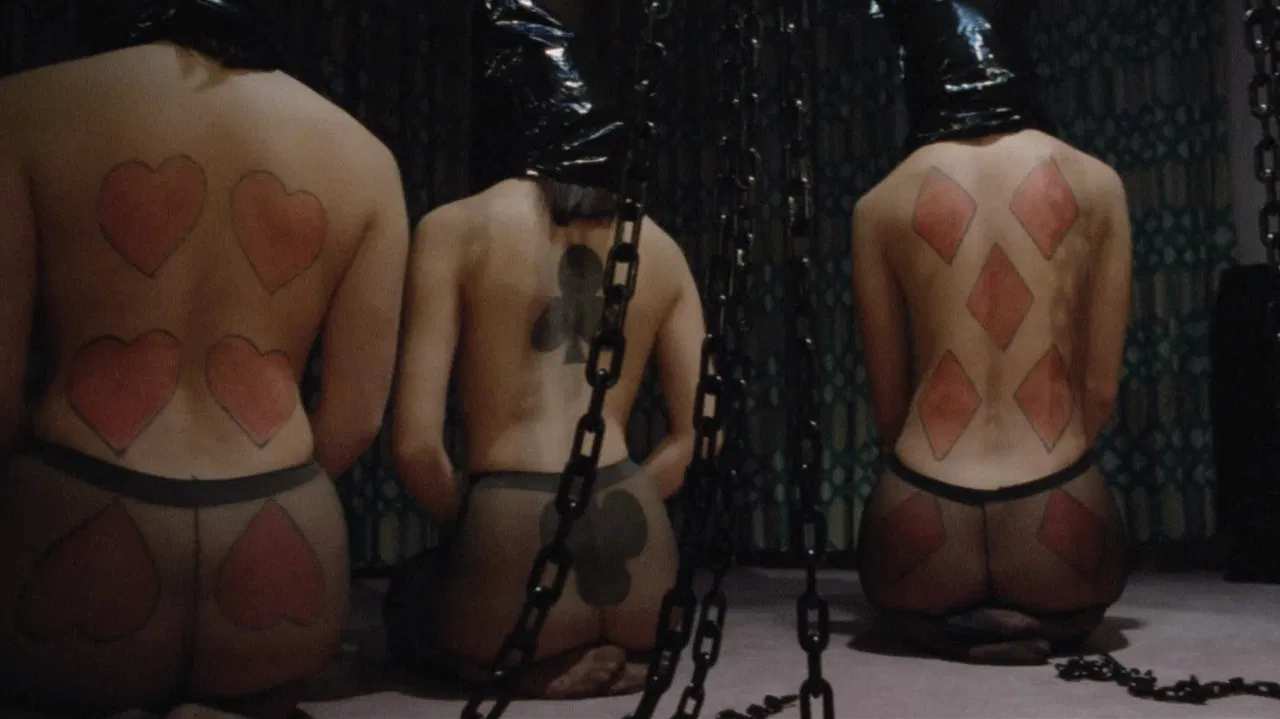
The film’s exploration of BDSM themes is central to its narrative, but it’s presented with a psychological depth that transcends mere titillation. Soeda’s "collection" of women, each tattooed with their chosen card, signifies a ritualistic power play. Rie, designated as his "first face card," is immediately distinguished from the "pawns." Her journey is not one of immediate capture and torture; instead, she is initially allowed to enjoy her "vacation," laughing and wandering the resort. The camera, in awe of Saeko Kizuki’s charm, bestows upon Rie a rare depth, allowing her character to gradually awaken to the sinister realities around her. This slow-build transformation is key: Rie is never as innocent as she looks, her gaze into a one-way mirror serving not just as a reflection, but as an anticipation of her impending transformation into the powerful "Queen" figure she is destined to become. This complex portrayal of female agency within a submissive context was a subversive element within Roman X, challenging traditional portrayals of women in exploitation cinema by allowing them to awaken as sadists, a stark contrast to the many masochists who preceded them.
The Collaborative Darkness: Yumeno and Sato’s Influence
While Yojiro Takita was known for his versatility, often excelling in comedies, Mania: House of Cards owes much of its distinctive darkness and unsettling atmosphere to the collaborative efforts of screenwriter Shiro Yumeno and assistant director Hisayasu Sato. Shiro Yumeno had a history of working with Takita, notably on the 1984 Giallo-esque film High Noon Ripper, a quirky and inspired search for a serial killer. This previous collaboration showcased their shared willingness to blend genre tropes with absurd elements, a characteristic that permeates Mania. The rapid mutations within pink film, where talent was constantly evolving and pushing boundaries, allowed for a continuous darkening and intensification of kinks, providing a fertile ground for their creative partnership.
Perhaps even more significant was the role of Hisayasu Sato as assistant director on Mania. At this point in his career, Sato had already directed a couple of films for Toei Central and one for Nikkatsu, but Mania proved to be a foundational "training ground" for him. It offered him a deep immersion into the world of BDSM cinema, a genre that would come to define his controversial and highly influential career. The experience on Mania not only solidified his understanding of extreme content but also forged a long-term collaboration between him and Yumeno, who would go on to write many of Sato’s most notorious works.
Without this pivotal collaboration and the hands-on experience gained during the production of Mania, it is arguable whether films like Sato’s Re-Wind (1999), Muscle (1990), or the deeply disturbing Splatter: Naked Blood (1996) would have ever come to fruition in the same way. These films are considered benchmarks in extreme Japanese cinema, pushing the boundaries of gore, sexuality, and psychological torment. Mania: House of Cards, therefore, stands as a crucial precursor, a foundational text in the lineage of uncompromising Japanese genre filmmaking. Before Kiyomi Ito would become the face of extreme female agency in later films, Saeko Kizuki, in Mania, was already reigning in the cinematic gutter, paving the way for future explorations of the grotesque and transgressive.
Legacy, Reappraisal, and the 40th Anniversary
Despite its initial role as mere "padding" for Nikkatsu’s in-house productions and its placement within the often-overlooked Roman X line, Mania: House of Cards has steadily garnered a reputation as a significant piece of Japanese genre cinema. Now approaching its 40th anniversary, the film is poised to rise from the obscurity that has long shrouded many of Roman Porno’s later, more extreme years. The perception of such films as disposable exploitation often overshadowed their artistic merits, particularly the creative ingenuity and technical skill employed under challenging production conditions.
The importance of preservation and reappraisal cannot be overstated. The 2022 Happinet DVD restoration of Mania: House of Cards was a crucial step in bringing this film to a wider, more discerning audience. This meticulous restoration revealed the vibrant colors, subtle lighting, and even the carefully "painted" blood and tattoos that were previously obscured by poor transfers and the inherent limitations of the original shot-on-video format. The clarity and detail brought forth by the restoration allowed viewers to appreciate the craftsmanship of cinematographer Yoichi Shiga and gaffer Masao Kanazawa, demonstrating that even in the "gutter" of Roman X, a high level of visual artistry was at play.
This renewed accessibility and visual fidelity set the stage for a proper reappraisal of Saeko Kizuki’s performance and the film’s broader thematic contributions. Kizuki, as the Queen of Roman X, embodies a powerful, albeit dark, form of female agency. Her character, Rie, does not merely survive; she asserts control within a genre often criticized for its objectification of women. She becomes an active participant in her own transformation, embodying a subversive power that resonates even today. Mania: House of Cards is more than just a stepping stone in Yojiro Takita’s illustrious career; it is a vital entry in the history of Roman X, a powerful showcase for Saeko Kizuki’s fearless talent, and a foundational text for a distinct strain of extreme Japanese cinema. Its complex exploration of BDSM, female awakening, and psychological horror continues to intrigue and challenge audiences, securing its place as a quintessential "best of nightmares" that should never be forgotten. As the film’s enduring narrative suggests, the Queen is already taken, and in this intricate game of cards, we are invited to accept our lesser position in her captivating, transgressive reign.