Narrative Framework and Character Archetypes
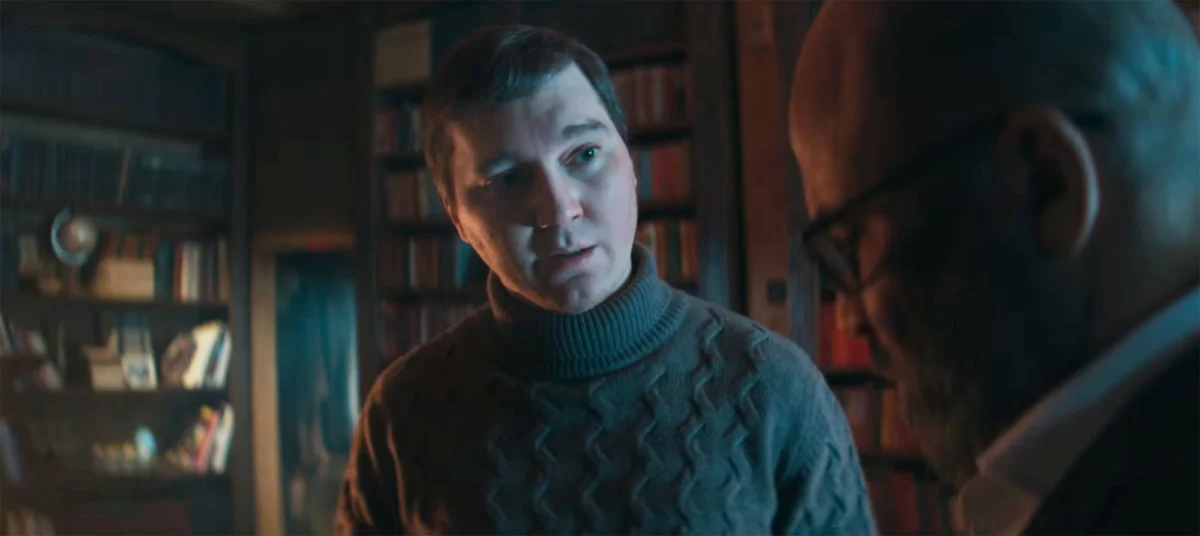
The film centers on the character of Vadim Baranov, portrayed by Paul Dano, a figure inspired by the real-life "grey cardinal" of the Kremlin, Vladislav Surkov. Baranov is introduced as a sophisticated young artist and reality television producer who finds himself thrust into the epicenter of Russian political life. In the wake of the Soviet Union’s collapse, a period characterized by economic instability and a vacuum of leadership, Baranov is recruited to serve as a strategic advisor to a rising KGB agent: Vladimir Putin.
As Putin ascends to the presidency in 2000, Baranov evolves into the regime’s premier "spin doctor," orchestrating a new form of political theater. The film meticulously depicts how Baranov utilizes his background in media and performance to blur the lines between truth and fiction, effectively turning the Russian state into a controlled spectacle. The narrative spans several decades, beginning in the early 1990s and following the trajectory of the regime into the contemporary era. Throughout this journey, the character of Ksenia, played by Alicia Vikander, serves as the emotional and moral anchor for Baranov, representing the only element of his life that remains outside the reach of state manipulation.
The Literary Genesis and Real-World Basis
The screenplay, co-written by Olivier Assayas and Emmanuel Carrère, draws heavily from Giuliano Da Empoli’s novel, which was a literary phenomenon in France, winning the Grand Prix du roman de l’Académie française. The source material is noted for its "insider" perspective, as Da Empoli himself served as a political advisor in Italy, providing him with a unique understanding of the intersection between intellectualism and raw power.
The real-world counterpart to Baranov, Vladislav Surkov, is often credited with inventing the concept of "sovereign democracy" and implementing "non-linear warfare"—a strategy of political control that involves funding opposing groups to create a state of constant confusion among the populace. By grounding the film in these historical and political realities, Assayas aims to provide more than a standard biopic; the film functions as a psychological study of how authoritarian structures are built from the ground up through the manipulation of narrative and public perception.

Production and Global Distribution Timeline
The production of The Wizard of the Kremlin represents a major international collaboration. Gaumont, one of the world’s oldest and most prestigious film studios, spearheaded the project alongside Curiosa Films. The film’s journey from production to global screens has followed a strategic rollout designed to maximize its impact during the 2025-2026 awards season.
- September 2025: World Premiere at the Venice Film Festival. The film received critical acclaim for its performances and its timely exploration of geopolitical themes.
- Late 2025: Screenings at the Toronto International Film Festival (TIFF), San Sebastian International Film Festival, and Zurich Film Festival. These screenings helped secure international distribution deals.
- January 2026: Theatrical release in France. The film performed strongly at the domestic box office, buoyed by the popularity of the original novel.
- March 2026: Release of the final official UK trailer and promotional campaign by Signature Entertainment.
- April 17, 2026: Scheduled theatrical release in the United Kingdom and Ireland.
- Late 2026 (Projected): While a firm United States release date has yet to be finalized, negotiations are reportedly ongoing for a late-year release to align with domestic awards eligibility.
Casting and Directorial Vision
Olivier Assayas, known for his diverse filmography including Irma Vep, Clouds of Sils Maria, and the political thriller Carlos, brings a specific intellectual rigor to the project. Assayas has long been fascinated by the ways in which global systems—whether they be corporate, criminal, or political—impact the individual. In The Wizard of the Kremlin, he uses the intimate relationship between Baranov and Putin to illustrate the broader erosion of democratic norms.
The casting of Jude Law as Vladimir Putin has been a focal point of industry discussion. Law’s portrayal is described as a transformation that avoids caricature, focusing instead on the cold, calculated pragmatism of the Russian leader. Paul Dano’s performance as Baranov provides a counterpoint, capturing the intellectual vanity and eventual disillusionment of a man who realizes he has helped create a monster he can no longer control. The supporting cast includes veteran actors such as Jeffrey Wright and Tom Sturridge, adding further gravitas to the high-stakes environment of the Kremlin’s inner circle.
Analytical Implications: Power and Propaganda
From a socio-political perspective, The Wizard of the Kremlin arrives at a time of heightened global scrutiny regarding Russian influence and the nature of modern propaganda. The film explores the "theatricalization of politics," a theme that resonates beyond the borders of Russia. By highlighting how Baranov uses postmodernist techniques to maintain the regime’s grip on power, the film offers a critique of how information is weaponized in the digital age.
Industry analysts suggest that the film’s focus on the "architects" of power, rather than just the figurehead, provides a necessary layer of complexity. It shifts the focus from a singular "villain" to the entire infrastructure of advisors, media moguls, and technocrats who facilitate the rise of authoritarianism. This thematic depth is expected to make the film a significant contender in upcoming international film awards, particularly in categories related to adapted screenplay and acting.

Official Responses and Industry Reception
While official statements from the Kremlin regarding the film have been non-existent—consistent with their policy of ignoring Western media portrayals that do not align with state interests—the film community has responded with significant interest. During the Venice Film Festival, critics noted that Assayas’ direction successfully balances the "coldness" of political maneuvering with the "heat" of personal ambition.
Signature Entertainment, the UK distributor, released a statement emphasizing the film’s relevance: "The Wizard of the Kremlin is a chillingly timely masterpiece that peels back the curtain on the most secretive corridors of power in the world today. With powerhouse performances from Paul Dano and Jude Law, it is an essential cinematic experience for anyone seeking to understand the mechanics of modern history."
Similarly, Gaumont representatives have highlighted the film’s role as a bridge between European arthouse sensibilities and mainstream political drama. The film’s ability to secure slots at diverse festivals from Busan to Zurich indicates a broad geographic interest in the subject matter, reflecting a global desire to decode the "riddle" of the Russian state.
Technical Execution and Aesthetic
Technically, the film is reported to utilize a stark, often oppressive visual palette to reflect the atmosphere of the Kremlin. Cinematography plays a crucial role in distinguishing between the vibrant, chaotic energy of the 1990s and the increasingly rigid, sterilized environment of Putin’s Russia. The use of actual historical footage interspersed with the narrative further blurs the line between the film’s fictionalized account and the reality of the events described.
The score, composed to evoke a sense of creeping dread and intellectual isolation, complements Dano’s performance as a man increasingly alienated from the world he helped shape. The production design meticulously recreates the opulence of the Kremlin, serving as a silent witness to the various betrayals and strategic shifts that occur within its walls.

Conclusion and Future Outlook
As The Wizard of the Kremlin prepares for its UK debut on April 17, 2026, it stands as a major cultural document of the mid-2020s. It represents a rare instance where a contemporary political figure is subjected to such a rigorous and high-budget dramatization while still in power. The film’s success in France and its anticipated reception in the UK suggest a strong appetite for narratives that attempt to explain the complexities of the current geopolitical landscape.
The lack of a confirmed US release date remains the only significant hurdle for the film’s global footprint. However, given the pedigree of the cast and the critical momentum built during the 2025 festival season, industry experts anticipate a major domestic distribution deal will be announced following the UK launch. As the film moves into wider distribution, it is likely to spark further debate regarding the role of cinema in documenting and deconstructing the mechanisms of state power and the individuals who wield it from the shadows.