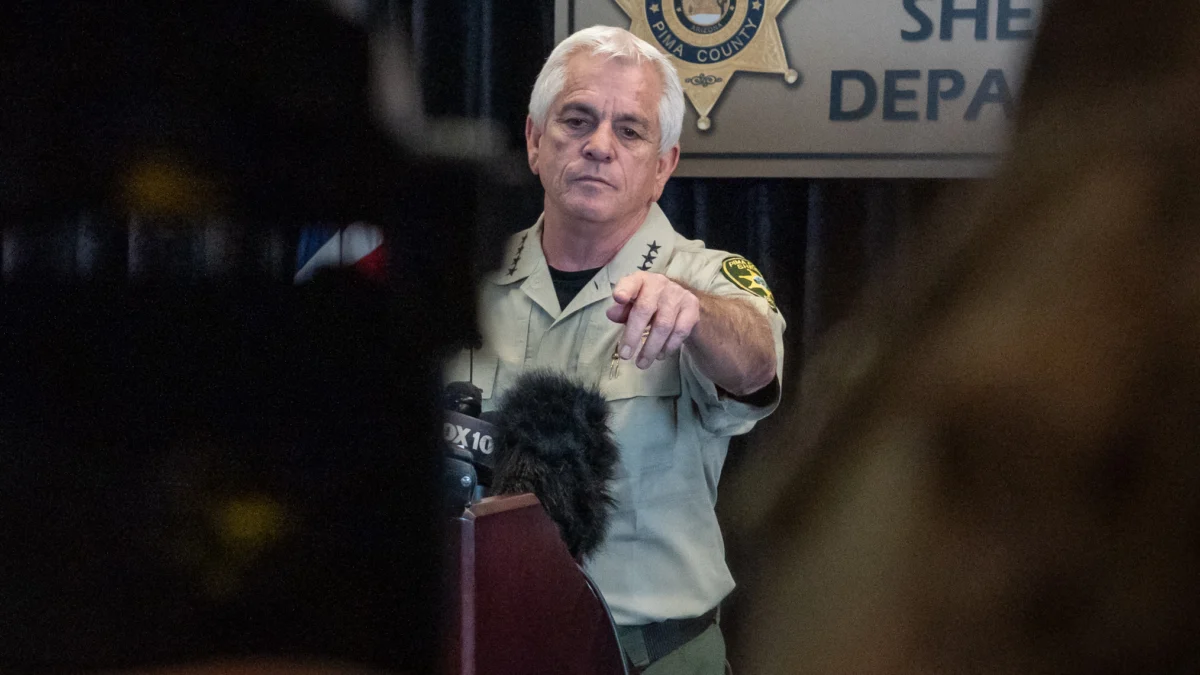
Pima County Sheriff Chris Nanos is currently navigating a period of unprecedented professional and public pressure as new details emerge regarding a 2024 airport security incident involving a loaded firearm, occurring simultaneously with a high-stakes investigation into the disappearance of Nancy Guthrie. The veteran law enforcement officer, who oversees one of Arizona’s largest sheriff’s departments, finds himself at the center of a growing debate regarding legal accountability, departmental transparency, and the efficacy of local investigative procedures in high-profile criminal cases.
The Tucson International Airport Incident: A Detailed Account
On November 6, 2024, an incident occurred at Tucson International Airport that has recently resurfaced to fuel criticisms of a perceived double standard for high-ranking officials. According to official incident reports first brought to light by Fox News Digital, Sheriff Nanos arrived at the airport’s B Concourse to board a scheduled flight. During the routine screening of his carry-on luggage, a Transportation Security Administration (TSA) X-ray technician identified what appeared to be a handgun.
Upon manual inspection by airport police, the weapon was confirmed to be a loaded firearm. Specifically, the report indicates that the magazine contained five rounds of ammunition, with a sixth round already positioned in the chamber. Under federal law and TSA regulations, firearms are strictly prohibited in the cabin of a commercial aircraft. While passengers are permitted to transport unloaded firearms in checked baggage—provided they are declared at the ticket counter and stored in a locked, hard-sided container—bringing a loaded weapon to a security checkpoint typically results in significant civil penalties and, in many jurisdictions, immediate criminal charges.
In this instance, Sheriff Nanos did not face arrest. The report states that after the discovery, Nanos was permitted to return to his vehicle to secure the weapon. Although he missed his original flight, he was able to book a later departure and continue his travel. The lack of immediate legal repercussions has sparked a backlash among local advocacy groups and residents who argue that a private citizen without a badge would have faced far more severe consequences, including hefty fines and potential incarceration.
Public Outcry and the Question of Accountability
The fallout from the TSA incident has been amplified by local civic leaders. Cory Stephens, President of the Conservative Coalition of America and a resident of Tucson, has been a vocal critic of the handling of the situation. During a public meeting held less than a week after the incident, and in subsequent statements, Stephens highlighted the disparity between the treatment of law enforcement officials and the general public.
“If a private citizen had encountered that at the airport, the consequences would have been greater,” Stephens told reporters. He emphasized that the safety of the community relies on the consistent application of the law, regardless of an individual’s title or office. The TSA’s standard operating procedure for discovering a firearm at a checkpoint usually involves a civil penalty that can range from $3,000 to nearly $15,000, depending on whether the firearm was loaded and if the passenger had prior violations. Furthermore, many airports work closely with local prosecutors to pursue "interference with airport screening" charges. The perception that Nanos was granted a "pass" has become a focal point for those questioning his leadership.
The Disappearance of Nancy Guthrie: A Community in Crisis
While the TSA incident raises questions about personal conduct, Sheriff Nanos is also facing intense pressure regarding his department’s handling of the Nancy Guthrie case. Nancy Guthrie, the mother of Today show co-anchor Savannah Guthrie, was reported missing from her Tucson-area home on February 1, 2026. The case, which authorities have categorized as a presumed abduction, has drawn national media attention and placed the Pima County Sheriff’s Department (PCSD) under a relentless spotlight.
The investigation is now entering its third month without a suspect in custody or a definitive location for the victim. In the early stages of the search, the PCSD deployed significant resources, including K-9 units, aerial surveillance, and door-to-door canvassing. Despite these efforts, the trail has seemingly gone cold, leading to public frustration and whispers of investigative mismanagement.
Sheriff Nanos has remained a visible figure throughout the process, frequently addressing the media to provide updates. In a notable interview with NBC News, Nanos suggested that the abduction appeared to be a "targeted" event rather than a random act of violence. However, he stopped short of offering 100% certainty, advising the community to remain vigilant. “It’d be silly to tell people, ‘Yeah, don’t worry about it. You’re not his target.’ Don’t think for a minute that because it happened to the Guthrie family, you’re safe,” Nanos stated, underscoring the lingering danger to the public.
Chronology of the Guthrie Investigation
The timeline of the Guthrie case illustrates the mounting tension within the Pima County community:
- February 1, 2026: Nancy Guthrie is reported missing from her residence. Evidence at the scene suggests a forced entry or a struggle, leading investigators to classify the disappearance as an abduction.
- February 5, 2026: The PCSD announces they are looking for a specific vehicle seen in the area, but the lead fails to produce a suspect.
- February 15, 2026: National media outlets, led by NBC, begin intensive coverage, putting pressure on local law enforcement to produce results.
- March 2026: Sheriff Nanos clarifies the "targeted" nature of the crime but acknowledges the lack of a definitive motive or suspect identity.
- April 2026: As the investigation hits the 60-day mark, local critics begin questioning whether early procedural errors—such as the timing of the initial perimeter lock-down—hampered the search.
Nanos Defends the Pima County Sheriff’s Department
In response to growing criticism regarding the Guthrie case, Sheriff Nanos has adopted a defensive posture. In a recent interview with KVOA, he sought to shield his investigators from public disparagement. Nanos adamantly denied that his team made any significant errors in the critical first hours of the investigation.
“You cannot attack my department. Attack the sheriff, but you will not get by with attacking my department,” Nanos told KVOA. He argued that discrediting the ongoing work of the PCSD is "very harmful" and does nothing to aid in the recovery of Nancy Guthrie. According to Nanos, his staff has worked tirelessly, logging thousands of hours on the case, and he maintains full confidence in their professional integrity.
However, for many in Tucson, the defense of the department is inextricably linked to the Sheriff’s own credibility. The juxtaposition of the TSA incident and the stalled abduction case has created a narrative of a department head who is perhaps more concerned with optics and personal privilege than with the rigorous application of justice.
Comparative Data: TSA Firearm Discoveries
To understand the gravity of the TSA incident, it is helpful to look at the broader context of airport security in the United States. According to TSA data:
- Record Numbers: In 2023, the TSA intercepted a record 6,737 firearms at airport security checkpoints nationwide. Approximately 93% of these firearms were loaded.
- Standard Penalties: For a first-time offender, the TSA typically imposes a civil penalty starting at $3,000 for an unloaded firearm and significantly higher for a loaded one. Repeat offenders can face fines exceeding $14,940.
- Legal Consistency: In most major U.S. airports, the discovery of a loaded firearm results in the temporary seizure of the weapon and the passenger being escorted to a police station for questioning.
The fact that Nanos was allowed to simply "stow the firearm in his vehicle" stands in stark contrast to the experiences of hundreds of travelers who are detained annually for similar oversights. This data supports the arguments made by individuals like Cory Stephens regarding the appearance of preferential treatment.
Broader Implications for Pima County
The dual controversies surrounding Sheriff Chris Nanos have significant implications for the political and social landscape of Pima County. As an elected official, the Sheriff relies on public trust to effectively manage a department of hundreds of sworn officers and civilian staff. When that trust is eroded—either through perceived personal indiscretions or through the failure to resolve a high-profile kidnapping—the entire infrastructure of local law enforcement can suffer.
Furthermore, the Guthrie case has highlighted the challenges faced by law enforcement in an era of instant digital scrutiny. The involvement of a high-profile family like the Guthries ensures that every move the PCSD makes is analyzed by both local residents and national experts. Any perceived "mistake," whether real or imagined, is magnified.
As the search for Nancy Guthrie continues into its third month, the pressure on Nanos is unlikely to abate. The community remains on edge, caught between the fear of a targeted abductor and the frustration of a legal system that many feel is failing to hold its leaders to the same standards as its citizens. For Sheriff Nanos, the coming weeks will be a test of both his investigative acumen and his ability to restore faith in his leadership amidst a storm of personal and professional challenges.