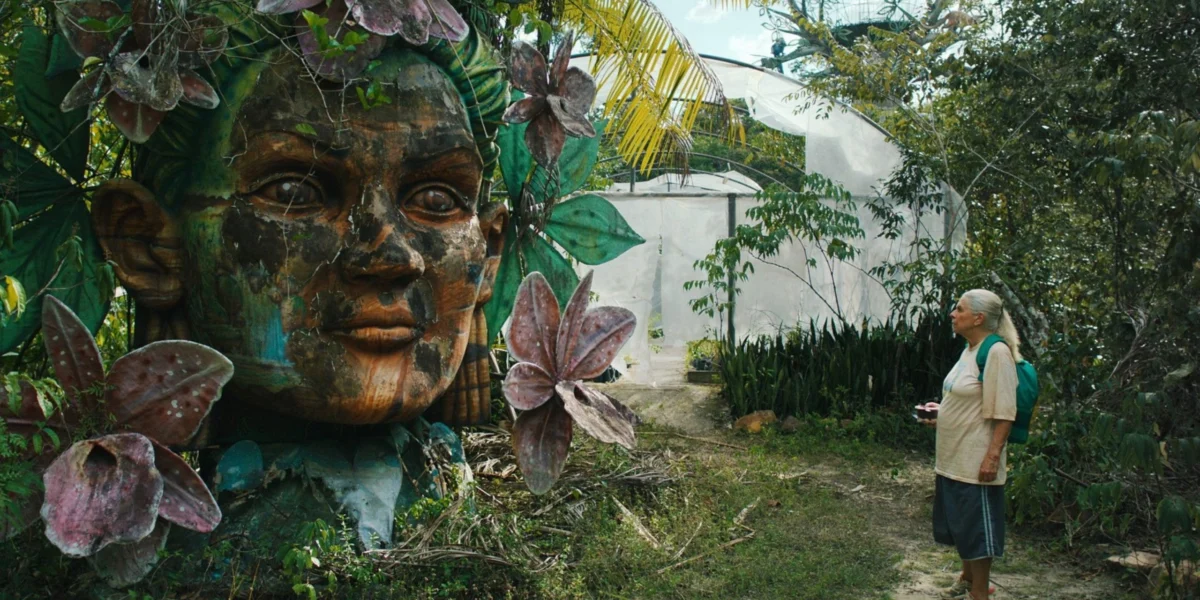
The Blue Trail, a dystopian drama directed and co-written by acclaimed Brazilian filmmaker Gabriel Mascaro, has transitioned from a celebrated international festival run to its North American theatrical debut. Following a prestigious world premiere in the main competition of the 75th Berlin International Film Festival, where it secured the Silver Bear Grand Jury Prize, the film is now screening in major metropolitan markets, including the Angelika Theatre in New York and the Landmark Nuart Theater in Los Angeles. Distributed by Dekanalog, the production features a central performance by Denise Weinberg alongside Rodrigo Santoro, offering a speculative yet grounded exploration of aging, state control, and environmental sovereignty within a near-future Brazilian landscape.
Narrative Overview and Production Context
The film centers on 77-year-old Tereza, portrayed by Denise Weinberg, who finds herself at the mercy of a bureaucratic regime that mandates retirement and imposes state-sanctioned guardianship. In this dystopian vision, the government has instituted a relocation program for its burgeoning elderly population, ostensibly to manage demographic shifts and resource allocation. When Tereza is placed under the legal guardianship of her daughter, played by a cast that emphasizes the generational friction of the era, the narrative shifts from a domestic drama into a journey of resistance.
Defying the relocation mandate, Tereza and her daughter embark on an odyssey into the Amazon rainforest. This setting serves as both a literal and metaphorical refuge, contrasting the sterile, controlled environment of the urban centers with the untamed and politically contested wilderness of the north. Gabriel Mascaro, who co-wrote the screenplay, utilizes this journey to examine the intersection of personal autonomy and collective social engineering.
The production marks a continued evolution for Mascaro, whose previous works, such as Neon Bull (2015) and Divine Love (2019), established him as a significant voice in contemporary world cinema. While his earlier films often focused on the intersection of bodies, labor, and spirituality, The Blue Trail shifts the lens toward the temporal reality of aging and the political implications of a society that views its elderly citizens as a logistical burden.
Chronology of Development and Critical Recognition
The trajectory of The Blue Trail reflects the growing international interest in Brazilian cinema that addresses complex socio-political themes through the lens of genre filmmaking. The project moved through several years of development and principal photography, much of which took place on location to capture the atmospheric density of the Amazon.
In early February of the festival year, the Berlin International Film Festival announced that Mascaro’s latest work had been selected for its Main Competition, a slot reserved for films of high artistic caliber and global relevance. The world premiere took place at the Berlinale Palast, drawing significant attention from international critics who noted the film’s visual language and Weinberg’s rigorous performance.
The jury for the 75th Berlinale, tasked with evaluating a diverse slate of global entries, awarded The Blue Trail the Silver Bear Grand Jury Prize. This award is historically regarded as the second-most prestigious honor at the festival, following the Golden Bear. The recognition underscored the film’s success in balancing its speculative narrative with a poignant critique of modern social structures. Following the festival win, Dekanalog acquired the North American distribution rights, leading to the current theatrical rollout in New York and Los Angeles.
Supporting Data: The Demographic Realities Behind the Fiction
While The Blue Trail is categorized as a dystopian drama, the thematic foundations of the film are rooted in observable demographic trends and economic pressures. The concept of a "growing elderly population" that the film’s government seeks to relocate is a reflection of the "Silver Tsunami"—a global phenomenon characterized by increasing life expectancy and declining birth rates.
According to data from the Brazilian Institute of Geography and Statistics (IBGE), Brazil is experiencing one of the world’s fastest aging processes. Projections suggest that by 2060, approximately 25% of the Brazilian population will be over the age of 65, a significant increase from the 9.2% recorded in 2018. This demographic shift poses substantial challenges to pension systems, healthcare infrastructure, and labor markets—issues that Mascaro’s film extrapolates into a state-mandated relocation policy.

Furthermore, the film’s focus on the Amazon aligns with ongoing international discourse regarding the region’s role as a geopolitical and environmental frontier. Data from satellite monitoring services indicates that the Amazon remains a focal point for debates over land use, indigenous rights, and conservation. By placing the film’s climax in this region, Mascaro links the struggle for individual autonomy (Tereza’s journey) with the struggle for environmental and territorial integrity.
Official Responses and Creative Intent
In various forums following the film’s premiere, Gabriel Mascaro has discussed the motivations behind the project. He has articulated a desire to move beyond traditional depictions of the Amazon as a static "green wall," instead presenting it as a space of complex human interaction and political refuge. Mascaro has emphasized that the film is less about a distant future and more about the "acceleration of current tendencies," specifically regarding how late-stage capitalism treats individuals who are no longer considered economically productive.
Rodrigo Santoro, who brings international star power to the production, has been noted for his support of the film’s nuanced approach to family dynamics under duress. Critical response has largely centered on the film’s ability to maintain a sense of intimacy despite its broad political scope. Reviewers from outlets such as Variety and The Hollywood Reporter highlighted the "unflinching" nature of Weinberg’s performance, suggesting that her portrayal of Tereza provides a necessary emotional anchor for the film’s more abstract dystopian elements.
The jury at the Berlin International Film Festival, in their citation for the Silver Bear, reportedly praised the film for its "visionary courage" and its ability to "reclaim the Amazon as a site of cinematic and political resistance." Such statements reflect a broader consensus that the film succeeds in using the tools of speculative fiction to address urgent contemporary anxieties.
Broader Impact and Industry Implications
The release of The Blue Trail carries significant implications for the Brazilian film industry and the broader landscape of international art-house cinema. For Brazil, the film’s success at a "Big Three" festival (Berlin, Cannes, Venice) serves as a testament to the resilience of its cultural sector, which has faced various funding and political challenges over the last decade.
The film also contributes to a growing trend of Latin American "social dystopia" cinema. Works like Michel Franco’s New Order (Mexico) or Kleber Mendonça Filho’s Bacurau (Brazil) have similarly utilized genre tropes—such as the thriller or the western—to critique class disparity, state violence, and neo-colonialism. The Blue Trail adds a new dimension to this trend by focusing specifically on ageism and the bureaucratic management of the human life cycle.
For the distributor, Dekanalog, the theatrical release in New York and Los Angeles represents a strategic attempt to reach North American audiences who are increasingly receptive to subtitled, high-concept dramas. The decision to debut the film at the Angelika Theatre and the Landmark Nuart reflects a targeted approach toward "prestige" audiences who frequent venues known for supporting award-winning international titles.
Future Outlook and Theatrical Availability
As The Blue Trail continues its run in select theaters, its performance will likely influence the trajectory of Mascaro’s future projects and the continued appetite for Brazilian cinema in the United States. The film is expected to expand to additional markets following its initial engagements in New York and Los Angeles, with a subsequent move to digital and physical media platforms later in the year.
The film’s exploration of the Amazon, coupled with its focus on the rights of the elderly, ensures its relevance in ongoing public debates. By merging a personal family narrative with a large-scale political allegory, The Blue Trail provides a framework for discussing how modern states balance economic efficiency with human dignity.
For audiences and scholars alike, the film stands as a significant case study in how contemporary directors are utilizing the Amazon not just as a background, but as a primary protagonist in the struggle for the future. As the global population continues to age and environmental pressures mount, the themes presented in The Blue Trail are likely to resonate far beyond the confines of the cinema, prompting deeper reflection on the "trails" society chooses to follow in the face of systemic change.