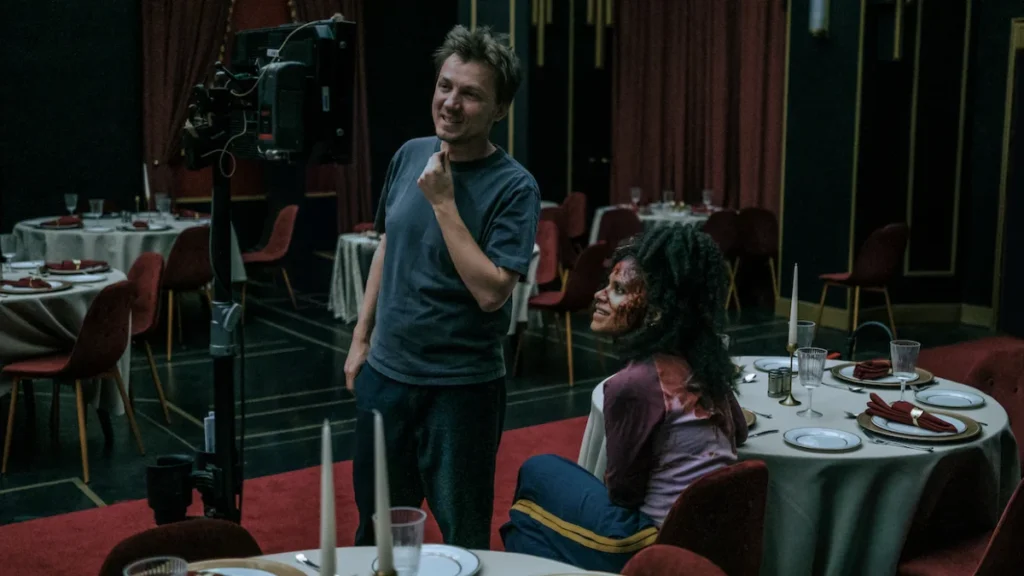
In a landmark shift for both the film and video game industries, acclaimed Japanese producer and director Genki Kawamura has successfully helmed a critically lauded and commercially successful big-screen adaptation of the indie video game Exit 8. Known for his work on global cinematic hits like Hirokazu Kore-eda’s Cannes Palme d’Or winner Broker, and Makoto Shinkai’s anime phenomenon Your Name, as well as his own contemplative directorial debut A Hundred Flowers, Kawamura’s foray into adapting a liminal horror walking simulator marks a significant evolution in how interactive media translates to the silver screen. Distributed by major Japanese studio Toho and handled by NEON in North America, the Exit 8 film is not merely a box office success but a testament to a new artistic approach, blurring the lines between gaming and cinema.
The Genesis of an Adaptation: Kawamura’s Distinctive Vision
Genki Kawamura’s journey to Exit 8 was paved by an unexpected artistic throughline. His 2022 directorial debut, A Hundred Flowers, a poignant drama exploring dementia, featured a sequence lauded for its unique portrayal of a distorted reality through a character’s perspective. This artistic exploration sparked a desire within Kawamura to delve deeper into altered perceptions, leading him to seek an "elevated horror" project. "There was one sequence in that film that was well-received in how it showed how the world looks from that perspective," Kawamura reflected. "I was hoping to expand on that, so I searched for some kind of elevated horror project to do so with. That’s when I encountered Exit 8. It was the perfect marriage of a game looking for a movie, and an opportunity for me to apply what I’ve learned."
Kawamura’s impressive resume as a producer includes some of the most influential Japanese films of the past decade. Your Name (2016) broke box office records for anime films, while Monster (2023) garnered critical acclaim internationally. These productions showcase Kawamura’s discerning eye for compelling narratives and commercially viable projects, yet his pivot to an indie horror game adaptation was a calculated risk that has evidently paid off. His background, rooted in both commercial success and critical artistry, positions him uniquely to bridge the perceived divide between high-concept cinema and the burgeoning world of independent gaming.
Understanding Exit 8: The Indie Game Phenomenon
The source material, Exit 8, is a 2023 indie video game crafted by developer Kotake Create. It belongs to the "walking simulator" and "liminal horror" subgenres, which have seen a surge in popularity, particularly through online streaming platforms like YouTube and Twitch. The game’s premise is deceptively simple: players navigate a recursive passageway within a Japanese underground station, meticulously searching for subtle anomalies in the environment. The core mechanic involves a binary choice: if an anomaly is detected, the player must turn back; if not, they proceed forward. Each successful loop brings them closer to the elusive "Exit 8," symbolizing escape from the endless puzzle.
The appeal of Exit 8 lies in its psychological tension, minimalist design, and reliance on player observation and memory. Liminal spaces, often characterized by their transitional, unsettling emptiness – like an abandoned subway corridor or an empty mall – are a staple of this horror subgenre, evoking feelings of disorientation and dread. Kawamura was introduced to the game by Yuto Sakata, a young producer at his company, Story. He recounted his own experience: "I played it myself. I thought it had a beautiful design—very simple rules. I also watched many YouTube videos and livestreams of other people playing through the game. What I found fascinating was that they were all playing the same game, but they’d all have different reactions and consequent actions that they’d take." This observation highlights the inherent narrative richness and emergent storytelling potential within indie games, where player agency and interpretation contribute significantly to the experience. The global video game market, valued at over $200 billion annually, represents a vast reservoir of creative IP, and titles like Exit 8 demonstrate that even small, niche games can possess profound narrative depth suitable for adaptation.
A New Cinematic Language: Adapting the Unadaptable
Kawamura’s approach to adapting Exit 8 eschews conventional direct translation, instead seeking to capture the essence of the gaming experience. The film commences in a first-person perspective, immersing the audience directly into the protagonist’s journey through a metro intro that fleshes out the character beyond a mere player avatar. However, as the familiar looping corridor of the subway station begins, the film makes a crucial shift to a third-person perspective. The protagonist is revealed to be Kazunari Ninomiya, a celebrated actor and member of the iconic Japanese idol group Arashi, effectively transforming the cinematic experience into a meta-commentary on watching someone else play the game.
This innovative directorial choice was inspired by a conversation Kawamura had with legendary Nintendo game designer Shigeru Miyamoto a decade prior. "One thing he said stuck with me—that a really great video game is not only fun for the players, but also for the people watching the players," Kawamura explained. "At times in this film, we place the audience in the shoes of the player, and at other times it’s almost as though they’re watching a Twitch livestream. It was intended as a metaphor for how the game industry itself is evolving." This "blurring of lines" between player and spectator, between film and game, offers a fresh perspective on adaptation, moving beyond literal interpretation to explore the phenomenon of gaming itself.
Furthermore, Kawamura’s team undertook a significant technical challenge to authentically recreate the game’s distinctive visual aesthetic. The original Exit 8 game features a glossy, highly reflective environment, reminiscent of graphics rendered in modern game engines like Unreal Engine. Rather than relying on extensive computer-generated imagery (CGI) in post-production, Kawamura opted for practical effects and meticulous production design. "The reflective tiles, the way the fluorescent lights bounce off the environment—none of this was achieved in post-production," he stated. "We took it on as a challenge, to recreate that Unreal Engine-like render and put it into the camera using practical effects and production design." This commitment to tangible realism in recreating a digital aesthetic underscores the film’s artistic integrity and its ambition to deliver a novel audiovisual experience that is simultaneously grounded and otherworldly.
A Broader Trend: Japanese Filmmakers Embrace Indie Gaming
The success of Exit 8 is not an isolated incident but rather indicative of a burgeoning trend within Japanese cinema. Independent horror filmmaker Jirō Nagae, known for his work on films like Kisaragi Station, also ventured into adapting an indie game with his theatrical release of The Convenience Store this year. Nagae discovered the original game through an online article in 2005 and immediately recognized its cinematic potential. "I found the concept extremely intriguing. I played the game myself and watched Let’s Play videos," Nagae recounted. "What struck me at the time was how closely the direction aligned with my own sensibilities. My approach to horror blends the damp, atmospheric stillness typical of Japanese horror with the dynamic jump-scare elements of Hollywood, and I felt that this game embodied that same fusion. I strongly believed that if this game were to be adapted into live action, I was the right person to direct it."

Like Exit 8, Nagae’s The Convenience Store benefited from collaboration with a major studio, in this case, NBCUniversal Entertainment Japan. This parallel development signals a significant shift in the Japanese film industry, where traditional studios are increasingly looking beyond established manga, anime, or novel IPs for new storytelling avenues. Nagae acknowledged the difference in scale between the two productions: "I was surprised when Toho announced their adaptation of Exit 8. And to be honest, The Convenience Store was not produced with the kind of large budget that Exit 8 had. It’s more of a small- to mid-scale production, even by Japanese standards." However, he stressed the overarching implication: "However, the fact that both films have performed well, both commercially and critically, demonstrates the enormous appeal and potential of indie games as source material—whether for low-budget productions or big-budget studio films."
Nagae candidly attributed this industry shift to a "shortage of fresh ideas" within established filmmaking circles. "The film industry, including major studios, has started to look toward indie games—an as-yet largely untapped resource—for that reason," he elaborated. "I believe this is especially true in Japan, where it can be difficult to get original films made." This perspective highlights the vital role indie games can play in revitalizing cinematic narratives, offering original concepts that resonate with contemporary audiences, often with pre-existing, engaged fanbases cultivated through streaming culture.
The Global Precedent: Markiplier’s Iron Lung and the "Pipeline" Theory
The phenomenon of indie game adaptations gaining mainstream traction is not confined to Japan. Earlier this year, popular YouTuber Mark Fischbach, known globally as "Markiplier," self-released his film Iron Lung into international cinemas, achieving near-unprecedented box-office success. Based on a minimalist indie horror game by solo developer David Szymanski, Iron Lung grossed over $50 million worldwide against a production budget of roughly $3 million. Markiplier had previously brought the original game to prominence through his livestreams, effectively establishing a curious co-authorship and a built-in audience even before the film’s production.
Markiplier’s influential streams also played a significant role in popularizing Exit 8 and The Convenience Store among a global audience, demonstrating the power of online content creators in identifying and amplifying niche cultural phenomena. Speaking with Little White Lies in February, Fischbach reflected on the proliferation of films similar to his own, articulating what he termed a "pipeline" theory. "It’s so cool, because I think it’s a pipeline," he said. "[The Convenience Store] is low-res. There’s no voice acting, it’s mostly sounds and text. Maybe filmmakers could reduce their idea down to a different medium—even just an audio podcast—and then use that to cultivate an audience and get it on screen. I think [Iron Lung] shows that it works." This "pipeline" concept suggests a democratized pathway for creative ideas, where initial incubation in accessible digital formats (like indie games or podcasts) can build a community and prove viability for larger-scale cinematic ventures.
The success of Iron Lung, a DIY project, alongside the major studio-backed Exit 8 and The Convenience Store, illustrates the broad spectrum of possibilities for indie game adaptations. Whether through direct fan-driven initiatives or traditional studio collaborations, the landscape for cross-media storytelling is rapidly expanding.
The Shifting Landscape of Entertainment and Future Implications
The success of films like Exit 8, The Convenience Store, and Iron Lung signals a profound shift in the entertainment industry, challenging traditional notions of intellectual property, audience engagement, and narrative development. The global video game market continues to grow, and its cultural footprint is undeniable. The "gamification" of cinema, not in the sense of adding interactive elements, but in adopting the unique narrative structures and participatory viewing experiences of gaming, represents a fertile ground for innovation.
Kawamura views indie video games as a "rich and potent" resource. "I think indie video games offer a medium for individuals to cast their creativity with a strong sharp edge in terms of what it is they want to express," he reflected. "In terms of Exit 8, it was this young individual from Kyoto. I could really see his personal creativity projected onto the game—from its visual concept to his inner thoughts. Playing it, it felt like viewing a piece of fine art." This perspective elevates indie games beyond mere entertainment, recognizing them as powerful forms of artistic expression that can inspire and inform other media.
The implications for the future of film are significant:
- New IP Sourcing: Indie games provide an untapped reservoir of original stories and concepts, offering a refreshing alternative to established franchises or remakes.
- Audience Engagement: The pre-existing, highly engaged fanbases of popular indie games, often cultivated through streaming, provide a built-in audience for adaptations, mitigating marketing risks.
- Creative Freedom: Filmmakers are finding new ways to interpret and expand upon game mechanics and themes, leading to innovative cinematic approaches that transcend simple plot retellings.
- Economic Viability: Indie game IPs can often be acquired at lower costs compared to major studio franchises, offering a high return on investment, as demonstrated by Iron Lung.
- Blurring Media Boundaries: The trend accelerates the convergence of different entertainment mediums, creating hybrid experiences that cater to a generation comfortable moving seamlessly between games, films, and digital content.
Kawamura’s final thoughts on Exit 8 encapsulate this transformative moment. "I think [Exit 8] worked because I didn’t consider it a video game adapted into a film," he said. "Rather, I tried to capture the phenomenon of video games, and what it says about us as a species. Blurring all those different lines, I created an experience that was simultaneously entertainment and arthouse. I didn’t want the film to be boxed-in and limited by those constraints. I’m still wondering what exactly we’ve created." This sentiment underscores the pioneering spirit driving these adaptations, pushing the boundaries of what film can be and what stories it can tell, inspired by the innovative spirit of indie game creators. The success of Exit 8 and its contemporaries has irrevocably altered the landscape, signaling a vibrant future where the interactive artistry of video games increasingly informs and enriches the cinematic experience.