The 1980s stand as a distinct era for fantasy cinema, a period marked by ambitious storytelling and a visual flair that often bordered on the wonderfully strange. While the genre’s trajectory shifted in the 1990s, the foundation laid by these earlier films, particularly their unpolished yet potent charm, continues to resonate. This retrospective series delves into canonical fantasy films released between 1980 and 1989, examining their enduring legacies. Following installments on Dragonslayer (1981) and The Flight of Dragons (1982), this piece focuses on another celebrated Rankin/Bass production, The Last Unicorn (1982), exploring its profound impact and lasting appeal.
A Childhood Touchstone and Adult Revelation
For many who experienced it during their formative years, The Last Unicorn was discovered through the ubiquitous medium of VHS rentals. The animated film, based on Peter S. Beagle’s 1968 novel, became deeply ingrained in the cultural consciousness of a generation. The author himself adapted the screenplay, a rare and beneficial occurrence that preserved the narrative’s core integrity. This adaptation, remarkably, maintained the novel’s postmodern sensibilities without succumbing to self-parody. It embraced the inherent magic of its mythos, a testament to Beagle’s sensitive handling of his own beloved creation. The film’s initial theatrical release was modest, yielding a disappointing profit, but its true destiny lay in the home video market, where it cultivated a devoted following that solidified its status as a cult classic.
The Quest for Lost Kin: Narrative and Themes
The plot of The Last Unicorn centers on a solitary unicorn, the last of her kind, who embarks on a quest to discover the fate of her missing brethren. Her journey brings her into the company of Schmendrick the Magician, a well-meaning but often bumbling sorcerer, and Molly Grue, a pragmatic and world-weary woman who embodies the bittersweet wisdom of age. Their path leads them to the desolate realm of King Haggard, a monarch obsessed with the unicorns. Haggard, it is revealed, has driven all the other unicorns into the sea, where they are held captive by the fearsome Red Bull, a creature that embodies primal, destructive force.
To protect the unicorn from the Red Bull, Schmendrick transforms her into a human woman, the Lady Amalthea. This metamorphosis triggers a profound existential crisis for the unicorn, as she begins to shed her immortal identity and develop mortal emotions, including falling in love with Prince Lír, King Haggard’s adopted son. The narrative masterfully explores themes of identity, loss, and the poignant beauty of fleeting experiences. Amalthea’s struggle between her true nature and her burgeoning humanity, coupled with her growing affection for Lír, forms the emotional core of the story. The film doesn’t shy away from the melancholy that pervades the narrative; it confronts eschatological grief and the inherent impossibility of reclaiming a lost golden age. This elegiac tone, present in both Molly Grue and King Haggard, underscores the characters’ differing strategies for coping with loss and disillusionment.
A Symphony of Voices and Visuals
The film’s enduring power is significantly amplified by its exceptional voice cast. Mia Farrow lends a delicate vulnerability to the Unicorn/Amalthea, while Alan Arkin provides a charmingly flawed portrayal of Schmendrick. Christopher Lee delivers a commanding performance as the melancholic King Haggard, and Jeff Bridges imbues Prince Lír with a noble earnestness. However, it is Tammy Grimes as Molly Grue who truly shines, imbuing the character with a potent blend of jagged tragedy and pragmatic resignation. Grimes’ performance is the emotional anchor of the film, a standout even amidst such a distinguished ensemble. Asa West’s insightful essay, "Becoming Molly Grue: How I Found an Unlikely Millennial Icon in The Last Unicorn," further illuminates the depth and complexity of this pivotal character, offering a valuable companion piece to the film’s thematic exploration.
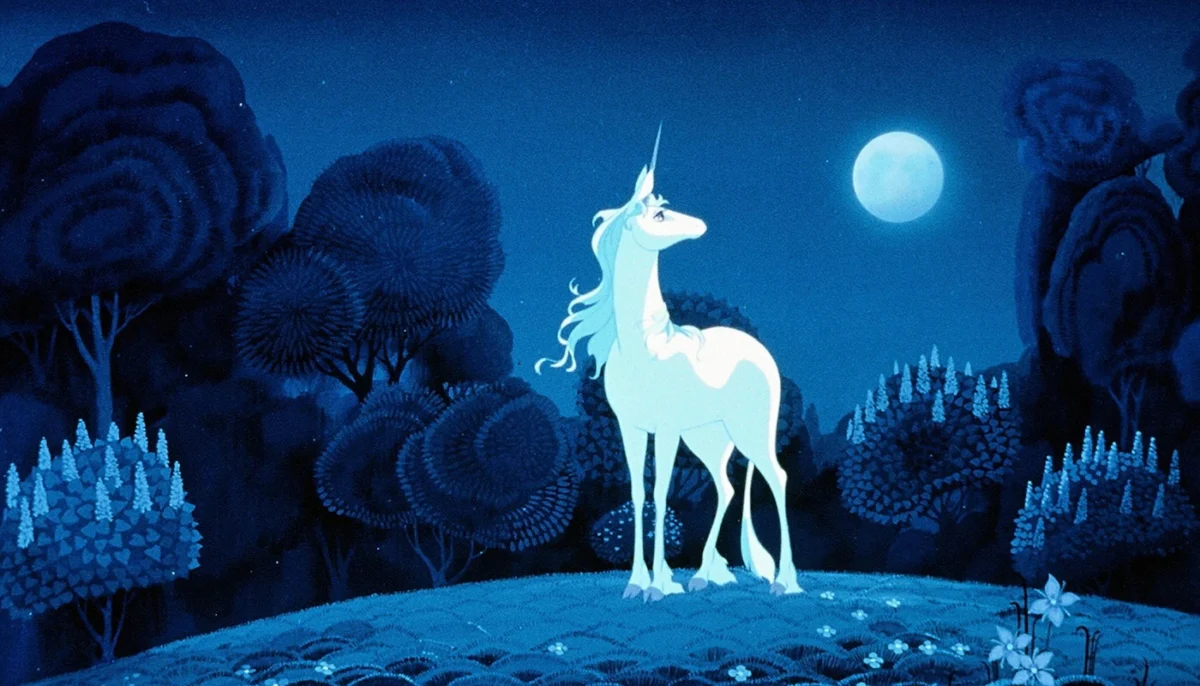
Visually, The Last Unicorn is a feast, despite occasional animation imperfections. The character designs, spearheaded by Lester Abrams, are a captivating blend of charming quirkiness and a strange, almost unsettling beauty, reminiscent of Brian Froud’s work and drawing inspiration from Norwegian folklore. The landscapes possess a stylized elegance, evoking the distinctive artistry of Mary Blair, a celebrated Disney concept artist known for her vibrant and imaginative worlds. The film opens with a breathtaking sequence, animating the Unicorn Tapestries over Jimmy Webb’s haunting and hopeful theme song, immediately establishing a high standard for visual artistry that the rest of the movie strives to meet.
The Darker Depths: Fear and Existential Dread
Beyond its thematic resonance and visual splendor, The Last Unicorn possesses a genuinely frightening quality that distinguishes it from many contemporary fantasy films. The sequence involving Mommy Fortuna’s traveling carnival, where the unicorn is displayed as a captive monster, is a masterclass in atmosphere and psychological horror. The grotesque design of Celaeno the Harpy, a creature of both monstrousness and obscenity, and Mommy Fortuna’s gleeful embrace of her own demise, having achieved her life’s purpose by trapping an immortal being, combine to evoke a profound sense of fear and existential dread. This chilling episode, though brief, leaves an indelible mark, demonstrating the film’s willingness to explore darker, more unsettling aspects of its fantasy world.
Enduring Legacy and Cultural Impact
The lasting impact of The Last Unicorn is multifaceted. It undeniably influenced a generation of fantasy enthusiasts and, like many of the best films from this era, contributed to the subsequent explosion of high fantasy content in the 2000s. Its thematic richness and sophisticated narrative paved the way for more complex and emotionally resonant fantasy storytelling.
The film’s influence can be observed in several specific areas:
- Influence on Legend (1985): It is plausible that The Last Unicorn‘s unicorn-centric narrative and its depiction of mythical creatures contributed to Ridley Scott’s 1985 film Legend. The design of Tim Curry’s iconic Dark Overlord, with its imposing horns and devilish visage, may have drawn unconscious inspiration from the Red Bull’s formidable presence.
- The Red Bull Energy Drink: While the popular energy drink’s name, Krating Daeng, translates to "Red Bull" in Thai, the film’s memorable antagonist undoubtedly contributed to the cultural resonance of the name. The image of the fiery Red Bull, even without wings, likely played a role in the brand’s global adoption of the translated moniker.
- Inspiration for Game of Thrones: George R.R. Martin’s descriptions of Dragonstone, a lonely, crumbling seaside castle adorned with monstrous stone visages, bear a striking resemblance to the visual of King Haggard’s fortress. This architectural despair and unsettling atmosphere likely found a precursor in the film’s stark and foreboding depiction of the King’s domain.
- Animation and Studio Ghibli: The animation studio Topcraft, responsible for The Hobbit (1977) and The Return of the King (1983), eventually became Studio Ghibli after a bankruptcy in 1985. The stylistic roots of this iconic animation house are clearly visible in The Last Unicorn, suggesting a cross-pollination of design sensibilities.
- Precursor to Magical Girl Anime: The unicorn’s graceful, doe-like visage and its transformation into a human form can be seen as a precursor to the beloved Magical Girl anime series that gained prominence in the following decades, such as Sailor Moon. This paved the way for young audiences to embrace characters who undergo similar transformations and embark on quests of self-discovery. The film’s impact also extended to the visual design of late-80s phenomena like My Little Pony, reflecting a broader trend in animated creature design.
A Lasting Enchantment
In assessing The Last Unicorn, it is clear that its reputation is not merely a product of childhood nostalgia. The film possesses genuine artistic merit, a compelling narrative, and thematic depth that continue to resonate with audiences of all ages. While certain aspects, like some of the musical numbers, may falter, the overwhelming strengths of Beagle’s screenplay, the stellar voice performances, and the captivating visual design far outweigh any minor shortcomings. It remains a powerful exploration of identity, loss, and the enduring, albeit often elusive, nature of magic. As this series continues, the focus will shift to another iconic 1980s fantasy film, 1986’s Labyrinth, promising another deep dive into the genre’s rich and varied past.