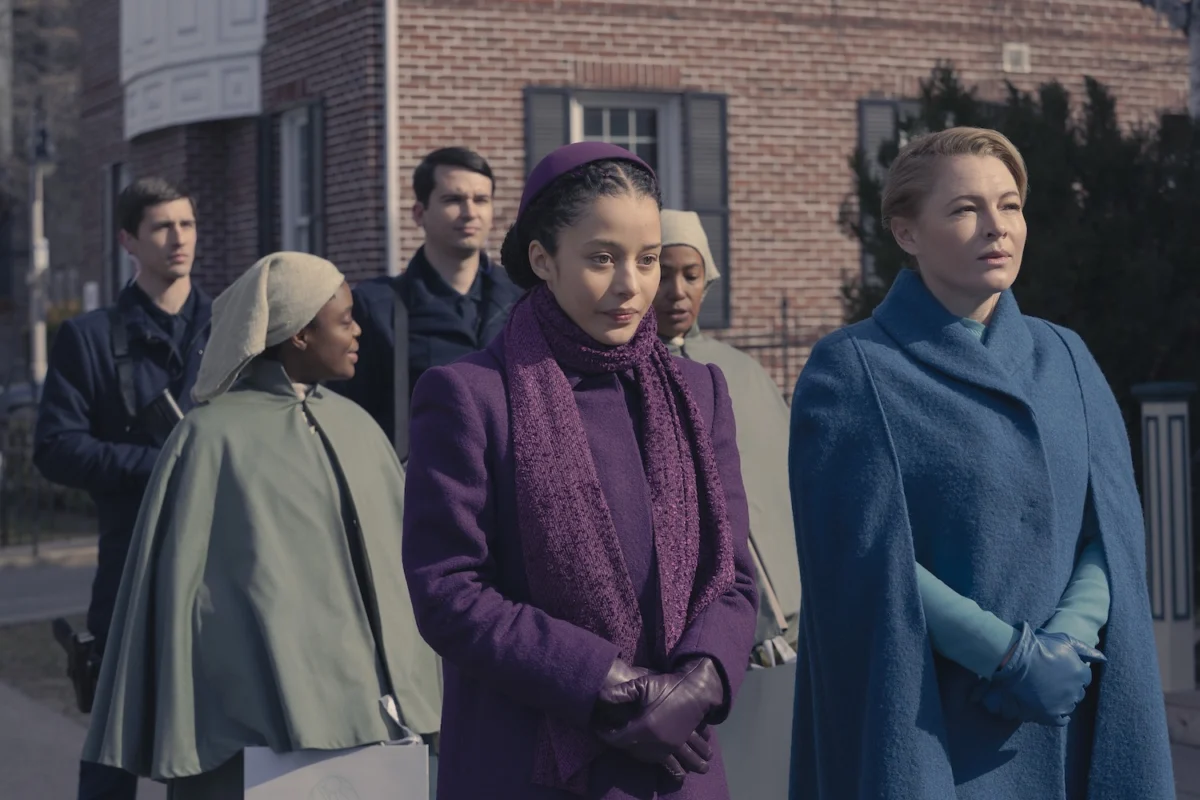
When the critically acclaimed adaptation of Margaret Atwood’s The Handmaid’s Tale first captivated audiences in 2017, it carved a distinct niche in the television landscape. Its signature style, characterized by potent needle drops and intense close-ups on Elisabeth Moss’s simmering fury, became instantly recognizable. However, as the narrative progressed through subsequent seasons, this initial impact began to dilute, a common challenge for long-running series. Now, Hulu’s ambitious spin-off, The Testaments, emerges not merely as a continuation, but as a compelling exploration that adeptly navigates the treacherous waters of Gilead from a fresh perspective. This new series distinguishes itself by leaning into the familiar tropes of teenage coming-of-age stories, even as it strives to forge its own identity separate from its formidable predecessor.
The Testaments masterfully balances the tender nuances of adolescent girlhood – the blossoming friendships and nascent attractions – with the burgeoning awareness of a world steeped in monstrosity. This isn’t the external threat of neighboring nations, but the insidious indoctrination by the Aunts, who shepherd young girls towards older Commanders in a desperate bid to perpetuate Gilead’s failing lineage. The series delves into the inner workings of this disturbing system, showcasing how these young women, each other’s entire world, are simultaneously shaped by and growing away from one another under the oppressive regime.
While the series excels in its unflinching depiction of girlhood within Gilead’s confines, particularly in scenes set within school cafeterias or during their closest approximation to celebratory events, there are moments where the narrative could benefit from a more assertive stride. The initial three episodes, while crucial for establishing the foundational dynamics of this enclosed society, exhibit a deliberate, sometimes slow, build-up. The focus is less on the broad strokes of Gileadean backstory, though the societal shifts are undeniably fascinating, and more on the intricate relationships and internal lives of these teenagers.
A Fragile Future: Gilead’s Shifting Landscape
Gilead, as depicted in The Testaments, is no longer the smugly dominant power it once presented itself to be. The loss of Boston several years prior has placed the theocracy on the defensive, its cultural cornerstone – the Handmaids – dismantled. While subjugation of the remaining women persists, the societal hierarchy and prescribed milestones appear more reactive, a desperate attempt to maintain control amidst instability.

This precarious state has, ironically, elevated the status of Aunt Lydia (Ann Dowd). Immortalized in statue form and with an academy bearing her name, Lydia represents a critical, albeit complex, figure. Despite her evident wavering convictions at the conclusion of The Handmaid’s Tale and Gilead’s subsequent loss of faith in her, both she and the regime recognize a symbiotic need for survival. The series begins four years after the events of The Handmaid’s Tale finale, a significant departure from the book’s 15-year time jump, a decision that reshapes the narrative trajectory and introduces key characters at an earlier stage of their lives.
Agnes MacKenzie (Chase Infiniti), a daughter of a Commander, finds herself in a privileged position within the strict social strata of Gilead. Her father’s rapid promotion following the assassination of core Commanders at the end of season six of The Handmaid’s Tale has placed Agnes among peers whose fathers hold less prestigious positions, such as dentists. This elevated status, however, does not shield her from the pervasive realities of Gilead.
Even within this dystopian framework, teenage girls exhibit universal behaviors. Agnes’s closest friend, Becka (Mattea Conforti), shares a bond that must be concealed behind platitudes and clandestine pinky promises, lest their connections be perceived as a threat to future marriages and motherhood. Hulda (Isolde Ardies), the endearing eccentric, harbors a dangerous fascination with science, which is currently tolerated, while Shunammite (Rowan Blanchard), the queen bee, clearly masks her own insecurities about remaining in girlhood.
The introduction of Daisy (Lucy Halliday), a member of the Pearl Girls, adds another layer of complexity. These white-clad missionaries, exuding the fervent zeal of the newly converted, strive to prove their worthiness more intensely than those raised within Gilead’s established structures. Their presence is largely tolerated by the Aunts, who utilize them as a source of free labor, and by figures like Lydia, who assigns Daisy to observe Agnes. However, their potential to evolve into proper Wives remains uncertain. Crucially, Daisy’s pious facade soon crumbles, revealing her as an operative working with the rebel network Mayday, driven by a personal vendetta.
These girls represent Gilead’s first generation to truly come of age within the regime, though not necessarily as its architects intended. With the Handmaids gone, the responsibility of perpetuating Gilead falls upon these barely pubescent girls. The theocracy’s continued existence hinges on their ability to bear children and, more disturbingly, to internalize this role as their ultimate aspiration.
The Rituals of Reproduction and Rebellion

Gilead’s fertility rituals have undergone a significant revision. The iconic Handmaids in their blood-red gowns, once a chilling symbol of the regime, have been replaced by a perverted version of adolescent self-help guides. Despite the pervasive messaging that fertility is a blessing, the underlying directive remains unchanged: women’s primary purpose is procreation.
Witnessing a household function without a Handmaid is jarring. Agnes, in her own home, recreates the movements of Offred, her mother, but within a vastly different context. Her Martha, Rosa (Kira Guloien), serves as a surrogate maternal figure, her pronouncements like "Under His Eye, cutie pie" providing dark moments of levity. While Agnes is clearly constrained, her existence as a Commander’s daughter affords her a more pampered form of imprisonment.
The series highlights the chilling indoctrination surrounding menarche. A pre-teen girl proudly ringing a school bell to announce her uterine bleeding, met with applause and the awarding of a "shiny new green pin," underscores the perverse celebration of this biological milestone. A midnight initiation ceremony, designed to feel like a clandestine rite of passage, is revealed as another cruel deception, fostering a false sense of agency over their futures.
The narrative also revisits Gilead’s past failures with child-brides. Eden Blaine (Sydney Sweeney), Nick’s Econowife, met a tragic end after her infidelity. Esther Keyes (Mckenna Grace), a senile Commander’s Wife, endured horrific abuse before enacting bloody revenge. Despite her desire to join Mayday, Esther was forced into Handmaid servitude and, tragically, found herself pregnant, unable to escape her fate. These past incidents, seemingly outliers that spiraled out of control, underscore the rationale behind Lydia’s premarital prep academy: to maintain Gilead’s future "Under Her Eye." However, the ultimate desired outcome for these young women – those who do not menstruate, those who struggle to conceive – remains unclear, leaving their futures as Econowives, Aunts, or something else entirely, in question.
Assemblies and Field Trips: Conditioning and Control
The Particicution, a brutal ritual from The Handmaid’s Tale, has been rebranded as an "Assembly" for the younger generation. In this re-imagined event, a "sinfully lustful man" is brought to the school, and the girls are tasked with passing judgment. While the Plums (the term for these young girls) are deemed too "tender" to enact the visceral violence of the Handmaids, they still participate in acts of vengeance through pointed fingers and vengeful screams.

These scenes are among the series’ most compelling, illustrating the varied methods of conditioning young girls to turn on one another. Their deepest insecurities are weaponized into demeaning insults, and they witness with gleeful dread the impact of their words. Unlike the Handmaids, who were largely coerced into such actions for survival, the deep-seated nature of this behavior in teenage girls is particularly disturbing.
The pilot episode’s "Field Trip" to witness the hanged bodies of men tempted by girls their age is grimly humorous. A subsequent Field Trip, however, is far more disturbing. Instead of visiting a museum or a workplace, the Plums are brought to the household of Penny Judd, a former classmate who has become a Wife. The experience mirrors a life-sized dollhouse, with the Plums playing house while the Aunts observe like bored chaperones, a subtle detail that adds depth to the narrative.
Daisy and June: A Complex Connection
Daisy’s initial emotional outburst at the Assembly, triggered by the Guardian’s severed hand, is a pivotal moment. As the only girl unable to stomach the brutality, her blasphemous reaction is witnessed only by Agnes, establishing a compelling push-and-pull dynamic between them. Initially, Agnes’s offer not to report Daisy appears as a test of their burgeoning bond. However, when Daisy confesses to maintain her pious persona, Agnes joins in the shaming, leading Daisy to retaliate by accusing Agnes of not reporting her. This complex exchange culminates in a moment of shared sisterhood as they endure the punishment of having their mouths scrubbed with soap.
Daisy’s role as a double agent presents a narrative puzzle. Her participation in these intense psychological maneuvers suggests that part of her Mayday mission involves assessing Agnes’s level of indoctrination. If her objective is to smuggle Agnes out, as initially suspected, testing the boundaries of their camaraderie and Agnes’s potential to betray her becomes crucial.
However, a significant divergence from the book alters this dynamic. In Margaret Atwood’s novel, Daisy is revealed to be Baby Nichole, Offred’s daughter with Nick, smuggled to Canada. Atwood’s 2019 novel incorporated plotlines from the show, positioning Baby Nichole as an international symbol of resistance. In the book, Daisy-as-Pearl-Girl doesn’t encounter Agnes until Agnes is training to be an Aunt, emphasizing an age difference. Their discovery of their sisterhood strengthens their resolve to escape Gilead, a bond further amplified by meeting Offred and their respective fathers.

The series’ timeline shift complicates this. Nichole, at the end of The Handmaid’s Tale series finale, is only three or four years old, meaning she would be around seven at the start of The Testaments. The series seems to have adopted many of Daisy’s character details except her true parentage. Later episodes offer a subtle Easter egg regarding her birth name, yet her familial connection remains ambiguous. The casting of Lucy Halliday, who bears a striking resemblance to Elisabeth Moss, fuels speculation about Daisy’s potential lineage. Possibilities include Charlotte, Janine’s daughter, or one of the children June rescued at the end of season three. However, timeline discrepancies make these theories challenging to reconcile.
The series’ focus on mothers saving each other’s children, even if they cannot reunite with their own, forms a powerful emotional core. June’s interaction with Daisy as a mentor figure, while estranged from her own daughter, grounds their scenes together and hints at potential flashbacks of their earlier encounters. This narrative choice also mirrors the "Skywalker problem" in Star Wars: at some point, the scope must broaden to include ordinary individuals caught in extraordinary circumstances.
The Power of Teenage Girls in a Dystopian World
Bruce Miller’s assertion that "there’s nothing in the world as powerful as a 14-year-old girl" presents a complex lens through which to view Agnes and Daisy. They are not quite disenfranchised Katniss Everdeens, but more akin to the tributes from District 1 in The Hunger Games. For June, who possessed a full understanding of her subjugation and the world that existed before, rebellion was a formidable challenge. Agnes and her peers face the additional hurdle of unlearning Gilead’s pervasive indoctrination. While their potential for impact is undeniable, the scale of change they can enact remains a subject of skepticism.
The age of these characters, hovering on the precipice of adulthood, evokes a desire to freeze time, to linger in the period before life-altering transformations. The Testaments captures this essence, even within its dystopian setting. The latter half of Miller’s quote speaks to Agnes, June, and others creating forbidden bonds where competition and animosity are expected. This theme of solidarity forged in adversity is precisely what makes The Testaments so compelling to watch.
Conclusion: A Glimpse into the Future of Gilead

The Testaments embarks on a journey that is both familiar and strikingly new. By centering the narrative on the experiences of young women navigating the oppressive structures of Gilead, the series offers a profound examination of resilience, rebellion, and the enduring power of human connection in the face of unimaginable adversity. The careful weaving of familiar character arcs with the introduction of new perspectives promises a rich and thought-provoking continuation of this iconic dystopian universe. The series’ success lies in its ability to explore the chilling realities of Gilead through the lens of adolescence, reminding viewers that even in the darkest of times, the seeds of change can be found in the most unexpected of places.