
A uniform grey nimbostratus has blocked the rays of the London sun the day I speak to Gianfranco Rosi, but this consummately Italian film-maker is feeling right at home. “When Jean Cocteau visited Naples, he wrote a letter to his mother in which he said, ‘Vesuvius makes all the clouds in the world.’ And I think that’s a beautiful image.” He gives a gracious nod to the blanket of grey outside the window. “I am sure there is one cloud over London today that has come straight from southern Italy.”
Rosi, 62, has earned his reputation as one of Europe’s most important documentary-makers with highly original and poetic portraits of Italian places. His 2013 film Sacro GRA – the first documentary to win the Golden Lion at the Venice film festival – followed a motley cast of characters who live or work on the ringroad that circles Rome. Fire at Sea, which scooped the Golden Bear at the Berlinale three years later, was a study of the inhabitants of the island of Lampedusa and the people who arrived there on perilously crowded boats at the height of the refugee crisis. It elevated Rosi to an elite circle of directors to have won the top prize at two of Europe’s three main film festivals.
His latest film, Naples-set Pompeii: Below the Clouds, completes the trilogy. But it also feels a deliberate bookend to the slew of films and TV series that have established the regional capital of Campania as the 2020s’ equivalent to 20s Berlin or 60s London. “I started this film with very little awareness of Naples,” says Rosi, who spent his childhood in Eritrea and Turkey and studied film in New York. “I was a tourist in a city that everybody loves, but I tried also to capture a Naples that is not immediately there.”

A City Defined by Volcanoes and Resilience
Rosi’s latest cinematic endeavor plunges viewers into the heart of Naples, a city often characterized by its vibrant street life, its rich history, and its proximity to the imposing Mount Vesuvius. However, Pompeii: Below the Clouds eschews the more commonly depicted facets of Neapolitan life – the bustling piazzas, the iconic culinary scene, the lingering specter of organized crime, or the fervent adoration for figures like Maradona. Instead, Rosi employs a stark, black-and-white palette to present a vision of Naples that feels almost otherworldly, a frontier settlement on an alien planet constantly under the subtle, yet persistent, threat of its volcanic neighbors.
The film’s aesthetic is intentionally disorienting, moving away from the sun-drenched, gritty realism often associated with portrayals of the city in popular culture, such as the My Brilliant Friend series, the Gomorrah television show, or Paolo Sorrentino’s The Hand of God. Rosi’s approach is to strip away the familiar, revealing a Naples that exists in a state of perpetual, low-grade anxiety, a city where the earth beneath its feet is a constant reminder of nature’s unpredictable power.
This unsettling atmosphere is amplified by a unique saxophone soundtrack by Oscar-winning British composer Daniel Blumberg. Blumberg’s score is designed to sound extraterrestrial, achieved by playing his instrument through an underwater speaker and then re-recording the sound with a microphone placed on Naples’ sandy beach. This sonic experimentation contributes significantly to the film’s otherworldly feel, mirroring the disquiet experienced by the city’s inhabitants.
A significant portion of Pompeii: Below the Clouds is set within the control room of the Naples fire brigade. This is where residents turn when the ground begins to tremble, a stark illustration of the constant vigilance required in a geologically active zone. The calls received by the brigade reveal a spectrum of reactions to seismic activity: some residents are consumed by terror, their primary concern the safety of their loved ones, while others, paradoxically, seem to harbor a strange longing for a catastrophic event.
Echoes of Herzog and the Psychological Landscape of Fear
This dynamic between fear and a morbid fascination with disaster evokes comparisons to Werner Herzog’s 1977 documentary La Soufrière. In that film, Herzog documented the preparations for a volcanic eruption on Guadeloupe, an event that ultimately never materialized, leaving the residents in a state of perpetual anticipation. Similarly, Pompeii: Below the Clouds captures the palpable tension of waiting for an event that looms large in the collective consciousness but remains perpetually just out of reach.
One caller’s impatient query, "Was that an earthquake? Will there be another one?" encapsulates this unsettling anticipation. The film doesn’t offer dramatic explosions or widespread destruction; instead, it focuses on the psychological toll of living in a region defined by volcanic potential. Vesuvius, and the wider Campanian volcanic arc including the Phlegraean Fields, becomes more than just a geographical feature; it transforms into a mythical figure, a deity embodying both destructive power and the potential for renewal.
Rosi himself spent four years immersed in Naples to create the film, stating, "Vesuvius became like a mythical figure to me, a deity. It’s like Shiva – a destroyer but also a regenerator. The volcano destroyed Pompeii, destroyed 3,000 years of history, but also preserved it under the ashes." This duality of destruction and preservation is a recurring motif, highlighting how the city has adapted to its precarious existence, a testament to human resilience in the face of overwhelming natural forces.
A Tapestry of Devotion and Resilience
Rosi’s observational filmmaking style, often compared to psychogeographers like Iain Sinclair and filmmakers like Patrick Keiller, seeks to excavate the psychological landscape of a place. In Pompeii: Below the Clouds, this excavation is not subterranean, but rather revealed in the minds and actions of the city’s inhabitants. The film presents a series of vignettes, each offering a glimpse into the lives of individuals who navigate their existence under the shadow of Vesuvius.

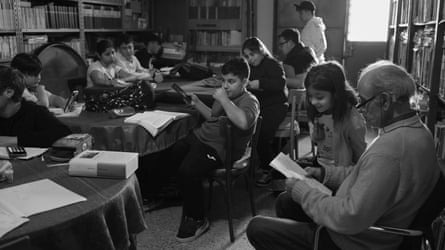
Among these are characters like Titti, a "street teacher" who imparts lessons in algebra, English grammar, and human geography from his antiques shop with a blend of stern patience and profound care. There is Maria, a conservator at the National Archaeological Museum, who guards the ancient heads and busts with a maternal pride, her devotion extending to the preservation of history. A group of Japanese archaeologists, having dedicated twenty years to diligent excavation at the Villa Augustea, represent a long-term commitment to uncovering the past. Even a Syrian ship captain, who docks at the port with a cargo of Ukrainian grain, brings a global perspective to the city’s enduring role as a hub of transit and sustenance, a stark reminder of ongoing international conflicts.
The portrayal of these individuals possesses a dramatic quality, amplified by the monochrome cinematography and the deliberate, static tableau compositions. This aesthetic choice, combined with the inherent Neapolitan temperament – the Italian saying un dramma napoletano refers to someone making a mountain out of a molehill – can lend the film a theatrical air. However, Rosi firmly asserts the authenticity of his encounters: "There’s not a single fictionalised moment in my film," he insists. "But I love when people think that, because I always try to break that thin line between documentary and fiction without actually fictionalising." This blurring of lines is a hallmark of Rosi’s work, inviting viewers to question the boundaries between observation and narrative.
Thematic Resonance: Poverty, Violence, and Secular Devotion
As in his previous acclaimed films, Rosi masterfully weaves together the narratives of his subjects, allowing their individual preoccupations to resonate and converge. Fire at Sea, for instance, explored themes of perception and blindness, with the impaired sight of its young protagonist, Samuele, mirroring the European authorities’ apparent inability to see the humanitarian crisis unfolding on its shores.
In Pompeii: Below the Clouds, the recurring themes are equally political and poignant: poverty, violence, and war. Titti’s lessons about Victor Hugo’s Les Misérables serve as a subtle commentary on social inequality, juxtaposed with the urgency of firefighters responding to a blaze ignited by disaffected youths. A woman’s desperate call to the emergency hotline from her bathroom, while her drunkenly raging husband is on the other side of the locked door, paints a stark picture of domestic turmoil and the vulnerability of individuals within the community.

"There is this kind of oxymoron I perceived throughout the four years I lived in Naples," Rosi recalls. "There’s a constant sense of a tragedy, but also a sense that the tragedy has already passed and we lived through it without realising what was happening. It’s a state of mind." This paradox of living with an ever-present threat while simultaneously moving through daily life is central to the film’s exploration of the Neapolitan psyche.
Despite the pervasive sense of impending doom, the film ultimately highlights the profound empathy and resilience that emerge from such challenging circumstances. "When I was editing the film, I asked myself what all these people I had met over the years had in common. And what they all share is a sense of devotion, of giving themselves to others." This "secular devotion," as Rosi describes it, is the unifying thread that binds the diverse individuals in his film.
Broader Implications and the Future of Naples
The historical context of Naples as a vital port, crucial for the distribution of grain and the prevention of wars in the Roman Empire, is brought to the forefront through the narrative of a Japanese archaeologist. This historical perspective is then powerfully contrasted with the present-day reality of the Syrian ship captain, whose vessel was nearly bombed in Odesa while transporting grain. His unwavering commitment to return to such a dangerous mission underscores a broader theme of dedication in the face of immense personal risk.
Rosi concludes that this quality of secular devotion is fundamental to the very fabric of civilization. In Pompeii: Below the Clouds, he offers not just a portrait of a city living under a geological threat, but a profound meditation on the human spirit’s capacity for connection, resilience, and unwavering commitment, even in the most uncertain of circumstances. The film serves as a powerful reminder that beneath the surface of everyday life, beneath the visible tremors, lie deeper currents of human experience that define our collective existence. The ongoing seismic activity in the region, with the Phlegraean Fields experiencing a period of heightened unrest, lends an even greater urgency and relevance to Rosi’s cinematic exploration of a city perpetually poised between disaster and enduring life.