The ancient tale of "The Wooing of Étaín," a cornerstone of early Irish literature, offers a complex and enduring narrative that continues to captivate readers and scholars alike. This intricate saga, dating back to at least the 12th century and potentially earlier, presents a rich tapestry of divine beings, human drama, legal intricacies, and supernatural transformations, painting a vivid picture of the early Irish worldview. While seemingly a fantastical myth, the story’s deep roots in Irish law, social customs, and cosmology reveal its profound significance in understanding the cultural fabric of medieval Ireland.
A Saga of Divine Lineage and Mortal Entanglements
The narrative begins with a cosmic union between two powerful figures of the Tuatha Dé Danann, the semi-divine race that predated humanity in Ireland. Eochaid Ollathair, known as the Dagda, a god of immense power associated with weather and fertility, and Eithne, who is also identified with the River Boyne, engage in a primeval act of procreation. This celestial coupling is not without its earthly complications, as Eithne is already married to Elcmar of the Brú. The Dagda, desiring Eithne, orchestrates Elcmar’s temporary removal, leading to the conception of their son, Óengus.
This initial act sets a precedent for the complex relationships that define the saga. Óengus, a central figure throughout the narrative, is fostered away, a common practice among early Irish aristocracy to forge alliances and provide a broad education. It is only when mocked by peers that Óengus learns of his true parentage, prompting a revelation from his foster-father, Midir, and an eventual meeting with his divine father, the Dagda.
The Intertwined Worlds of Myth and Law
A unique aspect of early Irish storytelling, and particularly evident in "The Wooing of Étaín," is the seamless integration of mythical events with legal principles. Traditional Irish society did not draw a strict line between fictional narratives and binding law. Poets, storytellers, and brehon lawyers often held overlapping roles, and the legal texts themselves frequently incorporated mythical precedents. This means that the events and resolutions within sagas like this were considered valid in shaping legal understanding and practice.
The narrative showcases this fusion through two key legalistic episodes that occur even before the main plot of Étaín’s wooing truly unfolds.
The Case of the Day and a Night
When the Dagda acknowledges Óengus, the customary transfer of land ownership is complicated by the continued presence of the cuckolded Elcmar. In a move that highlights the blend of chivalry and cunning, the Dagda devises a plan. He advises Óengus to use the auspicious occasion of Samhain, a time when the boundaries between the human and Otherworld realms are thinnest, to threaten Elcmar. Óengus is instructed to extort a promise of kingship over Elcmar’s land for "a day and a night." When Elcmar attempts to reclaim his domain after this period, the Dagda, now acting as a judge, employs a piece of verbal jujitsu. He interprets "a day and a night" as encompassing all time, thereby granting Óengus an eternal claim to the land. This demonstrates how narrative ingenuity could be employed to resolve disputes, blurring the lines between storytelling and legal decree.
The Blinding of Midir and the Price of Beauty
The saga takes another turn with a dispute among young men at the Brú. During this altercation, a holly stick strikes Midir, one of the Tuatha Dé Danann and the foster-father of Óengus, in the eye. This injury has profound legal implications in Irish society, as kings were expected to be physically perfect. A blemish could disqualify them from ruling. While the divine physician Dian Cécht heals Midir, the incident leads to further requests from Midir to his host: a chariot, a cloak, and the most beautiful woman in Ireland, Étaín of Ulster.
This episode is significant not only for its legal implications but also for its foreshadowing of the central conflict. The transaction of Étaín, mediated by Óengus as a proxy for Midir, deviates from typical romantic conventions where the suitor directly proves his worth. Instead, it becomes a matter of exchange, highlighting a more pragmatic, if unconventional, approach to securing a bride.
The Many Lives of Étaín
The central figure of the saga, Étaín, is not a static character but a being of multiple incarnations and transformations, embodying the themes of reincarnation and enduring beauty central to Irish mythology.
Étaín I: The Golden Fly
After Óengus fulfills Midir’s demands, Étaín is taken to Midir’s dwelling. However, Midir already has a wife, Fuamnach, who possesses potent druidic powers. In a fit of jealous rage, Fuamnach transforms Étaín into a pool of water, which then becomes a worm, and finally, a magnificent purple fly the size of a man’s head. This fly, despite its monstrous form, retains Étaín’s beauty, its wings producing sweet music and its dewdrops possessing healing properties.
This transformation is more than just a physical change; it represents Étaín’s displacement and suffering. Fuamnach’s magic unleashes a relentless wind that whips Étaín across Ireland for seven years. Eventually, exhausted, the fly alights on the cloak of Óengus, who had once sought her on Midir’s behalf. He shelters her, but Fuamnach’s malice persists. After another magical storm, Étaín, now a fly, lands on the roof of a house in Ulster. During a drinking bout, she falls into the beaker of the wife of a champion named Étarsceoil. The wife becomes pregnant, and Étaín is reborn as their infant daughter, whom they also name Étaín.
Remarkably, the narrative reveals that over a thousand years have passed since the conception of the first Étaín. This temporal vastness underscores the cyclical nature of existence and the enduring presence of the Tuatha Dé Danann in the Irish landscape.
Étaín II: The Royal Bride and the Tragic Love
This reborn Étaín, Étaín #2, becomes the object of desire for Eochaid Airem, the High King of Ireland. He marries her for political propriety, drawn to her beauty and lineage. However, Eochaid’s brother, Ailill Anglonnach, falls desperately in love with Étaín and languishes from unfulfilled desire. While caring for her ailing brother-in-law during Eochaid’s absence, Étaín discovers the cause of his malady. She agrees to meet him for a tryst, but each night she encounters an impostor who claims to be Ailill. She eventually learns that these impostors are servants of Midir, her former husband. The true Ailill had overslept, and Étaín had unknowingly made love to Midir’s emissaries. Étaín clarifies that her trysts were purely medicinal, and Eochaid returns, pleased to find his brother healed. This episode highlights Étaín’s agency, even within the constraints of her circumstances, and the lingering influence of Midir.
Étaín III: The Final Wooing and Cosmic Departure
The saga enters its final act with Midir’s return to Tara, this time as a splendid warrior. He has come to reclaim Étaín, who, despite having no memory of her previous lives or the transformations, has apparently encouraged Midir to negotiate her return. However, instead of a direct confrontation, Midir engages Eochaid in a series of games of fidchell, a board game akin to chess. Midir consistently loses, forfeiting increasingly valuable stakes. Finally, he wins and demands an embrace and kiss from Étaín as his prize.
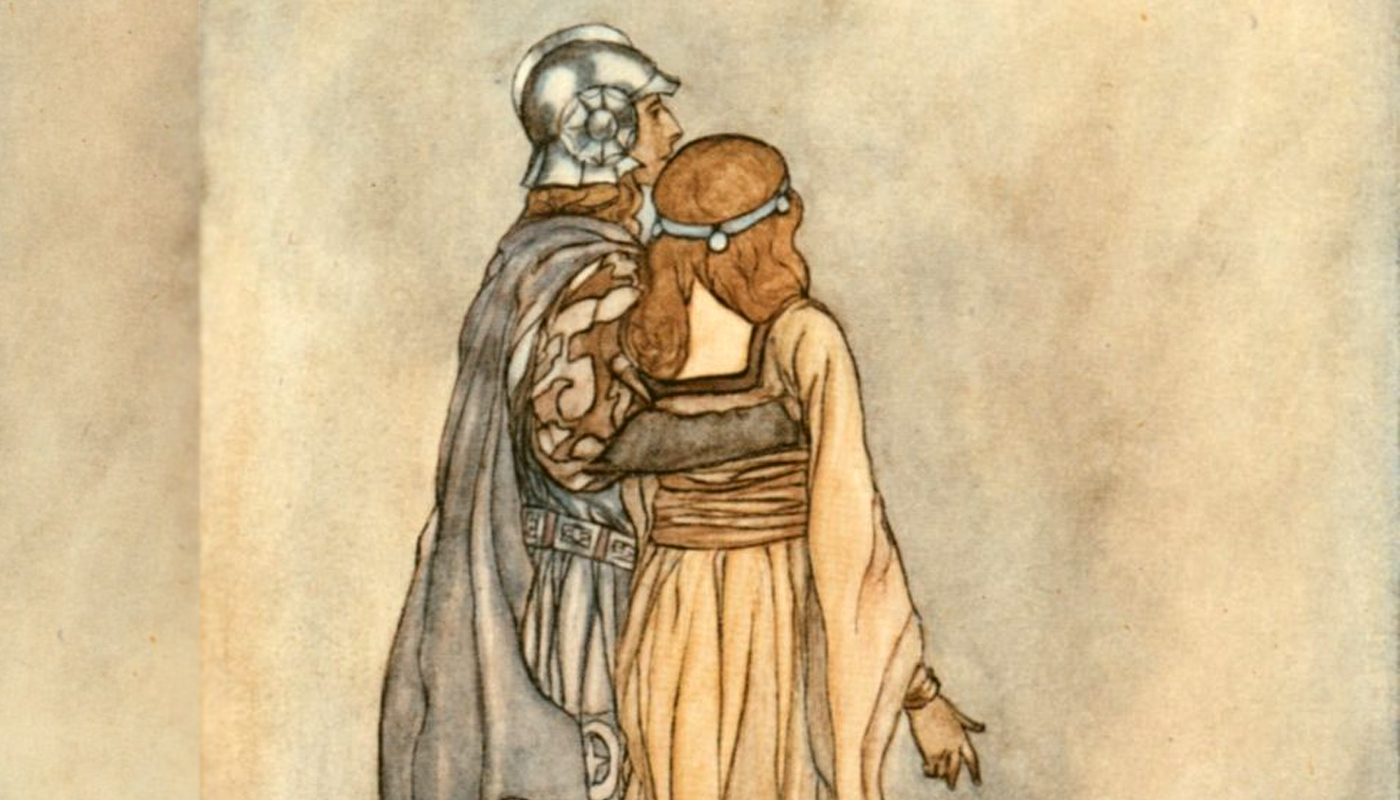
Eochaid, now determined to keep Étaín, mobilizes his forces and secures his household. Despite these precautions, Midir appears in the royal court. Taking advantage of the promised embrace, Midir levitates with Étaín through the roof and they disappear into the sky, transforming into swans. This dramatic departure signifies Étaín’s ultimate transcendence from the human realm, returning to her divine origins.
The Enduring Significance of "The Wooing of Étaín"
"The Wooing of Étaín" is more than just a collection of fantastical events; it is a profound exploration of key themes in early Irish culture:
- The Nature of Identity and Reincarnation: Étaín’s multiple lives and transformations underscore the Irish belief in reincarnation and the cyclical nature of existence. Her journey highlights the idea that essence can persist through radical change.
- The Agency of Women: Despite often being the object of desire or a pawn in divine schemes, Étaín demonstrates a surprising degree of agency. She chooses to heal Ailill, she negotiates her return to Midir, and her decisions, even those made unconsciously, shape the narrative.
- The Interplay of Myth and Law: The saga serves as a testament to how mythical narratives were integral to the legal and social structures of medieval Ireland, providing precedents and shaping understanding.
- The Persistence of the Supernatural: The constant presence of the Tuatha Dé Danann, their interactions with humans, and their dwellings (the síd mounds) reflect a worldview where the supernatural was an active and often disruptive force in the mortal realm.
- The Fluidity of Time and Space: The narrative deliberately plays with linear conceptions of time and space. The vast temporal gaps and the interconnectedness of mythical realms challenge modern expectations of narrative coherence, pointing to a different mode of storytelling logic, possibly rooted in ancient Celtic traditions or evolving medieval narrative structures.
The very composition of "The Wooing of Étaín" adds to its mystique. Scholars suggest that the various episodes might have originated as independent stories, compiled into the form we know it today sometime in the 12th century. This fragmented, layered structure is characteristic of much of early Irish literature, where stories rarely exist in a single, definitive version.
Ultimately, "The Wooing of Étaín" stands as a vital window into the imagination and societal values of medieval Ireland. It is a story that, like its titular character, has undergone countless transformations, yet its core themes of love, loss, divine intervention, and the enduring power of the human (and non-human) spirit continue to resonate. The tale’s complex weaving of cosmic and earthly affairs, legal precedent and supernatural transformation, makes it not only a captivating read but also an invaluable resource for understanding a rich and unique cultural heritage.