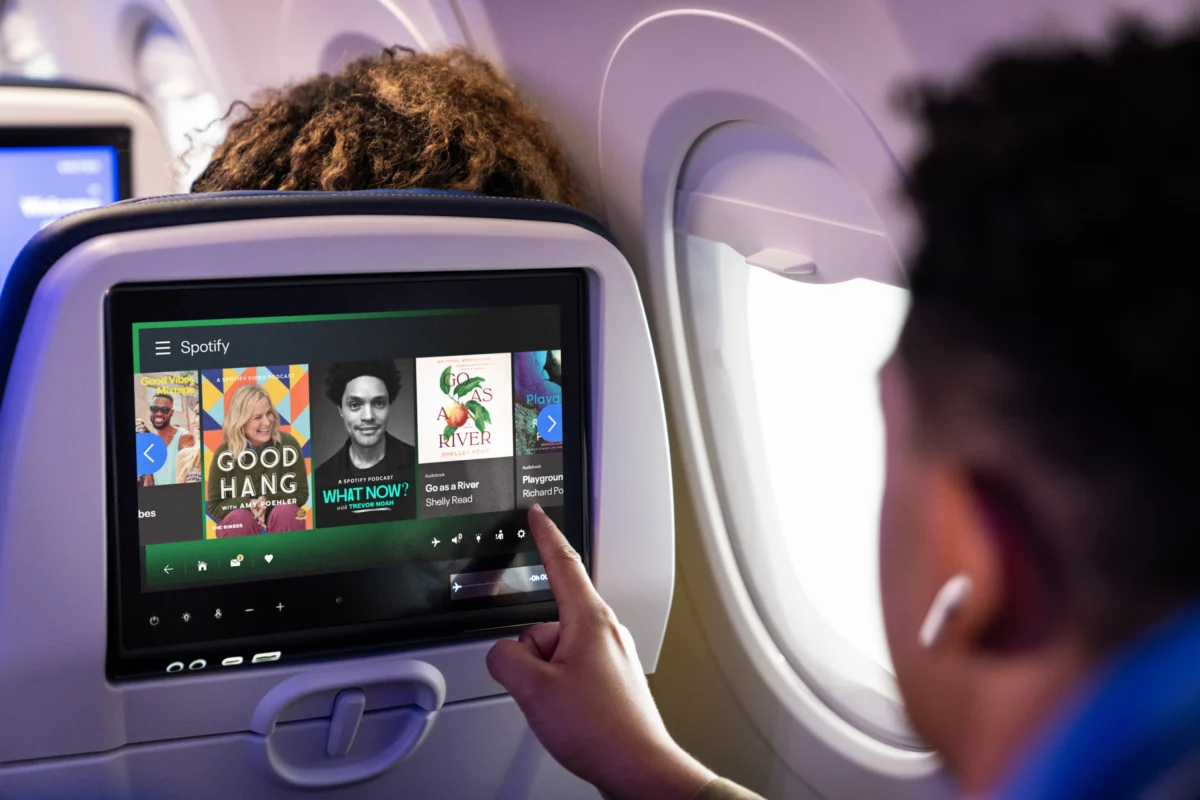
The traditional experience of air travel, long characterized by disconnected hours and limited entertainment options, is undergoing a fundamental transformation as United Airlines begins the large-scale deployment of SpaceX’s Starlink satellite internet across its global fleet. During a recent demonstration flight conducted at an altitude of 32,000 feet, the carrier showcased a level of connectivity previously reserved for ground-based fiber-optic networks, allowing passengers to seamlessly stream high-definition content from platforms such as YouTube and Netflix while cruising at speeds of 580 miles per hour. This technological leap signifies more than just a convenience upgrade; it represents a strategic shift in the "streaming wars," as airlines transition from being content curators to high-speed service providers, fundamentally altering the economics of in-flight entertainment (IFE).
The Technical Evolution: From Dial-Up Speeds to Low-Earth Orbit
For decades, in-flight Wi-Fi was notoriously slow, expensive, and unreliable, relying on ground-based towers or Geostationary (GEO) satellites positioned 22,000 miles above the Earth. These legacy systems suffered from high latency—the delay between sending and receiving data—often exceeding 600 milliseconds, making activities like online gaming, video conferencing, or even smooth video streaming nearly impossible. In contrast, Starlink utilizes a constellation of thousands of small satellites in Low-Earth Orbit (LEO), roughly 350 miles above the surface. This proximity reduces latency to approximately 20 to 40 milliseconds, providing a user experience indistinguishable from a home broadband connection.
United Airlines’ commitment to this technology involves outfitting more than 1,000 aircraft with Starlink’s electronically steered antennas. Unlike the bulky, mechanically steered dishes of the past, these low-profile antennas can maintain high-speed links even as the aircraft maneuvers through different latitudes and weather patterns. This infrastructure allows United to offer "gate-to-gate" connectivity, ensuring that passengers remain online from the moment they board until they reach the arrival gate, a service that was previously interrupted during takeoff and landing.
Strategic Integration: The Convergence of Personal Devices and Seatback Screens
The introduction of Starlink is forcing a reevaluation of the traditional seatback screen. Historically, airlines viewed these screens as a way to control the passenger experience, offering a limited selection of licensed movies and television shows. However, Andrew Nocella, United’s Executive Vice President and Chief Commercial Officer, emphasizes that the future lies in "optionality." The airline is not abandoning seatback entertainment; rather, it is integrating it with the new high-speed pipeline.
United is currently upgrading its newer aircraft, such as the Boeing 787-9 Dreamliner, with 4K-resolution screens and Bluetooth connectivity. The goal is to create a symbiotic relationship between the passenger’s personal devices and the aircraft’s hardware. A primary example of this is United’s new partnership with Spotify. By scanning a QR code on the seatback screen, passengers can link their personal accounts, gaining immediate access to their saved playlists and podcasts directly through the plane’s interface. This level of personalization suggests a future where passengers could log into their Netflix or Disney+ accounts at 30,000 feet, picking up a movie exactly where they left off at home.
The Economics of the In-Flight Streaming Wars
The shift toward high-speed internet is recalibrating a $300 million-per-year industry focused on in-flight content licensing. Historically, studios and streaming platforms viewed airlines as a "captive audience" market. Content was sold in windows: a movie would move from theaters to "early release" on planes before arriving on home streaming services. With the advent of Starlink, the necessity of these pre-loaded libraries is being questioned.
If every passenger can access their own streaming subscriptions via free Wi-Fi, the value of licensed seatback content might seem to diminish. However, industry analysts suggest that the opposite may be true. Streamers are increasingly using airlines as a marketing tool. For example, Delta Air Lines has partnered with Paramount+, while JetBlue offers Peacock and American Airlines provides Apple TV+ content. These partnerships allow streamers to reach a demographic of frequent travelers who may not yet be subscribers. By offering a "taste" of their premium content for free on the seatback screen, platforms hope to drive long-term subscriptions.

For United, the high-speed connection also solves a significant logistical hurdle: content freshness. David Kinzelman, United’s Chief Customer Officer, noted that under the old system, it could take up to 45 days to update the movie library across the entire fleet due to the physical limitations of uploading data to individual aircraft. With Starlink, the airline can update its entire digital catalog over-the-air from the cloud in a single day, ensuring that "just-released" titles are available to passengers almost instantly.
A Chronology of In-Flight Connectivity Milestones
To understand the magnitude of the Starlink rollout, one must look at the timeline of aviation’s struggle with the digital age:
- 2004: Boeing launches "Connexion by Boeing," the first serious attempt at satellite-based in-flight Wi-Fi. It is shuttered two years later due to high costs and low adoption.
- 2008: Gogo (then Aircell) launches air-to-ground (ATG) service on American Airlines, utilizing cell towers on the ground. Speeds are limited to roughly 3 Mbps for the entire plane.
- 2013: JetBlue introduces "Fly-Fi," using Ka-band GEO satellites to offer free Wi-Fi, setting a new competitive standard for the industry.
- 2021: SpaceX begins testing Starlink for aviation, promising "fiber-like" speeds.
- 2023: Delta Air Lines begins rolling out free, high-speed Wi-Fi for SkyMiles members across its domestic fleet, utilizing Viasat technology.
- 2024: United Airlines announces its fleet-wide partnership with Starlink, representing the largest commitment to LEO satellite technology in the aviation sector to date.
Broader Implications: Productivity and the End of the "Digital Detox"
The availability of high-speed internet is also changing how passengers utilize their time in the air. Beyond entertainment, the "vibe-coding" phenomenon—where developers use AI-assisted coding tools to build software—is becoming a reality in the skies. United executives shared anecdotes of passengers using the new Starlink connection to close real estate deals or manage complex software projects in real-time.
However, this constant connectivity has sparked a debate regarding the "last sanctuary" of the digital world. For many, flights were a rare opportunity to disconnect from the demands of work and social media. As airlines like United, Alaska Airlines, and WestJet move toward a model of ubiquitous, high-speed access, the boundary between the office and the aircraft cabin is effectively erased.
Furthermore, the environmental and astronomical impact of the LEO constellations required to power these services remains a point of contention. While passengers enjoy 4K streaming, astronomers have raised concerns about the "brightness" of satellite constellations interfering with celestial observations. SpaceX has worked to mitigate this with "VisorSat" technology, but the sheer volume of satellites planned for the coming decade ensures this will remain a topic of regulatory scrutiny.
Competitive Response and Future Outlook
The move by United puts significant pressure on its "Big Three" competitors, American Airlines and Delta. While Delta has already made strides with free Wi-Fi through a T-Mobile partnership, United’s reliance on Starlink’s LEO technology may provide a superior technical edge in terms of latency and global coverage, particularly on long-haul international routes over oceans where ground-based systems and some GEO satellites struggle.
Industry experts anticipate that the next phase of this evolution will involve "smart cabins." With a robust high-speed backbone, airlines can implement Internet of Things (IoT) sensors to monitor cabin temperature, seat functionality, and galley supplies in real-time, allowing for more efficient maintenance and service. For the passenger, the future cabin will likely look more like a connected living room than a pressurized tube.
As United Airlines continues its rollout, the focus will shift from the novelty of "Wi-Fi that works" to the creative ways that high-speed data can be leveraged to improve the customer journey. Whether it is through seamless gaming, real-time collaboration, or deeply personalized entertainment, the "streaming wars" have clearly found a new theater of operations six miles above the earth. The success of this initiative will be measured not just by megabits per second, but by how effectively United can translate connectivity into brand loyalty in an increasingly competitive global market.