The Cannes Film Festival has witnessed the premiere of James Gray’s latest cinematic achievement, Paper Tiger, a film that has quickly garnered acclaim for its raw emotional power and profound exploration of the American Dream’s darker facets. Opening with the resonant Aeschylus quote, "Let there be wealth without tears; enough for the wise man who will ask no further," the film immediately sets a tone of impending tragedy, echoing the classical Greek dramas in its depiction of betrayal, fear, and ultimate demise. This riveting drama is not merely a standalone work but serves as a spiritual companion piece to Gray’s 2022 film, Armageddon Time, and notably, his brooding 1994 debut feature, Little Odessa, firmly anchoring it within the director’s distinctive cinematic universe.
A Master’s Return to Personal Narratives
Paper Tiger marks Gray’s ninth feature film, and for many critics, it stands as arguably his most accomplished to date, achieving a gratifying full-circle symmetry in his extensive filmography. Throughout his career, Gray has consistently drawn inspiration from his personal and family history, weaving these intimate threads into expansive narratives that resonate with universal themes. His mother’s battle with a brain tumor informed the poignant character portrayed by Vanessa Redgrave in Little Odessa. The arduous journey of his émigré grandparents through Ellis Island provided the emotional bedrock for key parts of The Immigrant. More recently, his own bittersweet coming-of-age experience, marked by an awakening to prejudice and inequality, was meticulously chronicled in Armageddon Time.
This deep personal wellspring is again evident in Paper Tiger, which, while fundamentally a crime thriller, is equally a domestic drama rooted in Gray’s childhood memories. The film casts Scarlett Johansson and Miles Teller as Hester and Irwin, characters who are variations on Esther and Irving, the parental roles previously inhabited by Anne Hathaway and Jeremy Strong in Armageddon Time. Initial plans for Hathaway and Strong to reprise their roles were altered due to scheduling conflicts, a shift that Gray reportedly embraced as an opportunity to steer the project in a "more heightened direction." The result is a bracing melodrama – not one of artificiality and overwrought manipulation, but one fueled by genuine, raw emotional power and a darkly burdened heart, allowing for an intensified exploration of the family’s plight.
Thematic Resonance: Ambition, Betrayal, and the Corrosive Pursuit of Wealth
The film’s thematic core lies in its piercing account of the American Dream in tatters, particularly within the context of the mid-1980s. The Ronald Reagan era, a precise point on the country’s timeline, is often characterized by a burgeoning obsession with wealth, where financial gain transitioned from a mere goal to an all-consuming societal imperative. Paper Tiger deftly captures this zeitgeist, portraying how unchecked ambition can lead to perilous consequences. The Aeschylus quote at the outset serves as a powerful premonition, highlighting the ancient wisdom that wealth pursued without tears, without moral cost, is often a fleeting illusion, easily shattered by hubris and greed.
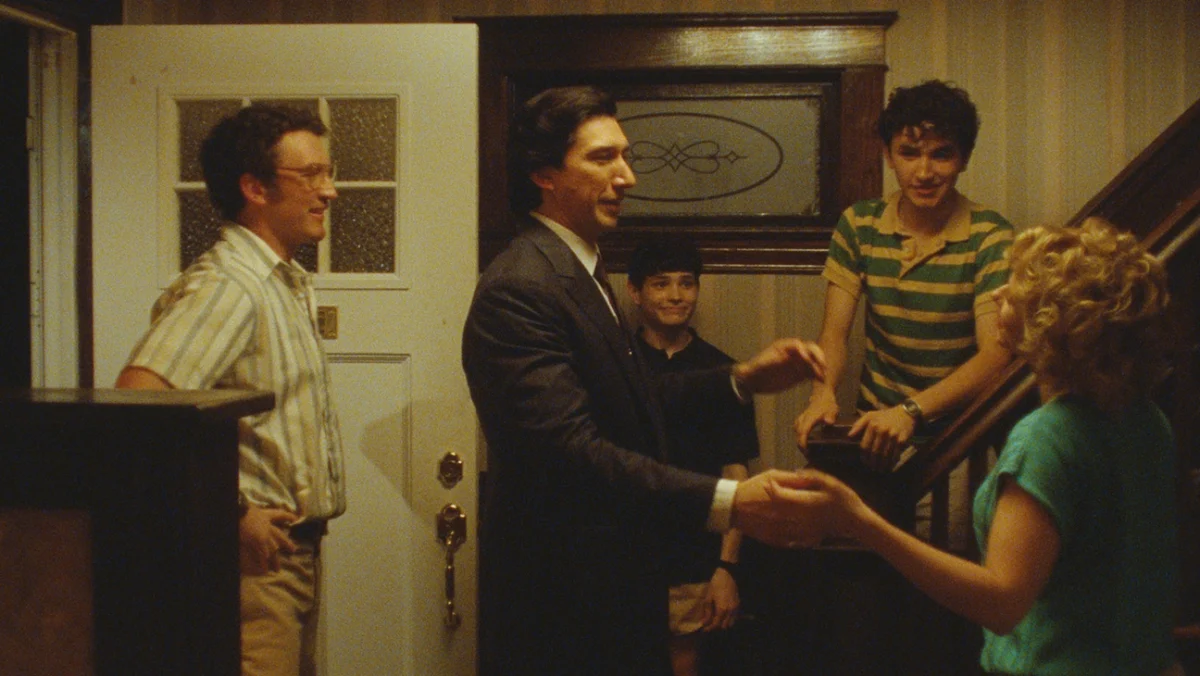
The narrative introduces Gray and his older brother through the characters of Ben (Roman Engel) and Scott (Gavin Goudey), who is on the cusp of his 18th birthday and college. Both boys idolize their Uncle Gary (Adam Driver), a former police officer who embodies everything their engineering-nerd father, Irwin, is not. Gary exudes charisma, drives a luxurious car, wears impeccably tailored suits, and, most alluringly to the impressionable youths, carries a gun in an ankle holster. His seemingly effortless success and magnetic personality create an aura of invincibility, positioning him as the family’s Midas-touched entrepreneur. It is this perceived invincibility, however, that ultimately sets the stage for the unfolding tragedy.
A Brooklyn Backdrop: The Gowanus Canal and Symbolic Decay
The setting plays a crucial symbolic role. A century prior, Brooklyn’s Gowanus Canal was notoriously one of the world’s most polluted waterways, a testament to unchecked industrialization that blighted the entire Eastern Seaboard with tons of toxic waste. Even in 1986, the year the film is largely set, the canal’s eye-watering stench and murky waters remained a stark reminder of its environmental degradation. Irwin initially dismisses the notion of gentrifying such a decaying industrial area. Yet, Gary, with his reputation for Midas-touch business deals and his strategic acts of generosity – such as arriving at dinner with caterers from Peter Luger Steak House – gradually persuades Irwin to consider a proposed partnership.
Gary, ever the smooth operator, downplays his ongoing discussions with the Russian mob to secure a lucrative contract. He whisks Irwin away to Gowanus to witness their supposed cleanup operation and to meet Alexei (Yavor Vesselinov), a thuggish figure overseeing the project. The Russians are seeking loopholes to circumvent stringent city regulations, and Gary proposes a consulting agreement, leveraging his connections and his brother’s engineering expertise. Despite Gary’s explicit instruction for Irwin to let him handle all discussions, Irwin’s innate conscientiousness leads him to ask pointed questions, instantly making Alexei prickly and foreshadowing the dangerous path they are embarking upon.
Stellar Performances Anchoring a Gripping Narrative
Adam Driver delivers one of his most compelling performances in Paper Tiger. His portrayal of Gary is a masterclass in calculated charm. Gary is adored by his brother’s family, and his visits to their modest suburban Queens home are always an occasion. Yet, beneath this affable exterior lies a man selectively sharing the truth, confidently reassuring Irwin that the Russians are mere "paper tigers" – far less threatening than they appear. Like an expert salesman, he paints a vivid picture of impending financial windfall, brushing aside Irwin’s concerns about the disposal of industrial sludge by asserting their involvement will be purely advisory, absolving them of responsibility for the Russians’ actions.
The film’s tension escalates dramatically in a harrowing sequence when Irwin, against Hester’s anxious wishes, drives the boys to Brooklyn one school night to show them Uncle Gary’s "get-rich-quick" scheme. Leaving his sons in the car, Irwin steps out to inform workers of a safety hazard, an act that provokes Alexei and his goons into violence. While Irwin is being assaulted, two mobsters terrorize the boys in the car before forcibly removing them and driving off with the vehicle. The most chilling moment arrives when Alexei, after examining Irwin’s papers, utters the ominous threat: "So now we know where you live."
This incident plunges the family into a vortex of fear and moral dilemma, firmly establishing Paper Tiger in prime James Gray territory. Irwin grapples with the instinct to call the police, but he and his completely freaked-out sons ultimately decide to conceal the incident from Hester. This decision exacerbates the already simmering tensions between Irwin and Gary. The direction is gripping, characterized by an unerring tonal control that blankets the film in ominous storm clouds. Christopher Spelman’s magnificently unsettling, full-bodied score, occasionally interwoven with lugubrious Russian choral music, amplifies the churning dread, creating an almost operatic sense of foreboding.
Scarlett Johansson’s performance as Hester is arguably her finest to date. As the spiral of menace tightens, fueled by Gary’s misplaced confidence and reckless actions, a bone-chilling warning left in the dead of night forces Irwin to finally confide in Hester. Johansson masterfully conveys a character simultaneously gripped by incandescent rage at the danger to which her sons were exposed and blood-curdling fear for her family’s fate. Miles Teller also expands his range in an affecting performance as Irwin, portraying a man wrestling with profound regret, self-castigation, disillusionment with his once-admired brother, and a stone-cold terror for his family’s survival.
Beyond the Crime: Personal Battles and Broader Implications
Adding another layer of profound tragedy to the narrative, Hester has been privately contending with mental lapses and throbbing headaches, keeping the results of her doctor’s medical tests a secret from her family and even from her good-natured but meddling mother (Cindy Katz), who constantly nudges them to leave the city for Great Neck. Johansson imbues Hester with a tough, Queens-accented edge, yet beneath it lies a woman clearly petrified by this perfect storm of ugly events. In a movie that frequently achieves an operatic scale with its clashes of violence, agonizing tensions, and vicious threats, the heart-stopping scene in which Hester receives her diagnosis at the doctor’s office stands out as perhaps the single most devastating moment, a shock even though it has been amply foreshadowed throughout the film.
The relentless escalation continues as Gary, despite being furious with Irwin for interfering and ruffling the Russians’ feathers, remains cocky enough to believe he can simply waltz in and resolve everything with a few calming words. However, this is not how mob boss Semion Bogoyavich (Victor Ptak), who presides over a vast criminal network, operates. The Russians perceive Irwin’s unannounced visit as a grave breach of trust, demanding a hefty price to make the "problem" disappear. The spiral of menace is breathtaking, showcasing Gary’s continued descent into recklessness, dragging his brother deeper into the criminal underworld.
The film does not shy away from dramatic crests, including a climactic shoot-out in a cornfield that serves as a model of steadily mounting suspense. The ending, a culmination of the film’s tragic trajectory, hits precisely the right note, offering both tragedy and a nuanced sense of redemption.
Cinematographic Excellence and Homage to Masters
Paper Tiger is visually stunning, a testament to the collaborative artistry of its crew. Cinematographer Joaquin Baca-Asay, who previously worked with Gray on We Own the Night and Two Lovers, masterfully slathers on dark, gritty textures, creating an immersive, palpable atmosphere without veering into excessive noirish stylization. Editor Scott Morris delivers a compact cut of just under two hours, yet the film breathes with the scope and gravitas of an epic. While obvious antecedents outside of Gray’s own body of work might include the works of Coppola, Lumet, Scorsese, or Mann, the film distinctly evokes the early crime films of Akira Kurosawa, from Drunken Angel and Stray Dog to the classic police procedural, High and Low. This comparison underscores the film’s meticulous construction, its deep psychological insight, and its unflinching portrayal of moral compromise within a criminal underworld.
Gray and his superb cast are in blazing form and full command of their craft, delivering a bruising movie that profoundly reveals the heavy price of pursuing the American Dream too recklessly, often at the expense of heeding ancient wisdom such as Aeschylus’s words. The film serves as a potent historical mirror, reflecting on the Ronald Reagan era as a pivotal moment in the nation’s psyche when the pursuit of wealth transcended mere aspiration to become an all-consuming, sometimes corrupting, obsession. Its premiere at Cannes has positioned Paper Tiger as a significant contender, a powerful artistic statement that reaffirms James Gray’s status as a formidable voice in contemporary cinema, capable of weaving deeply personal narratives into universal, tragic tapestries. The film’s critical reception points to its overwhelming power, ensuring its place as a compelling and resonant cinematic experience for audiences worldwide.