Dominga Sotomayor, one of Chile’s most distinctive cinematic voices, has once again captivated international audiences with her latest feature, La Perra, which premiered at the prestigious Cannes Film Festival. Known for her introspective character studies set within tightly defined, often claustrophobic environments, Sotomayor’s new film marks a significant evolution in her acclaimed career, venturing beyond the autobiographical narratives that previously defined her work into a realm of rich adaptation and profound thematic exploration. This shift, while seemingly a departure, ultimately deepens her signature concerns regarding the interplay between human identity, animal instinct, and the landscapes that shape our existence.
Dominga Sotomayor’s Evolving Oeuvre: From Personal Narratives to Universal Themes
Sotomayor’s cinematic journey has consistently demonstrated a fascination with the internal lives of her characters, meticulously framed by their immediate surroundings. Her 2012 debut, Thursday till Sunday, masterfully confined its narrative largely within a car, charting a family’s disintegrating dynamics during a road trip to northern Chile. This early work established her predilection for using physical space as a metaphor for emotional states, a theme she would further hone.
Her international breakthrough came with 2018’s Too Late to Die Young, a critically acclaimed film that garnered the Leopard for Best Direction at the Locarno Film Festival. Set within a bohemian commune at the pivotal dawn of Chile’s post-Pinochet era, the film explored the anxieties and freedoms of adolescence in a society grappling with its past. The commune, initially a sanctuary, subtly transformed into a space of growing confinement and internal tension, mirroring the psychological pressures on its young inhabitants. This film cemented Sotomayor’s reputation for crafting nuanced, atmospheric narratives that resonate on both personal and socio-political levels.
More recently, Sotomayor undertook a project for Netflix, Swim to Me (2025), which focused on an affluent villa in contemporary Santiago. While offering a different production experience and a broader audience reach, this film continued her exploration of confined spaces and familial relationships, albeit within a more structured, commission-driven framework.
La Perra, however, represents a deliberate artistic pivot. While retaining her signature focus on the relationship between spaces and the characters who inhabit them—how landscapes fundamentally shape self-perception and one’s place in the world—it is her first feature not directly drawn from her own childhood experiences. This move into "uncharted waters," as Sotomayor describes it, provided a newfound creative freedom, allowing her to delve into themes with a rawer, more obscure intensity.
"La Perra": A Deep Dive into Character, Landscape, and Domestication
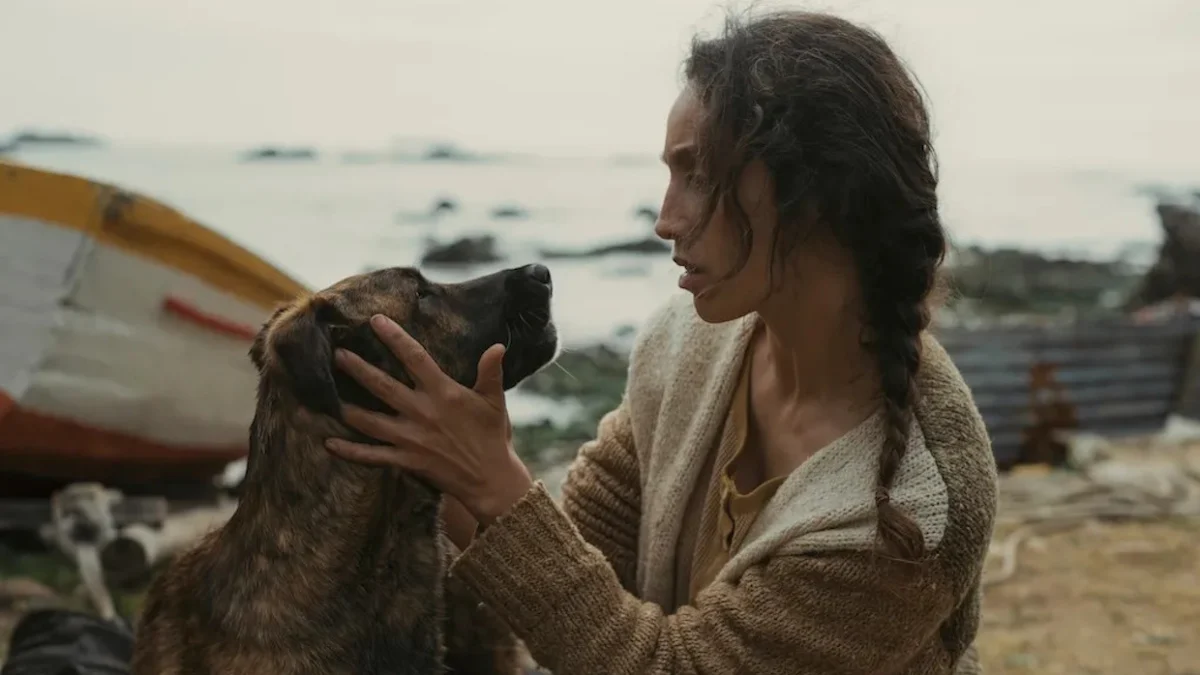
Adapted from Colombian author Pilar Quintana’s acclaimed 2017 novel of the same name, and co-written with Uruguayan screenwriter Inés Bortagaray, La Perra is a character study steeped in the desolate beauty of a windswept island off Chile’s southern coast. The narrative centers on Silvia (portrayed with compelling depth by Manuela Oyarzún), a childless woman in her 40s who sustains herself by harvesting seaweed. Her solitary existence is irrevocably altered when she adopts a stray puppy found along the shore. This puppy, named Yuri—a nod to the Mexican pop star whose 1980s hits weave through Clint Mansell’s evocative score—becomes more than just a pet; she emerges as a protagonist in her own right.
Pilar Quintana’s novel, celebrated for its visceral portrayal of motherhood, wildness, and the human-animal bond, won the prestigious Premio Alfaguara de Novela in 2018, further highlighting the literary weight behind Sotomayor’s adaptation. Quintana’s work is known for its unflinching gaze at female experience, often in communion with untamed nature, a sensibility Sotomayor clearly embraces and translates into her cinematic language. Clint Mansell, renowned for his darkly atmospheric and emotionally resonant scores in films like Requiem for a Dream and Black Swan, contributes a musical tapestry that underscores the film’s psychological depth and temporal ambiguity, seamlessly blending 1980s pop with his signature evocative compositions.
What distinguishes La Perra is Sotomayor’s resolute refusal to reduce the animal to a simplistic metaphor. As Sotomayor explained in an interview preceding the Cannes premiere, her interest lies in "the concept of domestication, the extent to which an animal can ever really be ours." Yuri is not merely a catalyst for Silvia’s character development or a surrogate for an emotional void. Instead, the film deliberately grants Yuri agency and perspective. Early in the narrative, cinematographer Simone D’Arcangelo—known for his striking work on films like Felipe Gálvez Haberle’s The Settlers (2023) and Alessio Rigo de Righi and Matteo Zoppis’s The Tale of King Crab (2021)—momentarily shifts the camera’s focus from Silvia to Yuri, capturing the dog running freely across the beach. This intentional choice signals the film’s commitment to exploring a symbiotic relationship rather than a hierarchical one, establishing both characters as independent entities pursuing their own forms of freedom.
The core theme of "domestication" extends beyond the human-animal relationship to human interactions themselves. Sotomayor notes that her films consistently explore how "the most familiar can become the most foreign." This is evident in the evolving dynamic between Silvia and Yuri; what begins as warm affection gradually morphs into something more complex, even threatening, reflecting the unpredictable nature of intimate bonds and the inherent wildness that resists absolute control.
Creative Departures and Artistic Freedom: The Shift from Autobiography
Sotomayor’s decision to adapt a novel and move away from autobiographical storytelling was a conscious evolution. Having carried her previous projects, Too Late to Die Young and Thursday till Sunday, with her emotionally for many years—projects deeply rooted in her childhood and the "blurrier parts of one’s memory"—she found a liberating lightness in working with a pre-existing text. This "digested" material, authored by another woman, offered a unique opportunity for an "exercise in empathy," allowing her to approach the unknown rather than constantly striving to understand herself. This perspective shift, she believes, allowed La Perra to become a "rawer, more obscure work."
The experience of making La Perra contrasted sharply with her Netflix commission, Swim to Me. While valuing both projects, Sotomayor emphasizes that La Perra was conceived as a film for the cinema, affording it "complete freedom." This creative autonomy, she notes, is not to be taken for granted, especially for a project of La Perra‘s scale. Working with significant producers like Rodrigo Teixeira (whose RT Features has backed acclaimed films such as Call Me By Your Name and The Witch) who trusted her vision, was crucial.

The distinctions highlight a broader industry trend: the tension between the commercial demands of streaming platforms and the artistic imperatives of independent cinema. While Sotomayor appreciated the liberties granted by Netflix—such as casting choices—she recognized that Swim to Me needed to cater to a wider audience, implying a more straightforward narrative. In contrast, La Perra embraced a "dispersed, meandering" cinematic style, exploring formal elements that felt new and "radical" for her. This formal freedom allowed her to delve into the "permeable border between the human and the non-human" with an uninhibited artistic rigor, aligning it more closely with the spirit of her earlier independent works.
Crafting the Unconventional: Atemporality, Fictional Geography, and Dual Perspectives
One of La Perra‘s most striking and ambiguous aspects is its deliberate manipulation of time. The film eschews linear chronology, blending smartphones and contemporary cars with vintage TV sets and props from earlier decades. This atemporality creates a disorienting, dreamlike quality, inviting viewers to "luxuriate in its enigmas." Even its flashback sequence—a first for Sotomayor—resists conventional temporal markers. Unlike films that use distinct palettes or period-specific costumes to signal jumps in time, La Perra‘s past and present seamlessly intertwine, blurring the distinction and suggesting that memory and experience exist outside rigid chronological boundaries. Sotomayor views cinema as less about linear time and more about "the kind that we imagine or remember," a philosophy powerfully enacted in La Perra.
The film also constructs an "imaginary geography." While filmed partly on the actual Santa Maria island off Chile’s southern coast, known for its rugged beauty and isolation, Sotomayor actively fictionalized the setting. Elements like Silvia’s shack and an abandoned beachside villa were fabricated or placed elsewhere, creating a composite, invented territory. This intentional blending of documentary-like aesthetics with invented reality allows the film to transcend a specific locale, fostering a sense of universality. The landscape, which Sotomayor describes as resembling an "Irish landscape" or "another country," contributes to the viewer’s inability to pinpoint where exactly the action unfolds, reinforcing the film’s timeless and placeless qualities. Even the thriving seaweed industry depicted at the film’s opening, while inspired by research into Southern Chile’s economy, was creatively enhanced for cinematic effect, illustrating Sotomayor’s love for cinema’s ability to "create a fake reality and then document it as if it was real."
Crucially, La Perra challenges traditional narrative structures by embracing Yuri’s perspective as much as Silvia’s. This unconventional choice eschews a single, unequivocal protagonist, establishing from the outset that the film is "about" both. The inclusion of Yuri’s point of view in the first chapter is a deliberate "statement," asserting the dog’s independent pursuit of identity and freedom. This dual perspective underscores the film’s central inquiry into domestication, questioning who truly exerts control and highlighting the inherent autonomy of all living beings.
The Art of Animal Direction: Challenges and Spontaneity
The casting and direction of the canine actors presented unique challenges for the production. Sotomayor insisted on using mutts rather than pedigree dogs, aligning with the film’s raw and authentic aesthetic. The adult Yuri was found just a month before shooting at an animal shelter in Santiago—a one-year-old, untrained dog bursting with "wild energy." A crew member adopted her, facilitating intensive sessions with Manuela Oyarzún to build familiarity. Directing such an untamed animal often meant embracing spontaneity; there were instances where the dog would simply run off mid-scene, necessitating pauses and adjustments. The puppy Yuri, a two-month-old abandoned on a highway, was cast for her resemblance to the adult dog.
This unconventional approach meant that while two trainers were on set, much of Oyarzún’s performance hinged on her natural reactions to the dogs’ unpredictable behavior. This dynamic, though difficult, ultimately contributed to the film’s organic and authentic portrayal of the human-animal bond, embedding the very "difficulties" of the shoot into the film’s expressive language.
Visual Language and Artistic Influences
Sotomayor’s collaboration with cinematographer Simone D’Arcangelo was a cornerstone of La Perra‘s visual identity. Though time constraints prevented a traditional storyboard, their pre-production involved creating a collage of island photographs and sharing artistic references. The visual language drew heavily from Sotomayor’s family legacy, referencing the works of her grandmother Carmen Couve and uncle Adolfo Couve, both painters. Their dramatic, 19th-century-esque landscape paintings, with barren islands and bulbous clouds, deeply informed the film’s atmospheric aesthetic. This was juxtaposed with a more psychological approach, drawing inspiration from the raw, intense portraiture of Lucien Freud and Francis Bacon, whose works delve into the depths of human and animal psyche.
Cinematic influences were equally diverse and profound. Discussions included Barbara Loden’s Wanda (1970), Michael Roemer’s Vengeance is Mine (1984)—praised for its odd structure and meandering quality—and Michelangelo Antonioni’s L’avventura (1960), a touchstone for its exploration of existential ennui and emotional drift. Australian films like Nicolas Roeg’s Walkabout (1971) and Henri Safran’s Storm Boy (1976), known for their open cinematic language and profound connection to nature and animals, also served as key references. This eclectic mix of influences allowed Sotomayor to consciously "let go of the idea that each scene had to have its own logic," embracing a more fluid and responsive style that mirrored the film’s thematic concerns.
Production Challenges and Creative Adaptation
The production of La Perra was marked by significant challenges, which Sotomayor candidly admits made it her most difficult shoot to date. Yet, these adversities ultimately became an integral part of the film’s "language." As actress María Paz Grandjean (who starred in Swim to Me and has a cameo in La Perra) observed, the difficulties transformed into the film’s expressive fabric. The spontaneity demanded by the unpredictable environment, the animal actors, and the invented geography forced Sotomayor and D’Arcangelo to constantly adapt their initial ideas to the unfolding circumstances. This process, far from being a hindrance, was ultimately liberating, imbuing La Perra with a raw, responsive energy that distinguishes it.
Broader Implications for Chilean and World Cinema
La Perra stands as a testament to Dominga Sotomayor’s artistic courage and evolution. By venturing into adaptation and embracing formal experimentation, she solidifies her position as a director unafraid to challenge both conventional narrative structures and her own established stylistic patterns. The film’s Cannes premiere not only brings international attention to Sotomayor’s singular vision but also underscores the vibrant and innovative landscape of contemporary Chilean cinema.
Her exploration of the human-animal bond, the fluidity of time, and the invented nature of space contributes significantly to broader cinematic discourse. In an era where commercial pressures often dictate artistic choices, La Perra champions the enduring value of creative freedom and the power of cinema to craft profound, ambiguous, and deeply personal experiences that resonate universally. It marks a compelling new chapter for Sotomayor, signaling a mature and adventurous phase in a career already distinguished by its originality and depth.