Historical Framework: The August 1942 Round-ups in the Southern Zone
To understand the narrative of When the Night Falls, one must look to the geopolitical climate of France in 1942. Following the armistice of June 1940, France was divided into the German-occupied Northern Zone and the "Free Zone" (Zone Libre) governed by the Vichy regime under Marshal Philippe Pétain. By 1942, pressure from Nazi Germany to implement the "Final Solution" intensified. While the Vel’ d’Hiv Roundup of July 1942 in Paris remains the most infamous instance of mass arrest, the events of August 1942 in the Southern Zone marked a critical escalation.
During this period, the Vichy government, led by Prime Minister Pierre Laval and Secretary General of the Police René Bousquet, voluntarily agreed to deport foreign Jews who had sought refuge in the Southern Zone. Unlike the Northern Zone, where German authorities took the lead, the round-ups in the south were conducted almost exclusively by French police and civil servants. Between August 26 and August 28, 1942, approximately 10,000 foreign Jews were arrested across the Southern Zone and funneled through transit camps like Vénissieux before being sent to Drancy and eventually Auschwitz.
Profiles in Resistance: Gilbert Lesage and Father Alexandre Glasberg
The film centers on two pivotal historical figures: Gilbert Lesage and Father Alexandre Glasberg. Gilbert Lesage, portrayed by Antoine Reinartz, was a young civil servant and a Quaker who served as the head of the Service Social des Étrangers (SSE). In his official capacity, Lesage was tasked with overseeing the social welfare of foreigners, but he used his position to gather intelligence and warn Jewish organizations of impending raids. In August 1942, he was appointed to lead a "screening commission" at the Vénissieux camp, a body officially designed to determine who met the strict criteria for deportation and who might be granted a reprieve.
Working alongside him was Father Alexandre Glasberg, played by Daniel Auteuil. Glasberg was a priest of Jewish origin and a founding member of Amitié Chrétienne, an interfaith resistance network. Glasberg was instrumental in maneuvering through the complex bureaucracy of the Vichy state to secure exemptions for as many individuals as possible. The film depicts the uneasy but necessary alliance between Lesage’s administrative authority and Glasberg’s humanitarian activism. Their collaboration represents a specific form of "legal resistance," where the rules of the state were turned against the state to save lives.
The Vénissieux Screening Commission: A Bureaucratic Battleground
The core of the narrative focuses on the "Commission de Criblage" (Screening Commission) at the Vénissieux camp. This commission was an anomaly in the history of the Holocaust in France. While the Vichy government intended for the commission to streamline the deportation process by identifying "non-transferable" individuals—such as those with specific health conditions or parents of French-born children—Lesage and his allies used the ambiguity of the criteria to expand the list of those saved.
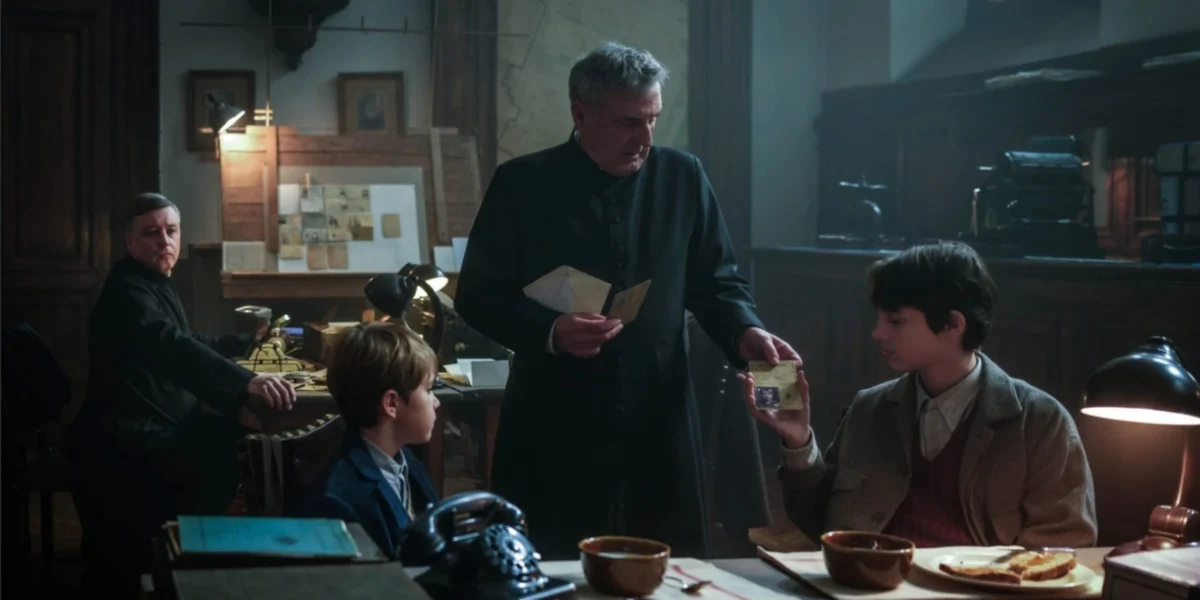
Historical records indicate that the commission at Vénissieux managed to remove 108 children and several hundred adults from the deportation lists in a single night. This was achieved through a combination of forged documents, deliberate misinterpretations of administrative orders, and the sheer bravery of the commission members who refused to sign over prisoners to the Gendarmerie. The film captures the "clinical style" of these proceedings, where life and death were decided over stacks of paperwork and whispered negotiations. This focus on the "administrative evil" of the era highlights how the Holocaust was not only a series of violent acts but also a logistical operation managed by desk-bound officials.
Cinematic Execution and Technical Production
Directed by Daniel Auteuil and co-written by Camille Lugan, When the Night Falls runs 100 minutes and adopts a visual language that mirrors the somber, restrictive atmosphere of 1942. The production features a cast that includes Grégory Gadebois, Alicia Dadoun, and Victor Bonnel, alongside Reinartz and Auteuil.
The film’s aesthetic is characterized by what critics have described as a "foreboding" and "detached" tone. The opening sequence—a silent, winding shot of a car moving through a camp of abandoned barracks—sets a mood of inherent dread. The art direction emphasizes the skeletal, imposing nature of the Vénissieux barracks, turning the setting into a character of its own. Auteuil’s directorial choices include the frequent use of long takes and a minimalist soundtrack, often relying on diegetic sounds like sirens to heighten the tension.
However, the film also employs unconventional visual techniques, such as extreme close-ups and dramatic focus shifts. While some analysts suggest these choices reflect the blurred moral lines and the claustrophobia of the era, others argue that the dark lighting and technical flourishes sometimes obscure the clarity of the historical narrative. The script’s heavy reliance on "administrative dialogue" serves to emphasize the absurdity of the bureaucratic process, though it creates a challenging experience for viewers accustomed to more traditional wartime dramas.
Chronology of the Vénissieux Incident
The events depicted in the film follow a tight chronological window that defined the fate of thousands:
- August 5, 1942: The Vichy government issues orders for the arrest of foreign Jews in the Southern Zone who entered France after 1936.
- August 26, 1942: Massive police raids begin across the Zone Libre. Thousands are transported to the Vénissieux transit camp near Lyon.
- August 27–28, 1942: The Screening Commission, led by Gilbert Lesage and supported by Father Glasberg and members of the OSE (Oeuvre de Secours aux Enfants), begins its work at Vénissieux.
- August 29, 1942: Under pressure from the regional prefect, the commission is ordered to cease operations. However, by this time, they have already secured the "illegal" release of dozens of children and adults.
- August 30, 1942: The remaining prisoners are deported to Drancy, and subsequently to the death camps in the East.
Supporting Data and Historical Impact
The scale of the August 1942 round-ups remains a significant point of study for historians of the Holocaust in France. Data from the Mémorial de la Shoah indicates that of the roughly 76,000 Jews deported from France during the war, only about 2,500 survived. The actions at Vénissieux represent one of the few instances where the machinery of deportation was successfully halted, albeit temporarily and on a local scale.
The intervention by Lesage and Glasberg had lasting repercussions. Gilbert Lesage was eventually arrested by the Gestapo in 1943 for his resistance activities, though he survived the war and was later recognized as Righteous Among the Nations by Yad Vashem. Father Glasberg also joined the armed resistance and continued his humanitarian work after the liberation of France. Their legacy is a testament to the impact of individual conscience within a collaborative state.
Official Responses and Contemporary Relevance
In the decades following the war, the French state’s role in the Holocaust was often downplayed, with the blame placed squarely on German occupiers. It was not until President Jacques Chirac’s 1995 speech that France officially acknowledged the responsibility of the Vichy state in the deportation of Jewish citizens and refugees.
When the Night Falls arrives at a time when European cinema is increasingly focused on these "marginal" or localized stories of the war. By highlighting the Vénissieux incident, the film contributes to the ongoing "duty of memory" (devoir de mémoire) in France. Educational organizations and historical societies have noted that such films are vital for illustrating the complexities of collaboration, showing that the Vichy regime was not a monolith but a system containing pockets of internal sabotage.
Broader Implications and Final Analysis
The film’s portrayal of the "banality of evil" through bureaucratic efficiency offers a chilling look at how easily human rights can be dismantled through paperwork and procedure. The line "This isn’t about fairness, it’s about efficiency," uttered by a character in the film, encapsulates the terrifying logic of the period.
While When the Night Falls has been critiqued for its pacing—alternating between rigid, dialogue-heavy scenes and long periods of silence—it succeeds in bringing a lesser-known chapter of French history to a global audience. The film serves as a reminder that the Holocaust was facilitated by thousands of small administrative decisions, but it was also hindered by individuals who chose to use their positions within that same system to protect the vulnerable. As an exploration of moral courage under occupation, the film provides a necessary, if somber, reflection on the capacity for resistance in the darkest of times.