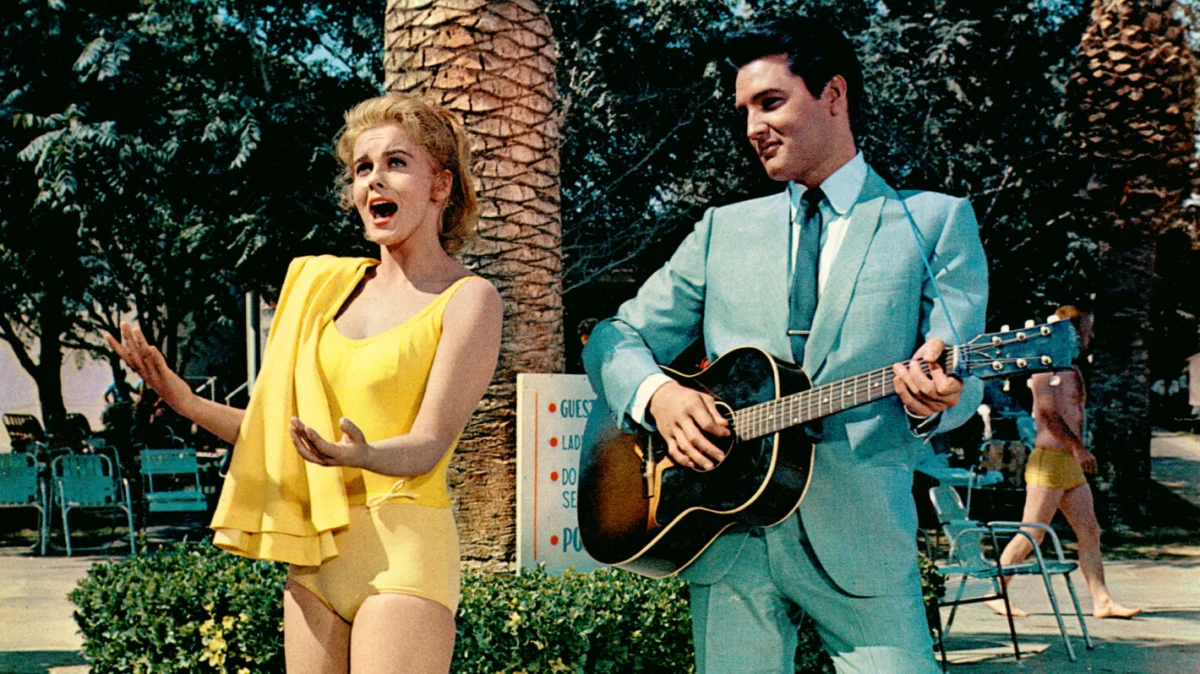
Released on May 20, 1964, Viva Las Vegas stands as a definitive milestone in the cinematic career of Elvis Presley, representing the pinnacle of his "musical comedy" era. Directed by the veteran George Sidney and produced by Metro-Goldwyn-Mayer (MGM), the film was not merely a commercial vehicle for Presley’s music but a cultural event that captured the high-energy, mid-century glamour of Nevada’s most famous city. As the film passes its 60th anniversary, it remains a subject of intense interest for film historians and musicology experts alike, serving as a time capsule of the 1960s entertainment landscape.
The narrative follows Lucky Jackson, a talented race car driver portrayed by Presley, who travels to Las Vegas to participate in the city’s inaugural Grand Prix. His journey is complicated when he loses the money intended for his car’s engine and falls in love with Rusty Martin, a vibrant hotel swimming instructor played by Ann-Margret. The film’s enduring popularity is often attributed to the palpable onscreen chemistry between the two leads, a dynamic that many critics argue was never replicated in Presley’s 30 other feature films.
The Production Context and Historical Timeline
To understand the significance of Viva Las Vegas, one must examine the timeline of Elvis Presley’s career and the state of the American film industry in the early 1960s. After returning from his military service in 1960, Presley’s manager, Colonel Tom Parker, pivoted the singer’s career away from live performances and toward a relentless schedule of motion picture production. By 1963, when filming for Viva Las Vegas commenced, the "Elvis formula"—a light plot interspersed with several musical numbers—was beginning to show signs of fatigue among audiences.
However, Viva Las Vegas broke the mold. George Sidney, known for directing high-caliber musicals like Show Boat and Bye Bye Birdie, brought a level of technical sophistication to the project that was often lacking in Presley’s other films. Filming began in July 1963, utilizing various iconic locations across the Las Vegas Strip, including the Sahara Hotel, the Flamingo, and the Tropicana. The production concluded in late 1963, leading to its spring 1964 release.
The film arrived at a pivotal moment in American history. It was released just months after the Beatles’ historic appearance on The Ed Sullivan Show, signaling a shift in the musical guard. Despite the burgeoning "British Invasion," Viva Las Vegas proved that Presley remained a formidable box-office draw. It earned over $9 million at the domestic box office, making it one of the highest-grossing films of the year and the most successful movie of Presley’s career in terms of profitability relative to its budget.
The Status of the Cast: Who Remains Today?
A central question for fans and historians today is the status of the cast members who brought this vibrant story to life. Given that the film was produced over six decades ago, the majority of the principal cast and crew have since passed away.
Elvis Presley, the film’s star, died on August 16, 1977, at the age of 42. His death marked the end of an era, but his performance as Lucky Jackson remains a highlight of his filmography, showcasing his comedic timing and athletic screen presence.
Ann-Margret, who played Rusty Martin, remains the most prominent surviving member of the cast. At 83 years old, she continues to be a celebrated figure in Hollywood. Her performance in Viva Las Vegas was a star-making turn; she was famously dubbed "the female Elvis" due to her high-energy dance style and vocal prowess. In the years following the film, she earned two Academy Award nominations (for Carnal Knowledge and Tommy) and won five Golden Globes. Ann-Margret has frequently spoken in interviews about her deep respect for Presley, describing their bond as a profound friendship that lasted until his death.
The supporting cast featured several notable character actors of the era:
- Cesare Danova, who played the suave Count Elmo Mancini, Lucky’s rival on the track and in romance, passed away in 1992 at the age of 66.
- William Demarest, the veteran actor who played Rusty’s father, died in 1983. He was well-known to television audiences for his later role in My Three Sons.
- Nicky Blair, who portrayed Lucky’s mechanic Shorty Fansworth, died in 1998.
While the primary billing has largely moved into history, several uncredited dancers and background actors who appeared in the elaborate musical sequences are still alive. Notably, Teri Garr and Toni Basil, both of whom would go on to achieve significant fame in their own right, appeared as uncredited dancers in the film. Both women are still alive today and have occasionally shared anecdotes about the rigorous rehearsal schedules demanded by George Sidney and choreographer David Winters.
Musical Significance and the Title Track
The soundtrack of Viva Las Vegas is arguably as famous as the film itself. The title track, "Viva Las Vegas," written by Doc Pomus and Mort Shuman, has become the unofficial anthem of the city. Interestingly, the song reached only number 29 on the Billboard Hot 100 upon its initial release, but its longevity has surpassed many of Presley’s higher-charting hits.
The film features several other standout musical moments, including "C’mon Everybody" and the duet "The Lady Loves Me." The latter is particularly noted for the playful, competitive chemistry between Presley and Ann-Margret. Musicologists often point to this film as the last time Presley seemed truly engaged with his cinematic musical material before the quality of his movie soundtracks began to decline in the mid-to-late 60s.
According to data from the Recording Industry Association of America (RIAA), the soundtrack and its associated singles have maintained steady sales and streaming figures in the digital age, contributing to the "Elvis" brand’s estimated annual revenue of over $100 million.
Behind-the-Scenes Friction and Director’s Vision
The production of Viva Las Vegas was not without internal conflict, much of it revolving around the dynamic between the two leads. George Sidney was enamored with Ann-Margret’s talent and gave her significant screen time, often framing shots to highlight her dancing and charisma. This reportedly drew the ire of Colonel Tom Parker, who feared that Ann-Margret was overshadowing his client.
Historical accounts suggest that Parker attempted to have certain scenes featuring Ann-Margret cut or shortened to ensure Presley remained the sole focus. However, Sidney stood his ground, recognizing that the friction and attraction between the two stars were exactly what made the film work. This "battle of the stars" ultimately benefited the film, providing it with an energy and "spark" that was absent from Presley’s more formulaic projects like Harum Scarum or Clambake.
Broader Impact on the Image of Las Vegas
Beyond its status as a piece of entertainment, Viva Las Vegas played a crucial role in shaping the global perception of Las Vegas. In the early 1960s, the city was still transitioning from a desert gambling outpost into a world-class entertainment destination. The film showcased the city as a playground of luxury, speed, and romance, accessible to the young and the ambitious.
The "Grand Prix" element of the plot also tapped into the mid-century American obsession with automotive culture and racing. The cinematography of the race through the desert remains impressive by 1960s standards, utilizing mounting techniques that provided audiences with a visceral sense of speed. This helped cement the association between Las Vegas and high-stakes excitement, a branding effort that the Las Vegas Convention and Visitors Authority (LVCVA) has leveraged for decades.
Critical Analysis and Legacy
From a critical perspective, Viva Las Vegas is often cited as one of the few Elvis films that can be judged as a "good movie" independent of its star’s fame. While many Presley films were criticized for thin plots and poor production values, Sidney’s direction and the high-caliber casting of Ann-Margret provided a professional veneer that elevated the material.
In retrospective reviews, film critics often highlight the "cross-generational" appeal of the movie. It appealed to the teenagers of 1964 who were fans of the "twist" and modern pop, while also catering to older audiences through its traditional musical structure and the presence of established actors like William Demarest.
The film’s legacy is also seen in the way it influenced future depictions of the city. From the glitz of the costumes to the neon-soaked night scenes, the visual language of Viva Las Vegas set a standard for "Vegas-style" entertainment. In 2004, the film was selected for preservation in the United States National Film Registry by the Library of Congress for being "culturally, historically, or aesthetically significant."
Conclusion: A Lasting Cultural Touchstone
As we reflect on the sixty years since Lucky Jackson and Rusty Martin first graced the silver screen, the impact of Viva Las Vegas remains undeniable. It stands as the definitive document of Elvis Presley at the height of his physical and cinematic powers, and it serves as a testament to the enduring talent of Ann-Margret.
While the neon lights of the 1964 Las Vegas Strip have mostly been replaced by modern mega-resorts, the spirit of the film continues to resonate. It is a reminder of a specific era in American entertainment—a time of transition, glamour, and the undisputed reign of the King of Rock and Roll. For the surviving members of the cast and the millions of fans worldwide, Viva Las Vegas is more than just a movie; it is an enduring piece of Americana that continues to capture the imagination of new generations.