In a significant revelation that underscores ongoing industry debates surrounding artificial intelligence, acclaimed actress Emily Blunt recently disclosed her apprehension about utilizing AI technology for a crucial vocal transformation scene in her upcoming film, Disclosure Day, directed by cinematic maestro Steven Spielberg. Instead of resorting to algorithmic generation, Blunt opted for an intensely personal and traditional method of vocal performance and sound design to bring her character’s unusual metamorphosis to life, a decision that highlights a growing sentiment among creatives regarding the preservation of human artistry in an increasingly automated landscape.
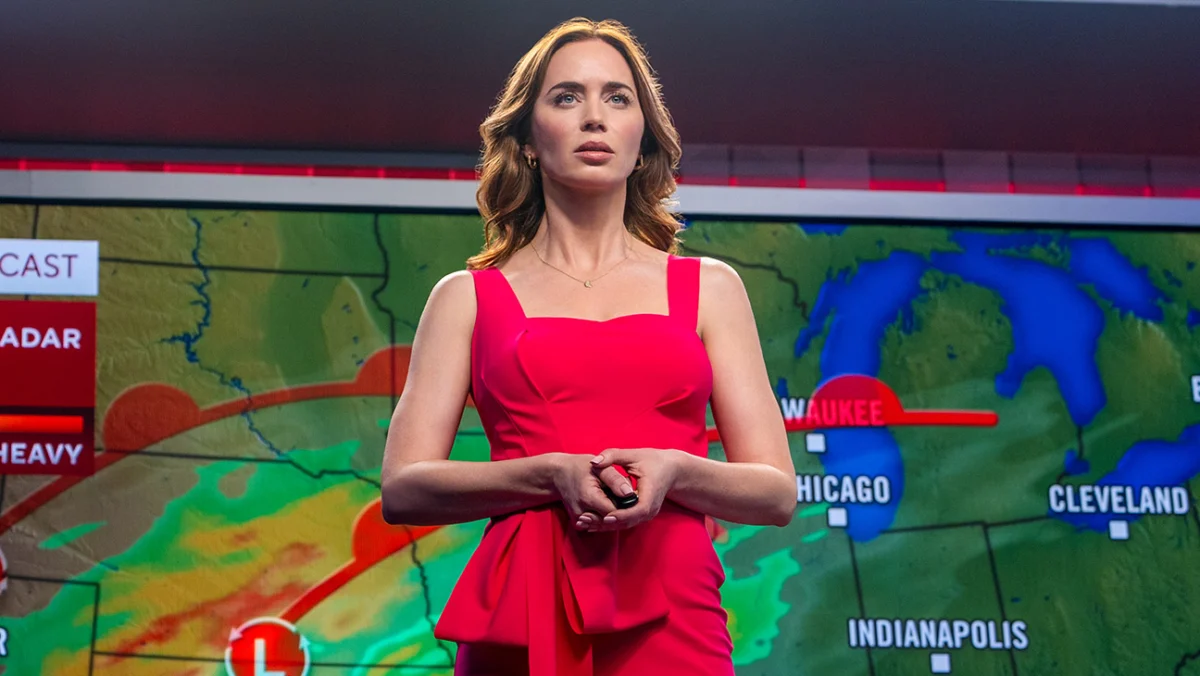
Blunt shared these insights during a candid appearance on the popular web series Hot Ones, where she was promoting Disclosure Day ahead of its theatrical release on June 12. The film, a highly anticipated addition to Spielberg’s legendary science fiction oeuvre, centers on the profound implications of humanity discovering verifiable proof of non-human intelligence. Blunt portrays Margaret Fairchild, a former journalist who transitions into a career as a TV meteorologist. Fairchild’s life takes an extraordinary turn following an encounter with non-human life, imbuing her with newfound, inexplicable abilities. A pivotal moment in the narrative involves Margaret undergoing a dramatic vocal alteration, spontaneously speaking a non-human language during a live weather broadcast.
The Intricacy of a Vocal Metamorphosis: A Four-Minute Oner
Describing the scene’s demanding nature, Blunt elaborated on its technical and performative complexity. "It’s a four-minute oner that we shot that leads up to that moment where she’s gradually sort of disintegrating," the Devil Wears Prada actress explained, referring to a continuous, unbroken shot. This technical choice amplifies the real-time, escalating tension of Margaret’s transformation, demanding sustained performance and precise execution. The challenge for the production team and Blunt herself was how to credibly depict this radical vocal shift, making it sound authentically alien yet rooted in the character’s deteriorating state.
Blunt acknowledged the various technical avenues available to achieve such an effect, including leveraging AI. "There’s various ways you could do it. You could go the AI route, which I’m a bit terrified of," she stated unequivocally. This sentiment, expressed by a prominent actress working on a high-profile production, resonates deeply within Hollywood, where the rapid advancement and potential applications of AI have become a contentious topic, particularly in the wake of recent labor disputes.
The Artisanal Approach: Human Ingenuity Over Algorithmic Artistry
Instead of ceding creative control to artificial intelligence, Blunt championed a hands-on, human-centric solution. Her proposal involved personally crafting the necessary sounds through a series of experimental vocalizations. "I thought I could make some really strange sounds," she recounted. "I said maybe I could come in and we’ll just do a range of weird sounds. And it’s what we did. I did sort of the clicking sounds, I did sort of humming sounds, consonant sounds, breathing, strange sounds."
This approach required a deep collaboration with the film’s sound design team. Microphones were strategically placed around the set to capture the nuances of Blunt’s vocal experiments. The raw material, a mosaic of her unique sounds, was then entrusted to the sound designer, who meticulously processed and manipulated them to create the final, otherworldly vocalization heard in the film. "The sound designer went away and created that weird sound," Blunt confirmed, highlighting the crucial role of human expertise in transforming raw performance into a polished cinematic element. This process mirrors traditional Foley artistry and bespoke sound design, where human-generated noises are recorded and then expertly layered and modified to achieve specific auditory effects, a stark contrast to algorithmically generated audio.
AI in Hollywood: A Growing Debate and Industry Crossroads
Emily Blunt’s "terrified" stance on AI is not an isolated sentiment but rather a microcosm of a much larger, industry-wide reckoning with artificial intelligence. The past year has seen unprecedented discussions and actions concerning AI’s role in filmmaking, notably during the Writers Guild of America (WGA) and SAG-AFTRA strikes of 2023. Both unions explicitly cited the unregulated use of AI as a critical threat to their members’ livelihoods, creative rights, and intellectual property.
Writers expressed fears of studios using AI to generate scripts or rewrite existing material, diminishing the need for human writers and potentially exploiting their past work as training data without compensation. Similarly, actors voiced concerns about their likenesses, voices, and performances being digitally replicated, scanned, and reused indefinitely without consent or fair pay, effectively creating "digital doubles" that could replace human talent in future productions. The WGA and SAG-AFTRA eventually secured groundbreaking protections against unchecked AI use in their new contracts, signaling a collective industry effort to establish ethical guardrails.
Beyond these labor disputes, the broader technological landscape of Hollywood has already seen AI integrated into various aspects of production. AI tools are employed for visual effects, such as de-aging actors, generating complex digital environments, and automating repetitive tasks. Voice synthesis technology has also advanced significantly, capable of replicating human voices with startling accuracy. However, the ethical implications, particularly concerning originality, authorship, and the potential for job displacement, remain fiercely debated. Blunt’s choice, therefore, serves as a powerful artistic statement, prioritizing human performance and traditional craft over the perceived efficiencies or novelties of AI in a scenario where either path was technically feasible.
Steven Spielberg’s Sci-Fi Legacy and Disclosure Day‘s Premise
Disclosure Day arrives with substantial anticipation, not least due to Steven Spielberg’s unparalleled legacy in the science fiction genre. The film’s premise, exploring the monumental implications of humanity confronting definitive evidence of non-human intelligence, aligns perfectly with Spielberg’s decades-long fascination with cosmic encounters and the human response to the unknown.
Spielberg’s filmography is replete with iconic sci-fi masterpieces that have shaped popular culture and redefined cinematic storytelling. From the awe-inspiring first contact in Close Encounters of the Third Kind (1977) to the heartwarming alien friendship in E.T. the Extra-Terrestrial (1982), and the groundbreaking genetic resurrection in Jurassic Park (1993), his work consistently explores themes of discovery, wonder, fear, and the profound impact of extraordinary events on ordinary lives. Other notable contributions to the genre include the prescient dystopian vision of Minority Report (2002), the philosophical exploration of artificial consciousness in A.I. Artificial Intelligence (2001), the visceral invasion narrative of War of the Worlds (2005), and the pop-culture laden virtual reality epic Ready Player One (2018).
Early social media reactions from journalists and critics who attended preview screenings have described Disclosure Day as "one of Spielberg’s best films in years," suggesting a return to the thematic depth and emotional resonance that characterize his most celebrated works. This early praise, coupled with the film’s intriguing premise, sets high expectations for its exploration of a moment that would irrevocably alter human civilization. The film promises to delve into not just the scientific discovery but also the societal, political, and personal upheaval such an event would trigger, with Margaret Fairchild’s transformation likely serving as a central metaphor for humanity’s own evolving understanding and adaptation.
The Ensemble Cast and Production Nuances
Beyond Emily Blunt’s central performance, Disclosure Day boasts an impressive ensemble cast, a hallmark of many of Spielberg’s large-scale productions. Joining Blunt are acclaimed actors such as Josh O’Connor, known for his Emmy-winning role as Prince Charles in The Crown; Colman Domingo, whose powerful performances in Euphoria and Rustin have garnered significant critical acclaim; Eve Hewson, recognized for her work in Bad Sisters and Behind Her Eyes; veteran British actor Colin Firth, an Academy Award winner for The King’s Speech; and Wyatt Russell, recently seen in Monarch: Legacy of Monsters and The Falcon and the Winter Soldier.
This diverse and talented cast suggests a rich tapestry of human reactions to the film’s extraordinary premise. Each actor is likely to bring a unique perspective to their character’s encounter with the unknown, contributing to the nuanced portrayal of a world grappling with unprecedented contact. The collaborative environment fostered by a director like Spielberg, known for his meticulous planning and ability to draw exceptional performances from his actors, would have been crucial in navigating the complexities of a film dealing with such profound themes.
The Craft of Sound Design: An Unsung Hero
Emily Blunt’s decision to actively participate in the sound design process for her character’s vocal transformation brings into focus the often-underappreciated art of sound design in filmmaking. In genres like science fiction, horror, and fantasy, sound designers are the architects of auditory worlds, crafting atmospheres, evoking emotions, and defining creatures or phenomena through carefully constructed sonic landscapes.
For Disclosure Day, the task of creating a "non-human language" and sounds indicative of a character’s "disintegration" is paramount to the film’s immersion and credibility. A sound designer’s role extends far beyond simply adding background noise; it involves a deep understanding of psychoacoustics, narrative pacing, and emotional impact. They might record natural sounds, manipulate them beyond recognition, or synthesize entirely new auditory textures. The use of Blunt’s raw vocalizations as a foundation provided an organic starting point, allowing the sound designer to imbue the alien language with a human core, making Margaret’s transformation more visceral and unsettling.
This traditional method contrasts sharply with AI-generated soundscapes, which, while capable of producing novel sounds, often lack the nuanced, human-driven intentionality that can communicate specific emotional states or character developments. The choice to invest in this human-led, iterative process underscores a commitment to artistic authenticity and the belief that certain creative nuances are best achieved through human collaboration and craft.
Implications for Creative Industries and the Future of Filmmaking
Emily Blunt’s "terrified" declaration and her subsequent choice to bypass AI for a key performance element carry significant implications for the broader creative industries. In an era where technological advancements constantly push the boundaries of what is possible, her decision serves as a powerful testament to the enduring value of human creativity, performance, and artisanal craft.
It reinforces the idea that while AI can offer tools for efficiency or generate novelties, it cannot yet replicate the unique, often unpredictable, and deeply personal essence of human artistic expression. For actors, sound designers, and other creative professionals, Blunt’s stance offers a form of validation, emphasizing that their unique skills and contributions remain indispensable, even as AI technologies mature.
The ongoing dialogue between technological innovation and artistic integrity will undoubtedly continue to shape the future of filmmaking. High-profile instances like Blunt’s decision in Disclosure Day contribute to establishing precedents and fostering a critical discourse about where and how AI should be integrated into the creative process. It highlights a preference for augmenting human creativity rather than replacing it, ensuring that the heart of storytelling remains firmly rooted in human experience and expression. As Disclosure Day prepares for its release, the film will not only explore humanity’s encounter with alien life but also inadvertently contribute to the evolving narrative of humanity’s relationship with its own created intelligence.