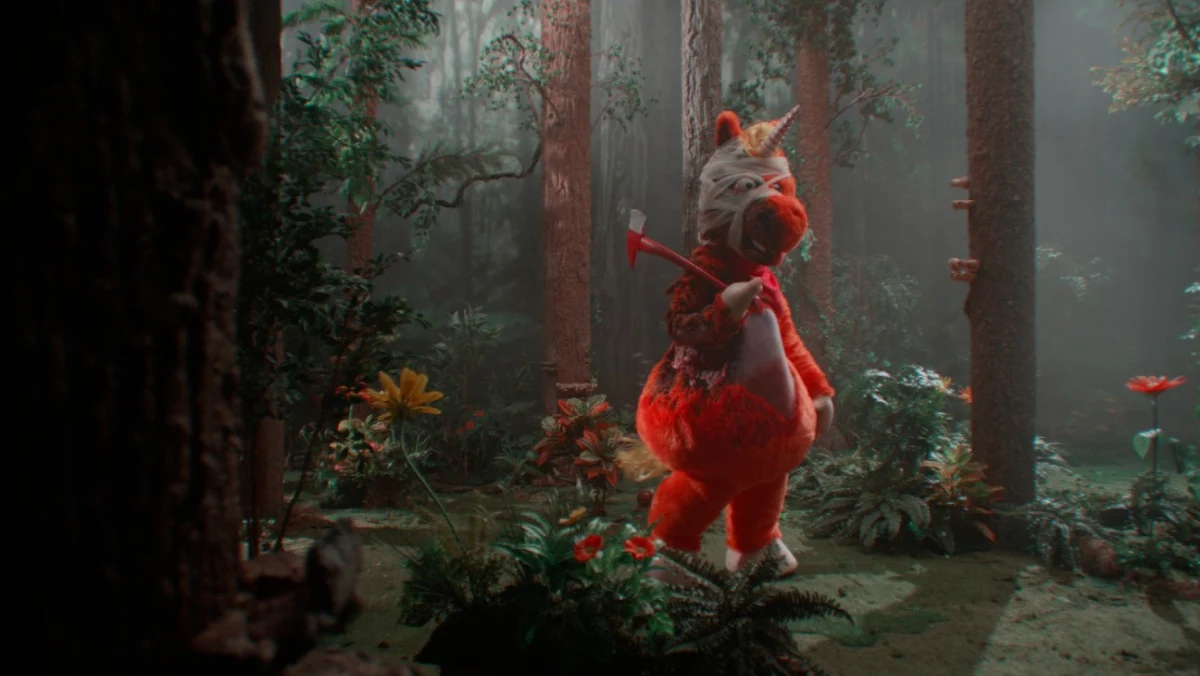
A vibrant orange unicorn, once the beacon of childlike wonder, reveals a sinister side in the recently released teaser trailer for Buddy, promising a unique blend of horror and comedy from director Casper Kelly. Roadside Attractions is set to bring this eagerly anticipated film to theaters on August 28, following its acclaimed premiere earlier this year at the prestigious Sundance Film Festival. The film boasts an impressive ensemble cast, featuring the talents of Cristin Milioti, Keegan-Michael Key, Topher Grace, Delaney Quinn, Patton Oswalt, and Michael Shannon, whose collective presence hints at a narrative rich in both psychological depth and dark humor.
The Genesis of a Twisted Tale: From Childhood Innocence to Unsettling Horror
Buddy centers on its titular character, a bright orange unicorn who is the beloved host of a classic children’s television program, It’s Buddy! The teaser trailer expertly juxtaposes idyllic scenes of Buddy dancing joyfully with children on his vibrant set against unsettling glimpses of terror, hinting at the profound shift the film takes. The premise hinges on a seemingly innocuous moment: when a child deviates from the prescribed fun, Buddy’s cheerful demeanor shatters, revealing a darker, more menacing persona. This disruption exposes the meticulously crafted, seemingly perfect world of the children’s show as a facade, beneath which lies an unnerving reality. The film taps into a primal fear—the corruption of innocence and the betrayal of trust from figures designed to nurture and entertain.
The narrative structure appears to navigate the delicate balance between genuine scares and comedic relief, a hallmark of the horror-comedy genre. It plays on the unsettling nature of mascots and children’s entertainers, a trope that has seen a resurgence in popular culture. The contrast between Buddy’s initial, saccharine image and his subsequent malevolent transformation is designed to disarm and then shock the audience, making the horror elements more potent by subverting expectations of comfort and familiarity. This thematic core allows Buddy to explore the darker undercurrents of childhood media and the often-unseen pressures and expectations placed upon both performers and their young audiences.
Casper Kelly: Architect of the Absurd and Master of Viral Horror
The directorial vision behind Buddy comes from Casper Kelly, a name synonymous with genre-bending, surrealist humor, and unexpected horror. Kelly is perhaps best known for creating Adult Swim’s viral 2014 horror short, Too Many Cooks. This thirteen-minute television segment, which rapidly gained cult status and internet notoriety, started as a typical 1980s sitcom opening sequence before devolving into a nightmarish, infinitely looping, and increasingly violent surrealist horror piece. Too Many Cooks was lauded for its audacious originality, its meta-commentary on television tropes, and its ability to evoke profound discomfort through repetition and subtle, then overt, shifts into the grotesque.
Kelly’s background with Adult Swim—a programming block celebrated for its unconventional, often experimental content—has undoubtedly shaped his unique approach to filmmaking. His work consistently demonstrates a willingness to push boundaries, challenge audience expectations, and blend disparate genres in unexpected ways. The success of Too Many Cooks proved Kelly’s aptitude for crafting compelling narratives within a short runtime and his skill in creating memorable, unsettling imagery. For Buddy, this history suggests that audiences should anticipate a film that is not merely a straightforward horror-comedy but one that likely incorporates elements of satire, meta-commentary, and a distinct visual style that blurs the lines between reality and nightmare. His involvement signals a film that will likely lean into the absurd, using humor as a vehicle to deliver its more terrifying moments, rather than just as comic relief. This stylistic lineage suggests that Buddy might not just deliver scares and laughs but also provoke thought about media consumption and the hidden depths of seemingly innocuous entertainment.
A Stellar Cast Elevates the Twisted Narrative
The strength of Buddy is further bolstered by its impressive cast, a mix of comedic stalwarts and dramatic powerhouses. The critical reception at Sundance, particularly the positive remarks from The Hollywood Reporter‘s chief film critic David Rooney, highlighted Keegan-Michael Key’s "inspired voice work as the title character" as the film’s "biggest plus." Key, renowned for his improvisational skills and incredible vocal range demonstrated in Key & Peele and various animated features (e.g., The Lion King, Toy Story 4), is ideally suited to embody Buddy’s dual nature. His ability to seamlessly transition between endearing charm and unsettling menace through voice alone will be crucial in selling the film’s core concept. The voice performance of a character like Buddy is paramount; it’s the primary conduit for conveying emotion and intent, and Key’s established versatility promises a nuanced and captivating portrayal of the anthropomorphic unicorn.
Cristin Milioti, known for her roles in critically acclaimed projects like Palm Springs and Made for Love, brings a particular gravitas to the film. Her background in dark comedies and genre-bending narratives makes her a perfect fit for Buddy‘s unique tone. Milioti has a proven track record of portraying characters navigating bizarre and often unsettling circumstances with a blend of humor and vulnerability, qualities that will undoubtedly serve her well in this horror-comedy context.
The supporting cast further enriches the film’s potential. Topher Grace, who has demonstrated range across both comedy (That ’70s Show) and drama (BlacKkKlansman), adds another layer of talent. Patton Oswalt, a celebrated comedian and experienced voice actor (e.g., Ratatouille, BoJack Horseman), brings his distinctive comedic timing and expressive vocal capabilities, which could be utilized for either comedic relief or to enhance the film’s unsettling atmosphere. Michael Shannon, recognized for his intense and often formidable dramatic performances (Nocturnal Animals, The Shape of Water), adds a serious dramatic weight to the ensemble, suggesting that the film will not shy away from genuine dramatic tension or unsettling moments. The combination of these performers, with their diverse skill sets, suggests a film that will be rich in character development and dynamic performances, underpinning the fantastical horror-comedy premise with believable human reactions.
Sundance Premiere and Initial Critical Reception
Buddy made its world premiere at the Sundance Film Festival earlier this year, a prestigious platform renowned for showcasing independent and genre-defying cinema. Sundance has a long history of launching films that go on to achieve critical acclaim and cult status, particularly within the horror and comedy genres, often providing a crucial springboard for unique voices and unconventional narratives. The festival’s programming committee is known for its discerning taste, and the inclusion of Buddy speaks to its perceived artistic merit and innovative approach.
However, initial critical reception, as encapsulated by David Rooney’s review for The Hollywood Reporter, suggests a nuanced take. Rooney noted that the movie "stretches its sketch-comedy idea to feature length by upping the gore and the demented detours but doesn’t go far enough to be as extreme or disturbing as it wants to be." This specific critique offers valuable insight into the film’s potential strengths and weaknesses. It implies that while Buddy successfully expands a concept that might typically thrive in a shorter format, its execution of extreme horror might not fully satisfy those seeking a truly boundary-pushing experience. This often presents a challenge for films adapting short-form, high-concept ideas into feature-length narratives; maintaining intensity and novelty across a longer runtime can be difficult.
Despite this observation, Rooney’s praise for Keegan-Michael Key’s performance indicates that the film’s core creative elements—particularly its characterization and voice work—are strong. The critique suggests that while Buddy might not be a groundbreaking horror film in terms of sheer terror, it likely excels as a character-driven dark comedy, leveraging its unique premise and stellar cast to deliver an engaging, albeit perhaps not overtly shocking, experience. This type of reception often leads to films developing a strong fan base among those who appreciate its specific blend of humor and mild horror, rather than those seeking pure, unadulterated scares. The Sundance premiere thus positioned Buddy as a thought-provoking entry in the horror-comedy landscape, initiating conversations about its balance of genre elements and its overall impact.
Production Journey and Behind-the-Scenes Talent
The journey of Buddy from concept to screen is a testament to collaborative filmmaking. Casper Kelly not only directed the film but also co-wrote the script with Jamie King, suggesting a unified creative vision from inception. This dual role often allows directors to maintain a strong authorial voice throughout the production process, ensuring that the final product closely aligns with their original intent. The collaborative writing process between Kelly and King likely refined the script, balancing its comedic timing with its horror elements and ensuring the narrative flow for a feature-length film.
A robust team of producers brought the project to fruition, with Tyler Davidson, Drew Sykes, Raphael Margules, J.D. Lifshitz, and Tracy Rosenblum serving as key figures in overseeing the film’s development and production logistics. Their collective experience is vital in navigating the complexities of independent filmmaking, from securing financing to managing the day-to-day operations on set. The executive producer roster, which includes Kelly, King, Kevin Flanigan, Dexter Braff, Roberto Linck, Nathan McAuley, Emilio Schenker, Gideon Tadmor, Adam J. Wilde, Geoff Yaw, and Ryan J. Kelly, further illustrates the extensive network of support and financial backing required for such a project. Executive producers often play crucial roles in securing funding, offering creative input, and facilitating distribution deals, all of which are essential for an independent film aiming for a wide theatrical release.
The film’s distribution by Roadside Attractions is also noteworthy. Roadside Attractions has a strong reputation for acquiring and distributing critically acclaimed independent films, often with a focus on character-driven narratives and unique genre pieces. Their involvement suggests a strategic approach to marketing Buddy to an audience that appreciates intelligent, well-crafted cinema beyond mainstream blockbusters. Their track record indicates a commitment to promoting films that resonate with niche audiences and often garner awards recognition, positioning Buddy within a lineage of thoughtful, independent productions.
The Broader Landscape: The Rise of "Mascot Horror" and Corrupted Innocence
Buddy arrives at a time when the "mascot horror" or "creepy mascot" subgenre is experiencing a significant surge in popularity. This trend involves taking characters traditionally associated with childhood innocence, joy, and comfort—such as beloved cartoon figures, video game characters, or theme park mascots—and twisting them into figures of terror. Examples abound, from the global phenomenon of the Five Nights at Freddy’s video game series and its recent film adaptation, to the more extreme and independent horror features like Winnie the Pooh: Blood and Honey and The Banana Splits Movie. These films capitalize on a profound psychological discomfort: the corruption of childhood memories and the subversion of trust.
The appeal of mascot horror lies in its ability to tap into deep-seated fears. Children’s characters are designed to be comforting and predictable, representing a safe, idealized world. When these figures turn malevolent, they shatter that illusion, creating a powerful sense of uncanny valley horror—something that looks human (or familiar) but behaves unnaturally, triggering revulsion and fear. This subversion is particularly effective because it preys on nostalgia, twisting fond memories into unsettling nightmares. For many, the idea of a beloved childhood icon becoming a source of terror is inherently more disturbing than a generic monster, as it signifies a betrayal of innocence and a loss of safety.
Buddy carves its own niche within this burgeoning genre by featuring a unicorn, a creature traditionally symbolizing purity, magic, and wonder. By transforming this mythical symbol into a sinister entity, the film elevates the "corrupted innocence" trope, moving beyond mere anthropomorphic animals to a more ethereal, yet equally unsettling, subversion. This choice allows Buddy to explore themes of illusion, performance, and the hidden darkness beneath a polished, cheerful exterior with a unique fantastical element. It suggests that the film aims not just for jump scares but for a more thematic exploration of how perceived perfection can conceal profound malevolence, making it a significant contribution to the evolving landscape of horror cinema that challenges and redefines traditional sources of fear.
Anticipated Impact and Future Outlook
As Buddy prepares for its theatrical release, its trajectory will be closely watched by fans of independent horror, dark comedy, and those intrigued by Casper Kelly’s distinctive style. The film’s success will likely be measured not solely by box office receipts, given its indie nature, but also by its ability to resonate with audiences and critics, potentially achieving cult status similar to Kelly’s previous viral hit, Too Many Cooks. Films that successfully blend genres often cultivate dedicated fan bases who appreciate their unconventional narratives and unique artistic visions.
The August 28 release date positions Buddy in a competitive late summer slot, but its unique premise and strong cast could help it stand out amidst larger studio productions. Roadside Attractions’ distribution strategy will be crucial in targeting the right audience, leveraging its Sundance premiere and the buzz generated by the teaser trailer. The film’s ability to balance its comedic and horror elements will ultimately determine its broad appeal and its longevity in the cultural conversation.
Beyond its immediate release, Buddy has the potential to contribute to the ongoing evolution of the horror-comedy genre. By pushing the boundaries of what constitutes a "creepy mascot" and by infusing its narrative with the surreal, satirical sensibilities of Casper Kelly, the film could inspire future filmmakers to explore similar thematic territories with renewed creativity. Its success might also further cement Keegan-Michael Key’s reputation as a versatile performer capable of excelling in a wide array of roles, including complex voice work in genre-defying cinema. Ultimately, Buddy promises to be a memorable cinematic experience, challenging perceptions of innocence and entertainment, and leaving audiences to ponder the true nature of their beloved childhood icons long after the credits roll.