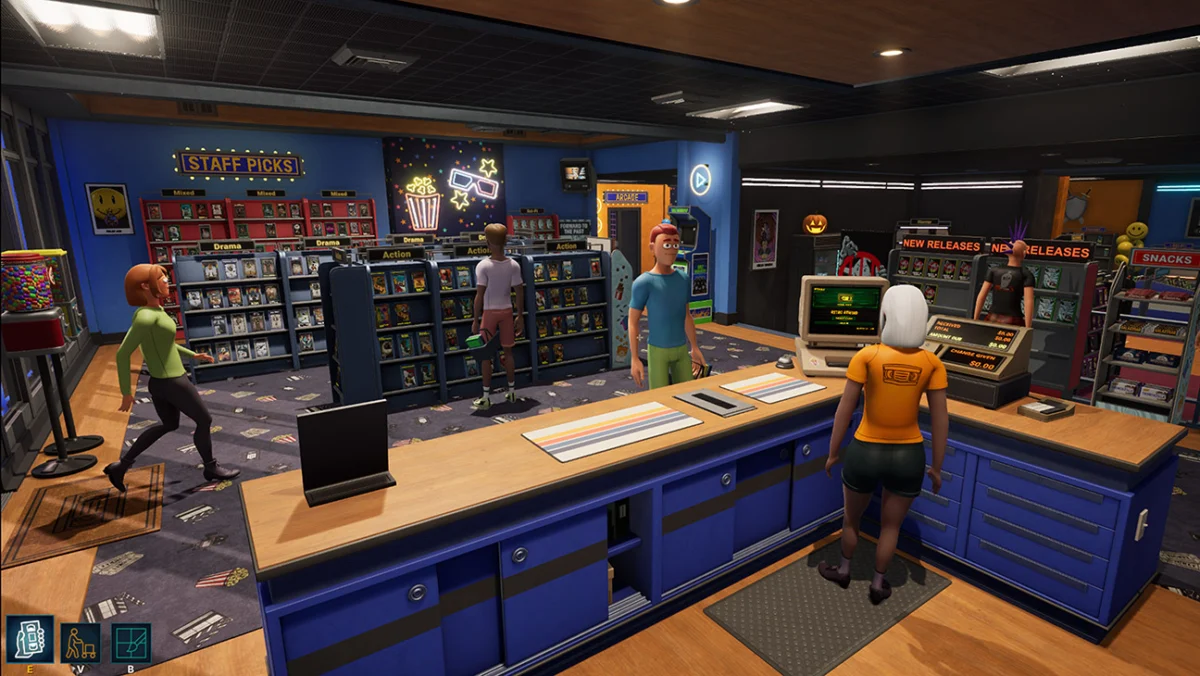
The digital storefront of Steam, the world’s largest distribution platform for PC gaming, recently witnessed an unexpected surge from an independent title that trades modern high-fidelity graphics for the grainy, magnetic charm of the 1990s. Retro Rewind: Video Store Simulator, developed by the Quebec-based Blood Pact Studios, debuted at the number one spot on Steam’s top-seller list upon its release last Tuesday. The game, which tasks players with managing a fictionalized version of a late-20th-century video rental outlet, has maintained a consistent position within the platform’s top 10 titles, signaling a robust market appetite for "cozy" simulation games and millennial-era nostalgia.
The Mechanics of a Bygone Era
Retro Rewind: Video Store Simulator offers a comprehensive management experience set in the early 1990s. Players assume the role of a store owner responsible for every facet of the business, from the macro-level aesthetic design of the floor plan to the micro-level tasks of daily operations. The gameplay loop includes designing the store layout, managing inventory, working the checkout counter, and handling concessions.
In a direct nod to the era of physical media, the game incorporates mechanical tasks that have long been obsolete in the age of digital streaming. Players must manually restock shelves and, most notably, "rewind" returned VHS tapes—a task that serves as both a gameplay mechanic and a thematic cornerstone of the experience. The economy within the game is strictly "cash only," reflecting the pre-digital transaction standards of the period, with pricing models meticulously adjusted to reflect 1990s inflation rates.
To populate the shelves of this virtual store, Blood Pact Studios utilized modern technology to recreate the past. The game features approximately 14,000 fictional movie titles. While the vast majority of these titles and their accompanying box art were generated using artificial intelligence prompts to create a sense of overwhelming variety, lead developer Samuel Gauthier personally spearheaded the creation of 21 "tentpole" films. These titles are parodies of genuine 1990s blockbusters; for instance, the Ghostbusters franchise is reimagined as "Phantom Patrol." These core films roll out on a weekly basis within the game’s internal calendar, mimicking the "New Release Tuesday" culture that defined the video rental industry for decades.
From Bonesaw to Business Management: A Strategic Pivot
The success of Retro Rewind marks a significant turning point for Blood Pact Studios, a small independent outfit co-founded by Gauthier. The studio’s previous project, titled Bonesaw, was a starkly different experience. Directly inspired by the high-stakes tension of Buckshot Roulette, Bonesaw was a gory, Russian Roulette-style card game where players faced off against a demonic entity, risking physical mutilation—specifically the loss of fingers via a buzzsaw—upon losing a hand.
While Bonesaw achieved a modest level of cult success, selling approximately 10,000 copies, its financial return was insufficient to sustain the studio. Priced at $6.66 to match its macabre theme, the game failed to generate the revenue necessary for long-term stability or to support a full-time staff. Gauthier, a 33-year-old father of two, recognized the need for a more commercially viable and accessible genre.
The development of Retro Rewind spanned 15 months, characterized by grueling 60-plus-hour work weeks. The shift from a niche horror-strategy game to a family-friendly management simulator was a calculated business move. Simulation games have seen a meteoric rise in popularity over the last five years, with titles like PowerWash Simulator and Gas Station Simulator proving that mundane tasks, when gamified, possess significant "loopability" and broad market appeal.
The Genesis of the Project: Personal History and Market Trends
The inspiration for Retro Rewind was born from a mix of financial necessity and personal anecdote. Gauthier, who grew up in a small town in Quebec, noted that his childhood memories of movie rentals were tied to local independent shops rather than the corporate giant Blockbuster Video, which he had never actually visited.
The conceptual spark occurred during a conversation with his children, aged nine and five. When Gauthier attempted to explain the concept of leaving the house to physically rent a movie, his children found the premise difficult to comprehend. This generational gap highlighted an opportunity to preserve a specific cultural moment through interactive media.

"I thought, maybe we should do something like that so I can show them," Gauthier stated regarding the game’s origin. By creating a digital archive of the video store experience, Gauthier has provided a tool for parents to share their own histories with a younger generation that has only ever known on-demand streaming.
Historical Context: The Rise and Fall of the Video Rental Giant
The backdrop of Retro Rewind is inextricably linked to the history of Blockbuster Video, the company that defined the industry the game simulates. Founded in 1985 in Dallas, Texas, Blockbuster grew to dominate the global market, reaching its peak in 2004 with over 9,000 stores and a valuation in the billions.
The game’s setting in the early 1990s captures the industry at its most influential, before the advent of the DVD and the subsequent rise of Netflix. Industry analysts often point to the year 2000 as the definitive turning point in this history. In a now-legendary meeting, Netflix co-founders Reed Hastings and Marc Randolph offered to sell their fledgling DVD-by-mail service to Blockbuster for $50 million. Blockbuster’s then-CEO, John Antioco, famously declined the offer, viewing Netflix as a niche business with no viable future.
Retro Rewind allows players to operate within an alternate timeline where the physical rental model remains supreme. Gauthier has expressed interest in expanding the game to include the transition to DVDs, which would introduce new mechanics such as disc cleaning and repair, replacing the manual labor of rewinding tapes. He has even floated the idea of a sequel or end-game scenario where the player’s store must evolve into a streaming service to survive, potentially correcting the historical "mistake" made by Blockbuster’s real-world leadership.
Technical Challenges and Future Expansion
Despite the game’s success on the PC platform, its future on home consoles remains uncertain. Currently, Retro Rewind is optimized for mouse-and-keyboard input, common for the point-and-click nature of management simulators. Porting the game to platforms such as the PlayStation 5, Xbox Series X/S, or the rumored "Nintendo Switch 2" presents significant hurdles.
Gauthier noted that development kits for these consoles are prohibitively expensive for a small indie studio, and the technical labor required to adapt the user interface for controllers is substantial. However, the game is currently compatible with Valve’s Steam Deck, allowing for handheld play which has become a crucial market segment for indie developers.
The studio’s immediate focus remains on post-launch support and addressing "big requests" from the player base. While Gauthier and his anonymous partner are eager to return to the multiplayer and cooperative spaces—citing the isolation of play-testing a solo simulator as a creative challenge—the continued commercial performance of Retro Rewind may necessitate a longer commitment to the simulator genre.
Market Analysis and Broader Implications
The success of Retro Rewind: Video Store Simulator is indicative of the "Nostalgia Economy," a trend where products leveraging the aesthetics and experiences of the 1980s and 90s find high resonance with the Millennial demographic. As this generation now possesses the primary purchasing power in the gaming market, experiences that evoke childhood memories have become highly lucrative.
Furthermore, the game’s use of AI to generate 14,000 titles highlights a growing trend in indie development: the use of procedural or AI-assisted content to provide the "illusion of scale." For a two-person team, manually creating 14,000 unique assets would be an impossible task. By leveraging these tools, Blood Pact Studios was able to deliver a product that feels "lived-in" and expansive, rivaling the content volume of much larger studios.
As of its first week, Retro Rewind is retailing at approximately $19.90 (with initial launch discounts bringing it lower). If sales continue at their current trajectory, the game is poised to become one of the most successful indie simulation launches of the year. It serves as a case study in how small developers can find success by identifying underserved niches—in this case, the tactile, mechanical nostalgia of the VHS era—and delivering a focused, polished experience that resonates across generations.