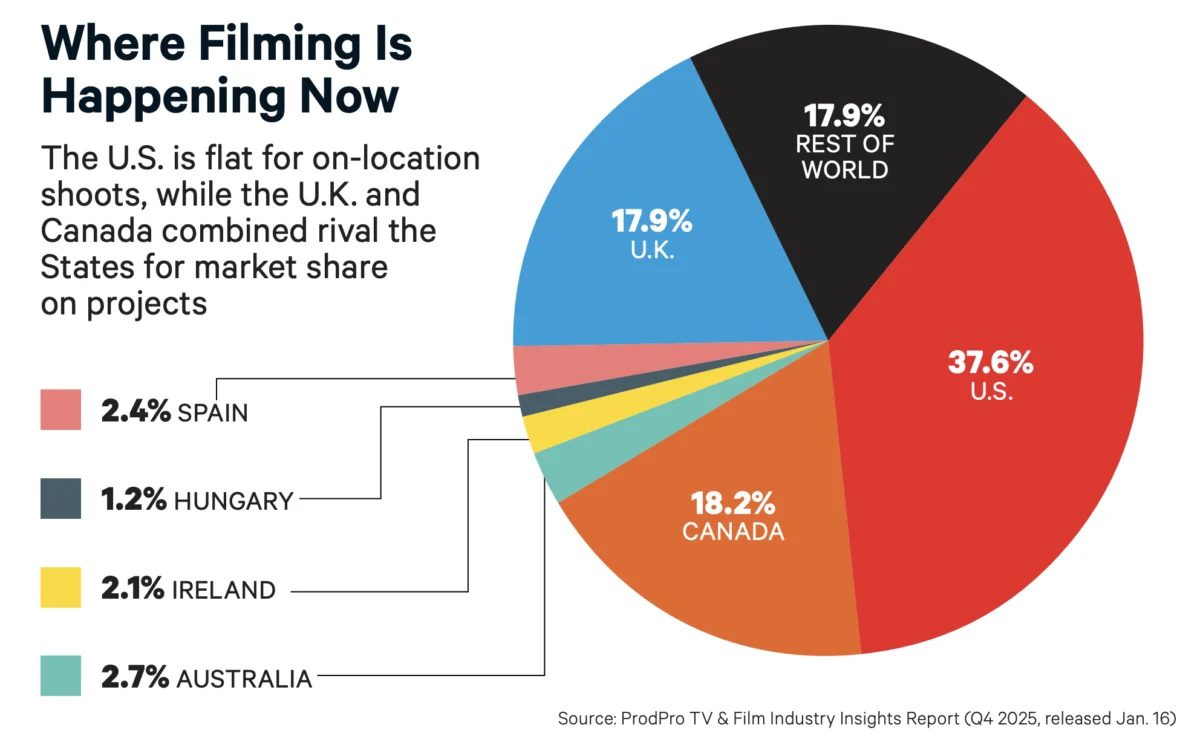
The landscape of the American entertainment industry is undergoing a seismic shift that threatens its century-long status as the world’s primary production hub. A convergence of rapid corporate consolidation, aggressive international tax subsidies, and a post-pandemic contraction has led to a startling exodus of film and television projects from the United States. During a high-stakes hearing convened on Friday at Burbank City Hall, U.S. Senator Adam Schiff, joined by industry advocates and labor leaders, sounded the alarm on what many consider an existential crisis for Southern California’s economic engine. The data presented was stark: nearly half of all scripted films and series produced last year were shot outside the United States, while Los Angeles County alone saw the evaporation of more than 42,000 entertainment-related jobs between 2022 and 2024. As the industry grapples with these losses, the push for a federal tax incentive has moved from a peripheral policy discussion to a central legislative priority for those hoping to keep the "Made in America" label on global entertainment.
The Economic Toll of Runaway Production
The hearing in Burbank served as a forum for detailing the systemic erosion of the domestic production infrastructure. For decades, the phenomenon known as "runaway production" was viewed as a localized issue managed through state-level incentives in places like Georgia, New York, and California. However, the current trend has escalated into a global competition that the United States is increasingly losing. According to data cited during the proceedings, the U.S. share of global production has plummeted from 52 percent to just 38 percent in a relatively short window of time.
This decline is most visible in the employment statistics of below-the-line workers—the electricians, carpenters, hair stylists, and camera operators who form the backbone of the industry. The International Alliance of Theatrical Stage Employees (IATSE) reported that employment for these workers has dropped by a staggering 45 million hours since 2022. This loss of work represents more than just a dip in corporate profits; it signifies a hollowing out of the middle class in cities like Los Angeles and Burbank. Senator Schiff emphasized that the "urgency cannot be greater," noting that the traditional reliance on state-level credits is no longer sufficient to compete with the national-level subsidies offered by countries like the United Kingdom, Canada, and Australia.
Corporate Consolidation and the Production Deficit
One of the most contentious points of the hearing involved the role of major studios and the impact of unprecedented corporate consolidation. Senator Schiff specifically highlighted the pending maneuvers involving Paramount, Skydance, and Warner Bros. Discovery. The trend of merging giant media entities has historically led to "cost-cutting synergies," which often translate to fewer greenlit projects and a greater reliance on cheaper international locales for those that do move forward.
The numbers illustrate a concerning trend among the industry’s biggest players. Over the last two years, Paramount, Skydance, and Warner Bros. Discovery combined to produce only 15 theatrical movies that were filmed within the United States. This figure is a fraction of the output seen in previous decades and underscores a shift in strategy where "tentpole" blockbusters—the massive productions that generate the most local economic activity—are increasingly outsourced to overseas hubs. IATSE President Matt Loeb noted during the hearing that while studios may commit to producing a specific number of films annually, such as the 30-picture-per-year commitment discussed in recent merger talks, those promises lack domestic value if the work is performed abroad. "A commitment to 30 pictures doesn’t mean anything unless they’re done here," Loeb stated, reflecting the frustration of a workforce that sees its opportunities exported to the U.K. and beyond.
Case Study: The Financial Reality of The Pitt
To provide a concrete example of how incentives influence production decisions, the hearing featured testimony from Noah Wyle, the star and executive producer of the upcoming series The Pitt. Wyle described his show as a "proof of concept" for the efficacy of subsidies. By utilizing California’s 20 percent tax credit, the production received a rebate of approximately $760,000 per episode. This incentive lowered the total first-season expenditure from an estimated $100 million to $88 million.
The $12 million difference is not merely a line item on a balance sheet; it represents the equivalent of the cost of two entire episodes. Wyle argued that without such incentives, the financial pressure to move production to a cheaper international location would be nearly insurmountable for producers. "It is vital to the strength of the industry and city to support these incentives," Wyle said. "It’s an investment in the city’s most precious commodity and asset—it’s an investment in its people." The testimony highlighted that when a production stays in the U.S., the financial benefits extend far beyond the studio lot, trickling down to local caterers, dry cleaners, and lumber yards that supply the sets.
The Global Subsidy War
The United States currently operates a patchwork of state-level incentives, with California, Georgia, and New York leading the way. However, these states are now competing not just with each other, but with entire nations that offer more streamlined and lucrative federal packages. The United Kingdom, for instance, recently enhanced its Audio-Visual Expenditure Credit (AVEC), offering a 34 percent credit on qualifying expenditures. Such robust national policies have made the U.K. a primary destination for major studio "tentpoles," drawing away the high-budget projects that once anchored the California economy.

Rep. Lou Correa, who also participated in the hearing, expressed concern over the government’s slow response to this shifting global landscape. "We’re always reacting," Correa remarked. "We’re not ahead of the curve here. It’s going to hurt us." The lack of a unified federal policy in the U.S. creates a disadvantage, as studios must navigate varying rules and caps in different states, whereas international competitors offer a stable, national framework that provides long-term certainty for multi-year projects.
The Call for a Federal Tax Incentive
The centerpiece of Senator Schiff’s legislative vision is the creation of a federal film and TV tax credit. The proposed policy would aim to level the playing field by providing a baseline incentive for productions that remain within the United States. Proponents argue that such a move would not only retain jobs but also protect the "cultural diplomacy" that American entertainment provides globally.
Labor leaders like Matt Loeb argue that without a comprehensive federal policy response, the U.S. risks "turning its back on a signature American industry." The argument for a federal credit is built on the premise that the entertainment industry is a vital part of the U.S. export economy. When productions move abroad, the U.S. loses tax revenue, specialized labor talent, and the secondary economic benefits generated by large-scale filming operations. Schiff and his colleagues are looking to build a bipartisan coalition that views film production through the lens of industrial policy, similar to how the government supports the semiconductor or renewable energy sectors.
Industry Implications and the Path Ahead
The challenges facing Hollywood are multifaceted. Beyond the competition for tax credits, the industry is still recovering from the dual strikes of the Writers Guild of America (WGA) and SAG-AFTRA in 2023, which halted production for months and accelerated the trend of studios looking for ways to reduce costs. Additionally, the rise of streaming-led "peak TV" has cooled, leading to a "contraction" where fewer shows are being ordered overall.
In this environment of scarcity, the location of production becomes a zero-sum game. If a federal tax credit is implemented, it could signal a reversal of the current trend. Loeb observed that the flight of production happened quickly, but it could be corrected with the right incentives. "They moved that fast and they can come back that fast," he said, referring to the studios’ ability to pivot their operations based on financial viability.
However, the path to a federal incentive is fraught with political and fiscal hurdles. Critics of film subsidies often argue that they represent "corporate welfare" and that the economic benefits are sometimes overstated. To succeed, Schiff and his allies will need to demonstrate that a federal credit is a revenue-neutral or revenue-positive endeavor that protects American jobs from foreign poaching.
Conclusion: Protecting an American Legacy
The hearing in Burbank concluded with a sense of renewed purpose but also a sober recognition of the work ahead. The entertainment industry is not just a collection of studios; it is an ecosystem of hundreds of thousands of workers whose livelihoods depend on the physical act of production taking place on American soil. As Hollywood faces the twin pressures of corporate consolidation and global competition, the call for federal intervention has become a rallying cry for those who believe that the future of American storytelling should be written, filmed, and produced at home.
The data remains the most compelling witness to the current crisis: the loss of 42,000 jobs and the drop in global production share are markers of an industry in retreat. For Senator Schiff and the leaders gathered in Burbank, the proposed federal tax incentive is more than a fiscal policy—it is a necessary defense of a cornerstone of the American economy. As the legislative process moves forward, the industry will be watching closely to see if Washington can act with the same speed and decisiveness as the international competitors currently luring Hollywood away.