The animated feature film, KPop Demon Hunters, has transcended its genre to become an international cultural phenomenon, culminating this past week with two prestigious Academy Awards: Best Animated Feature and Best Original Song. The film’s infectious music, compelling characters, and unique narrative have captured the imagination of audiences worldwide, signaling a significant moment in global entertainment.
A Symphony of Souls and Pop Music: The Narrative Unveiled
At its core, KPop Demon Hunters presents a classic battle between good and evil, reimagined through the vibrant lens of Korean pop culture. For centuries, humanity has faced the existential threat of a demonic king intent on consuming souls to expand his dominion. This relentless assault has been held at bay by a mystical barrier known as the Honmoon, a powerful ward sustained by the harmonious three-part vocals of a trio of female demon hunters and, crucially, the collective passion of their devoted fanbase.
The film’s innovative premise lies in its cyclical nature of defense. Each generation of demon hunters comprises a popular girl group, their musical genre evolving to reflect the prevailing trends of their era. In this iteration, the chosen genre is K-Pop, the globally recognized Korean pop music industry. The narrative centers on Rumi, Mira, and Zoey, the current K-Pop demon-hunting trio, as they strive to manifest the ultimate power: the golden Honmoon. This legendary artifact, if achieved, possesses the singular ability to permanently banish the demonic forces.
The Enduring Power of the Adorable Animal Sidekick
The film’s success also owes much to its masterful integration of a beloved narrative trope: the adorable animal sidekick. This narrative device, a cornerstone of animated storytelling since the inception of Hollywood animation, provides comic relief, emotional grounding, and often crucial plot assistance. From Jiminy Cricket’s moral guidance in Pinocchio to Mushu the spirited dragon in Mulan and Sebastian the crab’s flamboyant support in The Little Mermaid, protagonists have consistently benefited from these charming, non-human companions.
KPop Demon Hunters introduces two such characters, embodying a pair of animal powers deeply rooted in Korean folklore. While not explicitly named within the film’s dialogue, the creative team behind the production has referred to them as the "Derpy Tiger" and "Sussie Bird." These figures are not mere whimsical additions; they are integral to Korean folk art and mythology, frequently depicted together in traditional narratives.
Origins and Evolution: From Shadow to Spectacle
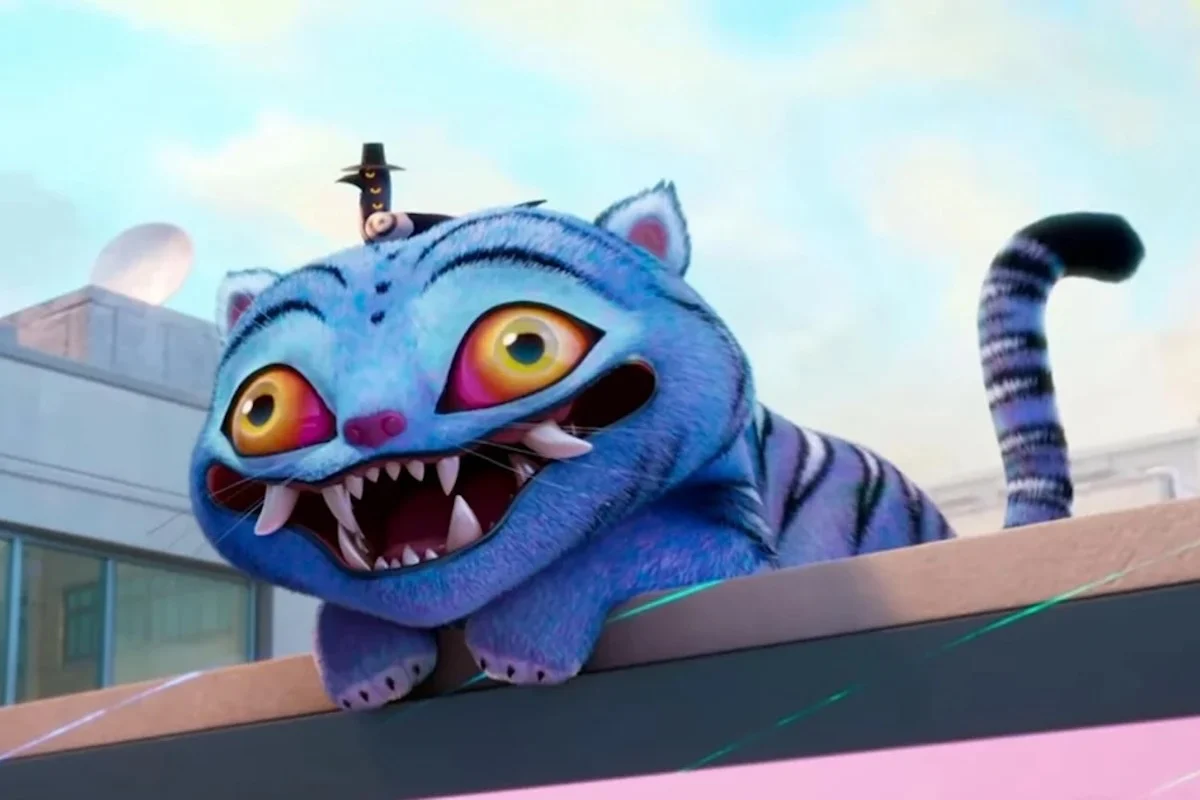
The audience first encounters the Derpy Tiger and Sussie Bird in the shadowy depths of the demon realm, initially appearing as ominous silhouettes tethered to Jinu, the demonic musician. As the film progresses, their forms emerge into the light, revealing distinct visual identities. The Sussie Bird is rendered as a geometric marvel of black and white, adorned with a striking tall-crowned hat. The Derpy Tiger, a creature of vivid blue, possesses enormous fangs and a perpetual, disarming grin, its eyes glowing with a lambent golden hue.
Their primary narrative function is that of intermediaries, facilitating communication between Jinu and Rumi. Their supernatural abilities allow them to traverse dimensions, melting into surfaces and reappearing at will. The tiger serves as a mobile messenger, carrying Jinu’s communications on its tongue, often depicted as a small card. The magpie, meanwhile, perches atop the tiger’s head or observes from the periphery, its multiple eyes keenly attentive.
Despite their initially foreboding introduction and dark origins, neither the tiger nor the bird ultimately embodies malice. Their role is largely neutral, characterized by diligence and a commitment to their assigned tasks. While the tiger’s imposing size and the bird’s peculiar nature might initially inspire apprehension, they are ultimately portrayed as non-threatening figures.
The Universal Force of "Kawaii"
The film’s creative team emphasizes that the power wielded by these animal companions is the "power of cute." This concept, recognized globally and particularly prominent in Japanese culture as "Kawaii," has become a potent force in modern society. Cute animals dominate internet culture and social media platforms, underscoring humanity’s innate attraction to the endearing.
The appeal of cuteness transcends conventional definitions. It is not limited to small, fuzzy, or harmless creatures. From the captivating intricacy of jumping spiders to the formidable presence of sharks and snakes, humans possess a remarkable capacity to find adorability in a wide spectrum of beings. This phenomenon is not without its potential pitfalls, as humorously captured by the popular meme, "If not friend, then why friend-shaped?" This sentiment highlights the potential for misjudgment when human perception of cuteness overrides an understanding of an animal’s true nature, particularly in the wild.
A Glimpse of Humanity in the Demonic
Within KPop Demon Hunters, the Derpy Tiger and Sussie Bird serve a critical narrative purpose: they subtly suggest that Jinu, the demonic antagonist, may not be entirely devoid of good. A pivotal moment occurs when Rumi inquires about the bird’s hat. Jinu’s response, "I made it for the tiger, but the bird keeps taking it," reveals a paternalistic and tender gesture. The act of crafting an accessory for a companion animal is profoundly human, echoing the widespread internet trend of "snakes in hats" and countless other instances of humans adorning their pets.
Beyond this sartorial detail, the interactions between Jinu and Rumi with the tiger further underscore this theme. Affectionate glances, casual strokes, and even the tiger’s purr in response, all demonstrate an inherent human impulse to form bonds with other species.
This capacity for interspecies empathy and the outward expression of affection are presented as the emotional heart of the film. It is this nuanced portrayal of connection, amplified by the charming presence of the animal companions, that elevates KPop Demon Hunters beyond a simple musical fantasy. While the K-Pop soundtrack and the dynamic characters provide a strong foundation, the Derpy Tiger and Sussie Bird add an indispensable layer of emotional depth, making their presence integral to the film’s celebrated success. The creative team’s decision to weave these folkloric creatures into the narrative has clearly resonated with audiences, demonstrating the enduring power of art to explore complex themes through universally understood elements.