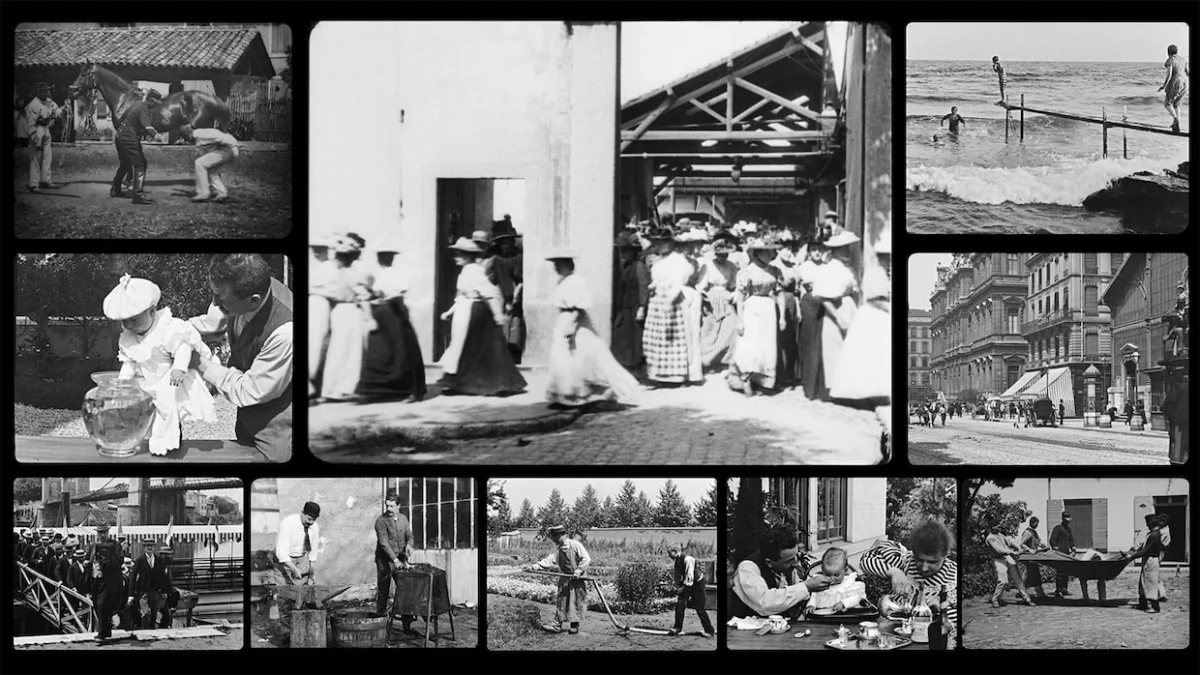
Thierry Frémaux, the influential 65-year-old French cultural figure, occupies a unique position at the nexus of cinema’s illustrious history and its evolving future. As the head of programming and operations for the prestigious Cannes Film Festival, which prepares for its 79th edition, and the director of the Lumière Institute and its accompanying Lumière Festival in Lyon, Frémaux maintains a pivotal role in both celebrating and shaping the medium. His latest endeavor, the newly released film Lumière, Le Cinema!, sees him don the filmmaker’s hat once more, offering an essayistic exploration of the pioneering Lumière brothers, Auguste and Louis, whose Cinématographe revolutionized public entertainment over 130 years ago. This cinematic project, a spiritual successor to a 2016 predecessor, meticulously compiles approximately 100 of the short films shot by the siblings during the nascent stages of cinema, underscored by Frémaux’s contemplative voiceover on the profound significance of their achievements.
Frémaux’s multifaceted career allows him an unparalleled perspective on the challenges and opportunities facing cinema today. From his busy schedule in Paris, overseeing the rigorous selection process for Cannes, he recently shared insights into how his deep engagement with film history informs his contemporary programming choices and his broader vision for the medium’s future. His unique vantage point offers a critical lens through which to examine the enduring legacy of the Lumière brothers and the ongoing battle for the big screen experience in an increasingly digitized world.
The Enduring Legacy of the Lumière Brothers and Early Cinema
The Lumière brothers, often credited with the first public projection of moving pictures, fundamentally altered human perception and laid the groundwork for an entirely new art form. On December 28, 1895, at the Salon Indien du Grand Café in Paris, they presented a program of ten short films, including the iconic Workers Leaving the Lumière Factory. This event marked a pivotal moment, ushering in the era of projected cinema and establishing the communal viewing experience that would define film for over a century. Their invention, the Cinématographe, was not merely a camera but also a printer and a projector, a remarkable piece of engineering that outmaneuvered competitors like Thomas Edison’s Kinetoscope. While Edison’s device offered individual viewing through a peephole, the Lumières championed the shared spectacle, an innovation Frémaux highlights as foundational.
Frémaux notes that while the Lumières are often seen as documentarians rather than storytellers, this perception overlooks their early forays into narrative. He points to L’Arroseur Arrosé (The Sprinkler Sprinkled), a comedic film from 1895, as one of the very first fiction films. This simple yet effective narrative, depicting a child pranking a gardener, showcases a fundamental principle that Frémaux believes is often lost today: simplicity. He invokes Pablo Picasso’s sentiment, "All my life, I tried to draw like a child," to underscore the power of the Lumières’ straightforward, impactful shots. "The story of cinema is not the story of images. It’s the story of shots. Good, beautiful, efficient shots. That is the language of cinema. Lumière got that right away at the beginning," Frémaux asserts, emphasizing the purity and directness of their cinematic language.
The initial public reaction to the moving image was one of profound shock and wonder. Audiences reportedly ducked as Arrival of a Train at La Ciotat Station seemed to hurtle towards them. This visceral impact, Frémaux suggests, is difficult to replicate in an age saturated with moving images. Despite this early success, Louis Lumière is apocryphally quoted as saying that cinema was "an invention without a future." Frémaux doubts the veracity of this quote, but even if true, he acknowledges it would have been an understandable sentiment at the time. "Who could have guessed during the first months, that first spring, that this machine would become what cinema is?" he muses. The brothers themselves, despite their initial skepticism, went on to direct or produce some 2,000 films, demonstrating their evolving belief in this nascent art form. Frémaux positions the Lumières as the "last inventors of the cinema," perfecting the process that many, including Edison, had been developing, and establishing the definitive framework for cinematic projection.
Cannes and the Continuum of Cinematic Vision
Frémaux’s dual role managing both the contemporary powerhouse of Cannes and the historically focused Lumière Institute provides him with a unique, holistic perspective on cinema. He views the history of film not as a separate academic discipline but as intrinsically linked to its present and future. For him, programming films for Cannes involves a similar critical approach to studying historical works. "Looking at the history of cinema, nobody cares if you like it or don’t like it. You have to describe the movie for what it is," he explains. This objectivity translates to his selection process for Cannes: "It’s not about what I like or don’t like, is it good or bad, but what is it—and is it important or not for us to show this film?" This method ensures that the festival remains a platform for diverse and significant cinematic expressions, whether they break new ground or echo timeless themes.
The Cannes Film Festival itself, founded in 1946, emerged from the ashes of World War II with a mission to celebrate international cinematic art, free from political influence. Its long history has seen it evolve into one of the most prestigious and influential film events globally, a benchmark for artistic excellence and industry trends. Frémaux’s tenure has been marked by a commitment to both established masters and emerging talents, reflecting his belief in cinema as a continuous dialogue across generations. His film, Lumière, Le Cinema!, can be seen as an extension of this philosophy, bridging the foundational work of the Lumières with the cutting-edge cinema showcased at Cannes.
The Battle for the Big Screen: Edison’s Kinetoscope vs. Lumière’s Collective Experience

The very genesis of film exhibition presented a dichotomy that continues to resonate today: individual viewing versus communal experience. Frémaux draws a sharp contrast between Edison’s Kinetoscope and the Lumières’ Cinématographe. Edison’s coin-operated Kinetoscope, requiring a solitary viewer, represented a distinctly "American way of life" focused on individual consumption. Edison reportedly believed the French were "crazy" for projecting films to a crowd, fearing that once seen, audiences wouldn’t return. The Lumières, however, understood the power of novelty and constant creation. "Lumière said, ‘Yes, they will be back, because we will make more movies.’ And they made 2,000 films," Frémaux recounts, highlighting the foresight that underpinned the theatrical model.
This historical divergence sets the stage for today’s debate on film exhibition. The "desire of people then is our desire now: to gather together and watch cinema on the big screen," Frémaux contends. However, this assertion faces significant challenges in the 21st century. The rise of television in the mid-20th century, followed by home video, DVDs, the internet, and most recently, streaming platforms, has steadily eroded the exclusivity of the theatrical experience. Data from various film industry reports consistently shows a decline in theatrical attendance in many regions, exacerbated by the COVID-19 pandemic. For instance, box office revenues in North America in 2023, while recovering, remained significantly below pre-pandemic levels, with streaming subscriptions continuing to climb globally.
Frémaux acknowledges this shift, noting that "cinema has faced a lot of problems ever since the invention of television… and now platforms." He dismisses the notion of cinema’s death, echoing Jean-Luc Godard’s query from the 1980s, stating, "Cinema won’t die. Cinema is everywhere. Even an Instagram post has the language of cinema in it." This broader definition of "cinema" reflects the ubiquity of moving images. Yet, he is quick to differentiate between the pervasive presence of moving images and the specific, collective, big-screen experience. "In a way, are platforms like Netflix the revenge of Thomas Edison against Lumière?" he asks, drawing a compelling parallel between Edison’s individual Kinetoscope and the personalized, on-demand consumption offered by streaming services. The convenience of watching "cat videos" or blockbusters alone on a personal device stands in stark contrast to the shared awe of the early Cinématographe projections.
Challenges and Optimism for the Future of Theatrical Cinema
The "cinema industry," distinct from the broader concept of moving images, is "something we have to protect," Frémaux states. He cites prominent industry figures like Tom Rothman at Sony, a vocal supporter of theatrical exhibition, and filmmaker Sean Baker, who used his Oscar platform to advocate for the cinema experience. These voices underscore a growing concern within the industry about preserving the integrity of theatrical releases and the unique cultural practice of going to the movies.
Frémaux observes a generational shift in how audiences first encounter cinema. Younger generations, he notes, "don’t know the past. Their first shock of cinema was not on the big screen. It was on television." This contrasts sharply with previous generations, whose formative cinematic experiences were often in dark theaters. Despite this, he remains optimistic: "If you say to a child today that we’ll go to the movies next Saturday, they will be very happy. So that’s why I’m not pessimistic." This sentiment is buoyed by the cultural context of France, where cinema enjoys significant government support, including subsidies for production, distribution, and exhibition, a model envied by many other countries. This robust support system helps sustain a vibrant theatrical culture and a diverse cinematic output.
The proliferation of "content" in the digital age presents both opportunities and dilemmas. While more people are "making stuff" than ever before, Frémaux suggests that the quality and intent behind these creations are paramount. He draws a line from the French New Wave filmmakers like Godard and Bresson, and American masters like Scorsese and Tarantino, who were deeply connected to early film history, to the aspirations of contemporary artists. "I think they admire the past, the history of film, and they still want to do it," he posits, suggesting an inherent drive among true filmmakers to engage with the medium’s heritage.
The Cannes Film Festival’s unique programming approach, which allows for films to be added and altered up until the last minute, reflects the dynamic nature of contemporary filmmaking. Unlike many other festivals that lock their lineups much earlier, Cannes often accommodates late submissions or final edits. Frémaux explains, "Now, until a week before their screenings in Cannes, they can still make some changes." This flexibility, while demanding, acknowledges the intense, often last-minute creative processes of high-profile productions and ensures the festival showcases the most current versions of cinematic art.
Artificial Intelligence and the Indispensable Artist
Looking ahead, the discussion inevitably turns to artificial intelligence and its potential impact on filmmaking. Frémaux, however, dismisses fears of AI replacing human creativity. "You can write with a computer, you can write with whatever you want. But if you want to be James Joyce, Faulkner, Hemingway, or Marcel Proust, you have to have the brain for that. Nothing will replace that," he asserts. His view underscores a fundamental belief in the unique, irreplaceable spark of human artistic vision. Despite technological advancements, he maintains that "cinema is still unique." The genesis of a film, for Frémaux, remains deeply human: "One morning, an artist gets up, calls their producer with an idea. A shot to start with. And then you have a film." This simple yet profound statement encapsulates his conviction that at the heart of cinema, regardless of the tools or screens, lies the singular vision of an artist.
In a world awash with fleeting images and personalized entertainment, Thierry Frémaux stands as a resolute guardian of cinema’s enduring power—the power of a shared story, projected large, and born from a singular creative impulse, a legacy that began with the pioneering spirit of the Lumière brothers over a century ago. His work, both at Cannes and the Lumière Institute, and now through his own cinematic exploration, serves as a vital reminder of cinema’s rich past and its compelling, albeit challenged, future.