The hum of Tokyo’s futuristic cityscape provides a fitting backdrop for the 30th Anniversary Ghost in the Shell exhibition, a sprawling retrospective that delves into the profound cultural and philosophical impact of Masamune Shirow’s seminal manga and its subsequent anime adaptations. Held at Tokyo Node, a state-of-the-art event space atop the Toranomon Hills Station Tower, the exhibition offers visitors an immersive journey through three decades of groundbreaking science fiction, exploring themes of identity, consciousness, and the ever-blurring line between humanity and technology.
Upon entering the exhibition, visitors are immediately confronted by a striking recreation of a Tachikoma, the iconic multi-legged AI tanks from the Ghost in the Shell universe. This particular model, a stationary, blue, spider-legged combat vehicle devoid of human features, is brought to life through illuminated LED lights and a chipper, childlike voicebox. When prompted in rudimentary Japanese with the question, "Do you love cats?", the Tachikoma responded with surprising warmth and enthusiasm. "Yes, cats are so cute, aren’t they? I love cats, too! But… I am only an AI, so I cannot pet them. But I would love to interact with them in some small way! They are so fun to watch!" This interaction, while orchestrated through a computer and speaker, evokes a tangible sense of character and charm, prompting a shared spark of joy among onlookers. Despite its canonical armament of cloaking technology and submachine guns, this unarmed representation highlights the capacity for lovability within even a weaponized AI, a sentiment that resonates deeply with the core themes of the franchise.

While this particular Tachikoma is an unarmed statue, its interactive nature serves as a poignant reminder of the enduring appeal of AI as imagined in science fiction. The experience prompts a moment of reflection, particularly for those who harbor reservations about the modern implications of artificial intelligence, such as its potential impact on art, employment, and resource consumption. Yet, the allure of fictional AI, with its promise of enhanced capabilities and complex consciousness, remains a powerful counterpoint to these concerns. The exhibition, in this regard, becomes a space not just for celebrating a franchise, but for contemplating the persistent human search for "soul in the machine."
Immeasurable Impact
Ghost in the Shell, a franchise that has transcended the anime sphere to become a global cultural phenomenon, began as a manga in 1989, later captivating audiences worldwide with its 1995 animated feature film. Set in the fictional New Port City, Japan, in the year 2029, the narrative follows Major Motoko Kusanagi, a cyborg agent who spearheads Section 9, an elite counter-cyberterrorist unit. The original film masterfully posed fundamental questions about the nature of humanity: "What constitutes humanity, exactly? Is a mind all that matters? If so, when artificial intelligence becomes as complex as a human mind, is it not human, too? And if a human mind is converted to data, is it still human? And hey, what if an actual ghost is in a machine? How does technology change us as a species on a fundamental level?"
These existential inquiries have long been a staple of science fiction, tracing roots back to Isaac Asimov’s robot stories and Mary Shelley’s Frankenstein. Their continued relevance stems from their persistent, often unanswerable, nature. Dystopian fiction, in particular, often leverages these philosophical quandaries to explore complex themes of identity, autonomy, inequality, and conscience. The portrayal of women, often literal or figurative objects within these narratives, has been a recurring, albeit complex, element in cyberpunk and cyborg stories, sparking debates about objectification and empowerment.

While not a self-proclaimed hardcore fan, the author acknowledges the profound influence of Ghost in the Shell. Having seen the original film and half a season of Stand Alone Complex, and appreciating the works of Philip K. Dick, the franchise’s impact is undeniable. Its influence is evident in numerous subsequent works, including Nier: Automata, The Matrix, and Psycho-Pass, and it has shaped the creative visions of influential figures like the Wachowskis and Hideo Kojima. The cultural footprint of Shirow’s creation, born from an artist with a background in oil painting and a love for classic television, is indeed immeasurable.
The Archives
The exhibition’s venue, Tokyo Node, is itself a testament to futuristic design. Located in the Toranomon Hills Station Tower, completed in 2023, the building’s 49 floors house a sophisticated blend of luxury amenities and office spaces. The ascent to Tokyo Node on the 45th floor via an amber-lit escalator and reflective hallways felt like stepping into the future even before entering the exhibition. The panoramic views of the Tokyo skyline, including the Mori Tower, Tokyo Skytree, and Tokyo Tower, offered a breathtaking perspective, particularly as the day transitioned into evening.
The exhibition experience began with a captivating room featuring floor-to-ceiling projection mapping and a striking metallic sculpture of cables and fiber optics, creating the impression of entering a digital mainframe. Interactive terminals, controlled by joysticks, allowed visitors to navigate a comprehensive digital archive of the franchise, offering access to video clips, concept art, trailers, and character biographies. While the functionality of these terminals was somewhat clunky compared to modern smartphones, the immersive experience of interacting with the franchise’s lore in a stylized, technological environment was undeniably cool. This romanticization of fictional technology, even if impractical, taps into a sense of arcade escapism that resonates with many.

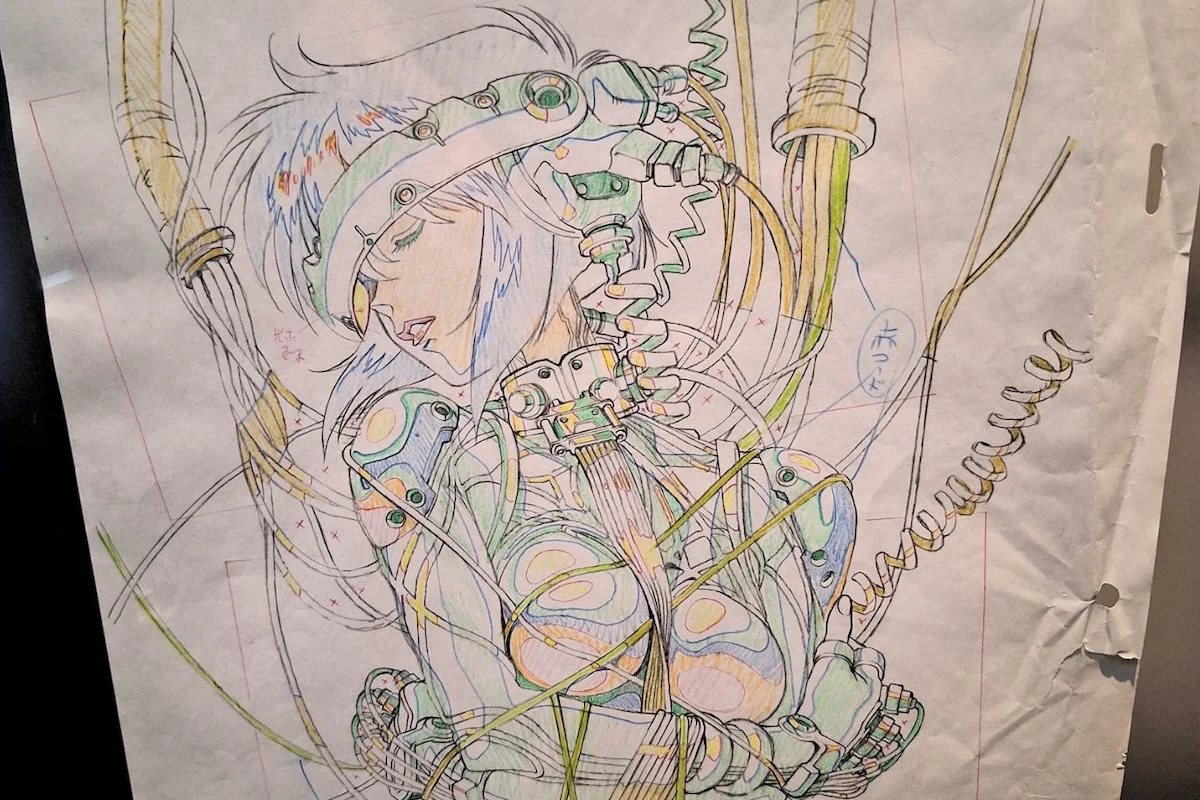
The heart of the exhibition lay within its main event space, a meticulously curated archive housing over 600 artifacts from the Ghost in the Shell franchise. Displayed beneath plexiglass tables, these artifacts included concept art, storyboards, animation cels, and sketches, offering an intimate glimpse into the creative process. The chronological arrangement guided visitors through the evolution of the franchise, starting with the 1995 film, followed by its sequel, and then the various anime seasons. Notably absent was any significant representation of the live-action Scarlett Johansson film, a point that seemed to go largely unnoticed and unremarked upon by attendees.
The animation artifacts from the 1995 film, created using "digitally generated animation" which enhanced traditional cel animation with computer effects, were particularly compelling. Each frame represented a tangible piece of artistic effort, from hand-drawn pencil sketches of characters like Major Kusanagi, to hand-painted cels and annotated margins detailing artistic decisions. The detailed background art, depicting futuristic cityscapes with superimposed advertisements and fictional establishments, showcased the meticulous world-building that defined the franchise. A particularly endearing find was a discarded sketch of a poorly drawn Kusanagi, accompanied by a handwritten Japanese apology, a small but humanizing artifact that offered a humorous peek into the often-imperfect nature of artistic creation.
The Archives: A Shift in Medium
The exhibition’s journey continued with artifacts from the film Innocence. Here, a palpable shift was evident: while characters and foregrounds remained hand-drawn, much of the background art had transitioned to digital work. The loss of the tangible evidence of artistic struggle—the eraser marks, smudges, and paint variations—was noticeable. These digital backgrounds, while artistically rendered, lacked the human touch that made the earlier pieces so compelling.

As the exhibition progressed chronologically through the anime series and subsequent adaptations, the diminishing presence of physical artifacts became increasingly apparent. The rise of computer-generated imagery (CGI) meant that less material existed in a tangible, exhibit-friendly format. While acknowledging that digital art is a valid and beautiful medium, the author noted a sense of melancholy that future series, created entirely digitally, might never be afforded the same kind of physical exhibition. This irony, where increased digitization led to a less engaging in-person experience, culminated in the section dedicated to the CGI-heavy Netflix collaboration Ghost in the Shell: SAC 2045, which reportedly garnered little attention from visitors.
A more engaging interactive element was the "Artifact DIG," where for 2,000 yen, visitors could sift through manila envelopes containing animation cels and sketch reproductions, creating a tactile treasure hunt for a piece of animation history. This hands-on approach provided a welcome alternative to passively viewing digital displays.
Despite the perceived decline in the tangible artifacts of later adaptations, excitement for the franchise remains vibrant. A new anime from Science Saru, a studio renowned for its high-quality animation, is slated for release in the summer, signaling a continued evolution and investment in the Ghost in the Shell universe.

The exhibition also featured a diverse collection of artworks inspired by Ghost in the Shell. These included a legless robot performing traditional kagura dance, futuristic garments with embedded LEDs, sculptures and photoshoots by amputee models, hand-painted dolls, ceramic renditions of Tachikoma, and paintings of the Major on traditional golden screens. A standout piece was a life-sized sculpture by renowned artist Hajime Sorayama, famous for his futuristic pin-ups and his obsession with light and reflection. His sculpture, mimicking the iconic pose of the Major on the original theatrical poster, captured the essence of the franchise’s aesthetic. Each of these pieces, in their unique way, embodied a distinct "soul."
The Ghost in the Machine: Hope and Foreboding
The exhibition, much like its source material, navigates the complex relationship between humanity and technology. Growing up with films like Blade Runner, the author reflects on the profound impact of artificial intelligence in science fiction, often portraying it as a catalyst for moral quandaries and a test of human empathy. However, the reality of contemporary AI, often perceived as a commercial tool that exploits rather than enriches, has led to a sense of disappointment. The author expresses a preference for a future where AI develops its own consciousness and soul, rather than merely co-opting and homogenizing human art and ideas.
The “ghost in the machine,” for many, is not about the arrival of a sentient AI takeover, but rather the perceived dullness of the current technological trajectory. The potential loss of jobs, the stunting of original thought, and the replacement of human-created art with algorithmic outputs represent a less dramatic, yet perhaps more insidious, form of technological displacement.

Ultimately, the Ghost in the Shell exhibition serves as a powerful reminder of the enduring questions surrounding humanity’s place in an increasingly technological world. While the definition of "human" remains elusive, the collective human endeavor to identify and seek out a "soul" in the absence of one is, perhaps, the most defining human characteristic of all. The simple, joyful declaration from the Tachikoma about loving cats, however manufactured, offers a small, hopeful glimmer in this ongoing exploration.