Maggie Gyllenhaal’s second feature as a writer and director, The Bride!, plunges audiences into a reinterpretation of Mary Shelley’s enduring gothic masterpiece, Frankenstein. The film opens with the spectral presence of Mary Shelley herself, portrayed by Jessie Buckley, whispering from the ethereal subconscious. Shelley, who died in 1851, laments the unwritten sequel to her most iconic work, pondering its potential identity: "Is it a horror story, a ghost story, or, most frightening of all, a love story?" This profound question sets the stage for a cinematic journey that deftly intertwines elements of a cat-and-mouse road movie, a jewel-toned Jazz Age thriller, and a romantic caper, pushing the boundaries of genre and thematic exploration.
At its core, The Bride! follows Frankenstein’s monster, who now goes by the moniker Frank (or Frankie, to those intimately acquainted), compellingly brought to life by Christian Bale. Driven by a century of profound loneliness, Frank exhumes a woman from a fresh grave to address his solitude. This resurrected woman, the titular Bride, is also portrayed by Buckley, forming a haunting dual role that underscores the film’s central themes of creation and identity. Shelley’s ghost, a recurring motif reminiscent of Boris Karloff’s iconic portrayal in the original Frankenstein film, periodically appears, bathed in uplit shadows, urging the "reinvigorated" corpse towards fearless action.
The Genesis of a Modern Myth: Gyllenhaal’s Vision and Inspiration
The inspiration for The Bride! arose from an unlikely source: a forearm tattoo. Gyllenhaal recounted that encountering a man with a tattoo of the Bride sparked her curiosity about a character so iconic yet so minimally developed in existing narratives. This led her to delve into Mary Shelley’s original 1818 novel, Frankenstein; or, The Modern Prometheus, and subsequently the 1935 classic Bride of Frankenstein. Gyllenhaal’s profound engagement with Shelley’s text, written by a then-19-year-old woman grappling with themes of creation, abandonment, and societal judgment in the burgeoning Romantic era, led her to question whether Shelley had truly expressed everything she desired. "Is this everything that Mary Shelley wanted to say?" Gyllenhaal pondered, imagining the societal constraints on a female author in the early 19th century and the "unpublishable," even "unthinkable," thoughts she might have suppressed. This notion of an unspoken narrative became the fertile ground for The Bride!.
Mary Shelley’s life itself was a testament to defying convention. Born to philosopher William Godwin and feminist Mary Wollstonecraft, Shelley was immersed in intellectual and radical circles from a young age. Her elopement with Percy Bysshe Shelley and the genesis of Frankenstein during a ghost story competition with Lord Byron and John Polidori at Villa Diodati underscore a life lived outside societal norms. The novel, a cornerstone of gothic literature and an early work of science fiction, explored the ethical dilemmas of scientific ambition and the consequences of neglecting one’s creations. While Shelley’s monster famously desired a female companion—"‘Shall each man,’ cried he, ‘find a wife for his bosom, and each beast have his mate, and I be alone?’"—Shelley tragically resisted granting him one within the original text.
The 1935 Universal Pictures film, Bride of Frankenstein, directed by James Whale and starring Boris Karloff as the Monster and Elsa Lanchester in the dual role of Mary Shelley and the Monster’s Mate, offered a cinematic interpretation. While iconic for its visual design and Lanchester’s striking, frizz-haired portrayal, the character of the Bride received a mere two minutes of non-speaking screen time before her dramatic rejection of the Monster. Gyllenhaal’s The Bride! seeks to rectify this historical omission, providing the character with a voice, agency, and a central narrative. This approach mirrors Gyllenhaal’s previous engagement with existing source material, notably her critically acclaimed adaptation of Elena Ferrante’s novel for The Lost Daughter (2021). She described an "imaginary dialogue" with Ferrante during that project, a similar creative communion she felt with Mary Shelley while developing The Bride!, envisioning Shelley "egging the Bride on" to be more truthful and fearless.
A Jazz Age Gothic Thriller: Plot and Thematic Exploration
Set against the vibrant, yet volatile, backdrop of 1936, The Bride! immerses its audience in a meticulously crafted Jazz Age aesthetic. This period, characterized by societal upheaval, changing gender roles, and the glitz of new entertainment forms, provides a rich tapestry for the film’s genre-bending narrative. The visual style, described as "jewel-toned," evokes the glamour and danger of the era, while the "cat-and-mouse road movie" structure propels the narrative through a landscape teeming with both elegance and lurking threats.
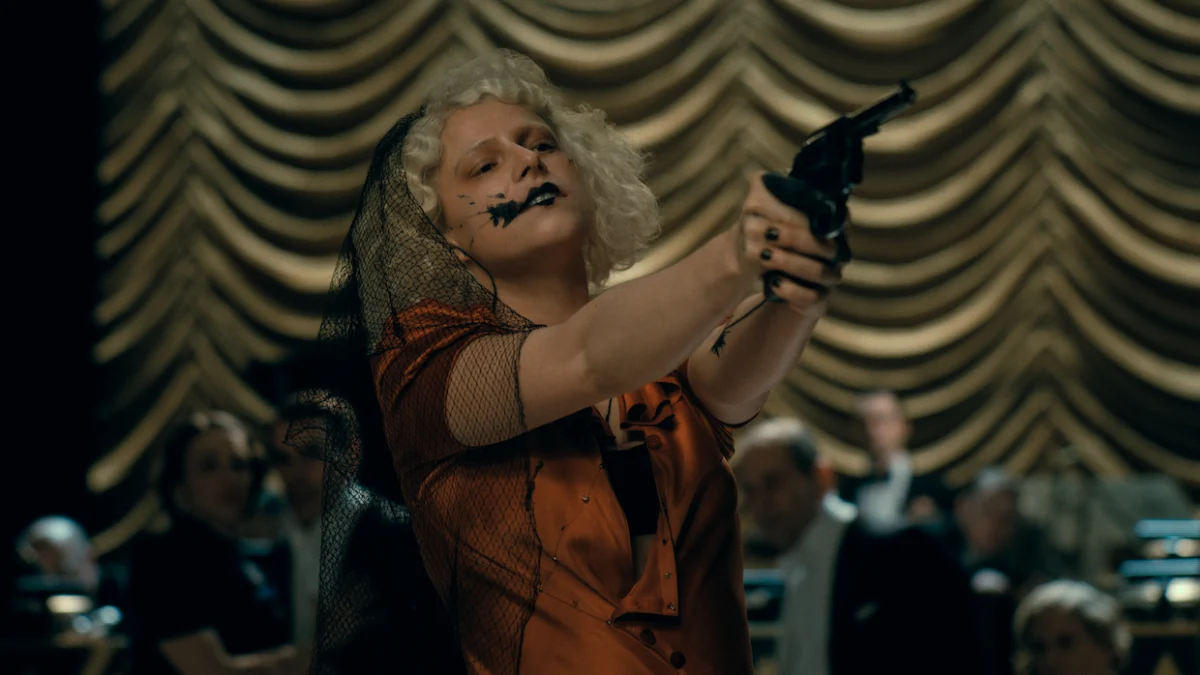
The characters are central to the film’s innovative retelling. Christian Bale’s Frank, stitched and bolted together, retains a rugged handsomeness, his eyes conveying a profound devotion. He speaks of the Bride with awe, declaring, "She’s too beautiful," after he and Dr. Euphronious (Annette Bening) have cleaned her. The Bride herself, brought back to life by the mad scientist Dr. Euphronious, is a striking figure with a frizzy bleached bob, a black tongue, and ink splatters that suggest a punk aesthetic, perhaps expensive Berlin-style tattoos. Her immediate situation is one of frustration and rage, which, "delightfully, if inexplicably," transforms into a galvanizing battle cry for women from Chicago to New York. The headline "Killer Bride Ignites A Revolution" encapsulates this unexpected surge of female empowerment.
The violence depicted in the film, often occurring in nightclub alleyways and on ballroom floors, is primarily in self-defense. The Bride, repeatedly subjected to unwanted advances and worse, reacts with ferocity. Yet, these acts lead to Frank and the Bride being branded as terrorists, hunted by a determined detective (Peter Sarsgaard) and his assistant (Penélope Cruz). Adding another layer of peril, a mob boss’s henchman is also on their trail, as the Bride’s previous incarnation, a woman named Ida, was buried for knowing too much, hinting at a past steeped in dangerous secrets.

Gyllenhaal delves deeply into the psychological and societal implications of love and connection. She contends that "connection is scary for people," particularly when it demands acknowledging "not just the parts of us that we’re proud of, but the parts of us that we’re terrified of and ashamed of—what I’ve been sort of calling the monstrous aspects. And to love someone or to connect to someone, including those aspects, takes real bravery." This perspective redefines horror, suggesting that the most profound fears are not external monsters but the vulnerabilities inherent in true intimacy.
The film’s tone is unequivocally feminist, resonating with contemporary discussions around women’s agency and empowerment. The Bride’s mantras, "I would prefer not to" and "Me too," are direct allusions to modern movements. Gyllenhaal’s active involvement in the #MeToo and #TimesUp movements, where she notably stated in 2019 that "There have to be consequences for disrespecting women sexually, or at all," finds direct expression in her script. The film becomes a powerful narrative enacting those very consequences, presenting a heroine whose pronouncements are, in Gyllenhaal’s words, "braver than even what people are able to say right now."
Crafting the Vision: Production and Collaboration
The making of The Bride! marked a significant step up in production scale for Maggie Gyllenhaal. While The Lost Daughter was a more intimate production, characterized by limited resources—Gyllenhaal noted she had "no dolly track and maybe four lenses to work with"—The Bride! allowed her to embrace "IMAX-level guns and getaway cars." This increased scope and budget are notable, as Gyllenhaal highlighted, "It’s still very rare for women to make films, particularly at this scope and with these particular tools, like IMAX." This access to broader cinematic tools allowed for a more expansive realization of her vision, blending genre conventions with her distinctive artistic sensibility.
Gyllenhaal’s directorial approach is deeply rooted in fostering a respectful and collaborative environment, particularly evident in her work with family members. The Bride! marks her first time directing her brother, Jake Gyllenhaal, who plays Ronnie Reed, a dashing Hollywood film star. Ronnie serves as Frank’s initial inspiration for an ideal masculinity, but his eventual snubbing of Frank leads to another explosive machine-gun showdown. Peter Sarsgaard, Gyllenhaal’s husband, also features in the film, continuing their professional collaborations. Gyllenhaal emphasized the importance of mutual respect on set: "It’s scary to work with people if you’re not sure that they respect you. We don’t have that problem. I learned this as an actress: when you feel respected and seen, you feel free to push yourself to the edge and actually learn something on a film, as opposed to pretending to learn something. And that’s what I want all my actors to be doing." This philosophy likely contributed to the compelling performances from her high-caliber cast, including Christian Bale, Jessie Buckley, Annette Bening, Peter Sarsgaard, and Penélope Cruz.
The thread of "messy women," "bad women," and women who defy societal conventions runs through Gyllenhaal’s projects, both as an actress and a director. From her breakout roles in films like Secretary to her nuanced portrayal of complex female characters in The Lost Daughter, Gyllenhaal consistently explores the interior lives of women who resist easy categorization. This aligns perfectly with her reinterpretation of the Bride, transforming a two-minute silent role into a fully realized, furious, and revolutionary figure.
Critical Reception and Broader Implications
Early reviews for The Bride! have presented a more mixed picture compared to the widespread acclaim The Lost Daughter received, which garnered Oscar nominations and the Best Screenplay award at the Venice Film Festival. While some critics have lauded its bold vision, others, such as the New York Post, have offered dismissive remarks like, "Leave her at the altar!" This disparity in reception is not entirely unexpected for a film that embraces a "punk sensibility," as Gyllenhaal acknowledged. Such unconventional approaches often polarize audiences and critics, appealing intensely to those who resonate with its message while alienating others accustomed to more traditional narratives.
Gyllenhaal views The Bride! as a deliberate act of challenging the male-dominated history of cinema. She stated, "It is definitely a movie from a woman’s point of view. And I do believe that women have a different point of view, because we have such a different experience moving through the world. So much of cinematic language was created and invented by men, because women didn’t have access to the tools. We weren’t included." This observation highlights a systemic issue within the film industry that has historically marginalized female voices and perspectives.
Statistics consistently underscore this disparity. Reports from organizations like the USC Annenberg Inclusion Initiative and the Center for the Study of Women in Television and Film at San Diego State University frequently show that women direct a small fraction of top-grossing films. For instance, in 2023, women comprised only 16% of directors on the 250 highest-grossing films and a mere 14% on the top 100 films. While these figures represent a slight increase over previous years, they still fall far short of equitable representation. Gyllenhaal’s point that "Something like 7% or 8% of the films last year were made by women, and yet so many of them are the films that we’re talking about," suggests that despite limited opportunities, female-directed films are often making significant cultural and critical impacts.
The Bride! therefore arrives at a pivotal moment, contributing to a growing body of work that seeks to redefine cinematic language and storytelling from diverse perspectives. Gyllenhaal’s challenge to the audience – "Everyone says they want something new. Well, alright. Can you take it?" – encapsulates the film’s audacious spirit and its demand for viewers to engage with narratives that may subvert expectations. Its implications extend beyond mere entertainment, sparking conversations about gender, power, and the enduring relevance of classic myths when viewed through a contemporary, feminist lens. By giving the Bride a voice and agency, Gyllenhaal not only crafts a compelling narrative but also participates in a broader cultural reckoning, urging the industry and its audiences to embrace the "monstrous aspects" of truth and connection, both on and off screen.