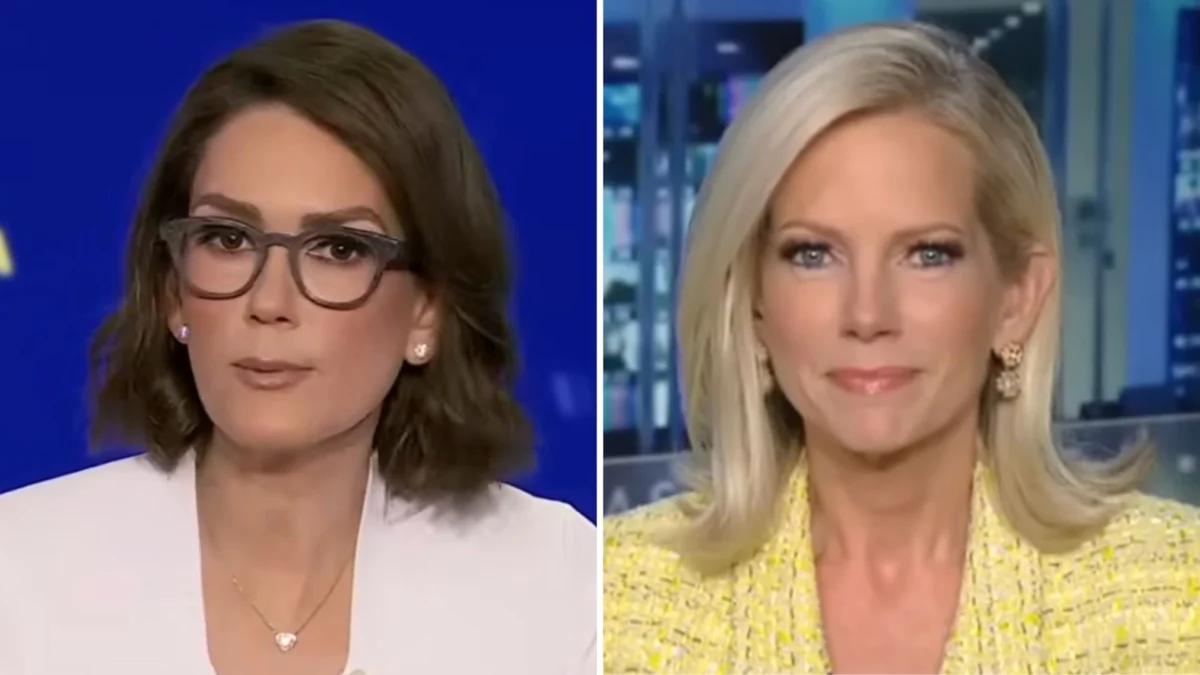
During a period of heightened geopolitical tension involving ongoing hostilities with Iran, President Donald Trump pivoted his public focus toward the domestic media landscape on the evening of Monday, April 6. In a series of pointed communications shared via his Truth Social platform, the President targeted two prominent figures at Fox News: Jessica Tarlov, a co-host and liberal commentator on the high-rated program The Five, and Shannon Bream, the anchor of the network’s flagship Sunday morning political broadcast, Fox News Sunday. These latest critiques represent a continuation of the President’s complex and often adversarial relationship with the press, specifically targeting individuals he perceives as ideologically opposed to his administration or insufficiently rigorous in their questioning of political opponents.
The most direct of these attacks was aimed at Jessica Tarlov. In a post addressed specifically to the leadership of Fox News, the President called for her immediate removal from the airwaves. He characterized Tarlov as one of the "worst personalities on television," citing her voice and her rhetoric as primary grievances. "For Fox executives only, take Jessica Tarlov off the air," the President wrote. He further asserted that "people cannot stand watching her," labeling the commentator a "real loser" and thanking the network’s executives for their "attention to this matter." This public demand for a private media company to terminate an employee has sparked significant discussion regarding the boundaries between executive power and journalistic independence.
The Role of Jessica Tarlov and the Success of The Five
Jessica Tarlov has served as a permanent co-host on The Five since early 2022, filling the "liberal chair" previously occupied by figures such as Juan Williams and Bob Beckel. A Democratic strategist and Vice President of Research at the Harris Poll, Tarlov provides a counter-narrative to the conservative-leaning perspectives of her colleagues, including Jesse Watters, Jeanine Pirro, Dana Perino, and Greg Gutfeld. Despite the President’s assertions regarding her popularity, The Five has consistently remained the most-watched program in cable news, often drawing over three million viewers per night—a feat rarely achieved by non-primetime programming.
The President’s animosity toward Tarlov is not a new development. Only a month prior, during a live broadcast of The Five in which Tarlov was absent, the President called into the program to speak with the other hosts. During that exchange, he explicitly stated that he "wasn’t a fan" of Tarlov and suggested that the show’s quality would improve in her absence. At the time, he remarked, "I think your show would be better without her, but who am I to say that? I think it would be a lot better."
Tarlov has not remained silent in the face of these criticisms. Responding to the President’s earlier comments via the social media platform X (formerly Twitter), she quipped about her absence from the show, noting that had she been present, she would have challenged his claims regarding his polling data. Referring to his approval ratings at the time, she wrote, "Was so bummed to miss the show today! But I definitely would’ve said he’s even inflating his numbers to 42%!"
Scrutiny of Shannon Bream and the SAVE Act Controversy
The President’s Monday evening critiques extended beyond Tarlov to include Shannon Bream, the host of Fox News Sunday. His criticism of Bream was twofold, focusing on a perceived factual error regarding legislative nomenclature and a perceived lack of "hard-hitting" interviewing techniques when dealing with Democratic guests.
The President took issue with Bream’s reference to the "SAVE Act," a piece of legislation aimed at requiring proof of citizenship for voter registration. He insisted that the correct title was the "Save America Act." "Tell Shannon Bream of FoxNews that it’s not the Save Act, it’s the Save America Act, a big difference!" he posted. However, legislative records indicate that the "Safeguard American Voter Eligibility Act," introduced by Republican Representative Chip Roy, is commonly abbreviated as the "SAVE Act." The term "Save America" is more closely associated with the President’s own political action committee (PAC), suggesting a possible conflation of his personal branding with the formal legislative title.
Furthermore, the President criticized Bream’s interview with Representative Jake Auchincloss, a Democrat from Massachusetts. He characterized Auchincloss as a "lightweight" and accused Bream of failing to correct him when he allegedly "spewed out Democrat propaganda and lies." The President concluded this portion of his tirade by contrasting his own record with that of the Democratic Party, claiming, "I always close deals, unlike the Dems, and did great with China in every way, also, unlike the Dems!"
A Pattern of Confrontation with Female Journalists
The targeting of Tarlov and Bream is consistent with a broader trend observed over the past year, in which the President has frequently directed his most vitriolic media critiques at female reporters and anchors. In February, he engaged in a high-profile confrontation with CNN’s Kaitlan Collins. During that interaction, he told Collins, "You are so bad. You are the worst reporter. No wonder CNN has no ratings."
The President’s remarks to Collins often strayed from professional critique into personal commentary. "She’s a young woman. I don’t think I’ve ever seen you smile," he remarked during one exchange. "You know why you’re not smiling? Because you know you’re not telling the truth. You’re a very dishonest organization, and they should be ashamed of you."
Critics and media analysts have frequently pointed to these interactions as evidence of a gendered approach to media relations. However, the administration has consistently denied these claims. White House spokesperson Abigail Jackson previously addressed these concerns, stating that the President’s critiques have "nothing to do with gender" and are instead a reflection of the "public’s trust in the media being at all-time lows." Jackson argued that the President is simply holding journalists accountable for what he perceives as biased or dishonest reporting.
Timeline of President Trump’s Recent Media Critiques
The recent attacks on Fox News personalities are part of a dense timeline of media-related grievances aired by the President throughout the current election cycle:
- January – February: The President repeatedly targets CNN and MSNBC during primary victory speeches, labeling them "fake news" and "enemies of the people."
- February: The specific confrontation with Kaitlan Collins occurs, drawing widespread condemnation from press freedom advocacy groups.
- March: The President calls into The Five to express his dissatisfaction with Jessica Tarlov’s presence on the panel.
- Late March: The President intensifies his criticism of the New York Times and the Washington Post, specifically targeting individual reporters covering his ongoing legal proceedings.
- April 6: The Truth Social posts targeting Tarlov and Bream are published, coinciding with major developments in the Middle East.
Public Reaction and the Question of Presidential Decorum
The President’s comments on Monday were met with a swift and polarized reaction on social media. Supporters of the President echoed his sentiments, arguing that Fox News has drifted too far toward the political center and that voices like Tarlov’s are "out of touch" with the network’s core audience. Some users argued that as a major political figure, the President has every right to voice his opinion on who should be representing political discourse on television.
Conversely, a large segment of the public expressed alarm at the President’s direct attempt to influence the personnel decisions of a private news organization. One user on X noted that Tarlov "lives rent-free in his head," suggesting that the President’s preoccupation with a single commentator is disproportionate to the gravity of his office. Another user emphasized the erosion of political norms, stating, "You really have to keep reminding yourself that none of this is normal. A sitting president, or former president for that matter, should never be telling television executives who to hire/fire. It’s just bizzaro world we’re living in."
Others focused on the resilience required for Tarlov to perform her role. "Give Jessica a raise actually," one commenter wrote. "The amount of bs she deals with from her coworkers is ridiculous." This sentiment reflects a common perception that Tarlov’s role as the lone dissenting voice on The Five is a difficult position that requires a high degree of professional composure.
Analysis of Implications for Media Independence
The President’s demand for Tarlov’s termination raises significant questions about the independence of the media in an era of intense political polarization. While politicians have long complained about media coverage, the directness of a call for a specific individual to be "taken off the air" by a head of state—or a leading presidential candidate—is considered by many historians to be a departure from traditional American political conduct.
From a strategic perspective, these attacks serve several purposes for the President’s campaign:
- Base Mobilization: By attacking "liberal" voices on a "conservative" network, the President reinforces his image as a fighter who is willing to take on the establishment wherever it exists.
- Pressure on Media Outlets: Such critiques can serve as a "warning shot" to media executives, potentially influencing future casting decisions or editorial directions to avoid the President’s ire.
- Diversionary Tactic: Some analysts suggest that these outbursts serve to distract from more pressing or controversial issues, such as foreign policy crises or legal challenges.
Supporting Data: The Landscape of Media Trust
The President’s assertion that his attacks are a response to low public trust in the media is supported, in part, by recent data. According to a 2023 Gallup poll, only 32% of Americans say they have a "great deal" or a "fair amount" of trust in the mass media to report the news "fully, accurately and fairly." This matches the record low recorded in 2016 and 2021.
However, the same data reveals a deep partisan divide. While only 11% of Republicans express trust in the media, 58% of Democrats and 29% of independents maintain a level of confidence. By targeting liberal commentators like Tarlov, the President is speaking directly to the 89% of his base that views the media with skepticism.
Conclusion
The recent criticisms of Jessica Tarlov and Shannon Bream underscore the volatile relationship between Donald Trump and the news organizations that cover him. As the 2024 election cycle progresses, the tension between political figures and the journalists tasked with reporting on them is expected to remain a central theme. Whether these attacks will lead to changes in network personnel or further erode the traditional norms of presidential communication remains to be seen. For now, the "war" between the President and the press continues to play out in real-time, one social media post at a time.