John Valley’s holiday horror offering, American Dollhouse, which recently screened at the Overlook Film Festival on April 10th, presents itself as a deceptively low-key indie thriller before erupting into a spectacle of extreme gore and exploitation. The film, a product of Roosevelt Film Lab, has generated considerable buzz within the horror community for its audacious tonal shift and commitment to visceral shock, drawing comparisons to contemporary extreme horror fare like Inside and Terrifier 3. While initially positioning itself within the familiar tropes of domestic thrillers, American Dollhouse ultimately pivots to deliver a blood-soaked, holiday-themed descent into madness, earning it a place among this year’s more polarizing festival entries.
The narrative centers on Sarah, portrayed by Hailley Lauren, who, against the implicit warnings of countless cautionary tales, returns to her recently inherited childhood home. The property, left to her and her brother Michael (Tinus Seaux) by their deceased mother, becomes a point of contention. Michael advocates for a swift sale to capitalize on holiday-season finances, but Sarah, grappling with unspecified trauma and seeking refuge from urban life, insists on staying. This decision sets the stage for Sarah’s internal struggle with her past and the complexities of returning to a place steeped in personal history. However, her personal demons soon become overshadowed by a far more immediate and external threat.
![‘American Dollhouse’ Unwraps Gruesome Christmas Carnage [Review]](https://www.dreadcentral.com/wp-content/uploads/2026/04/PRESS_TOP-DOWN_AMERICANDOLLHOUSE-e1775087402597.png)
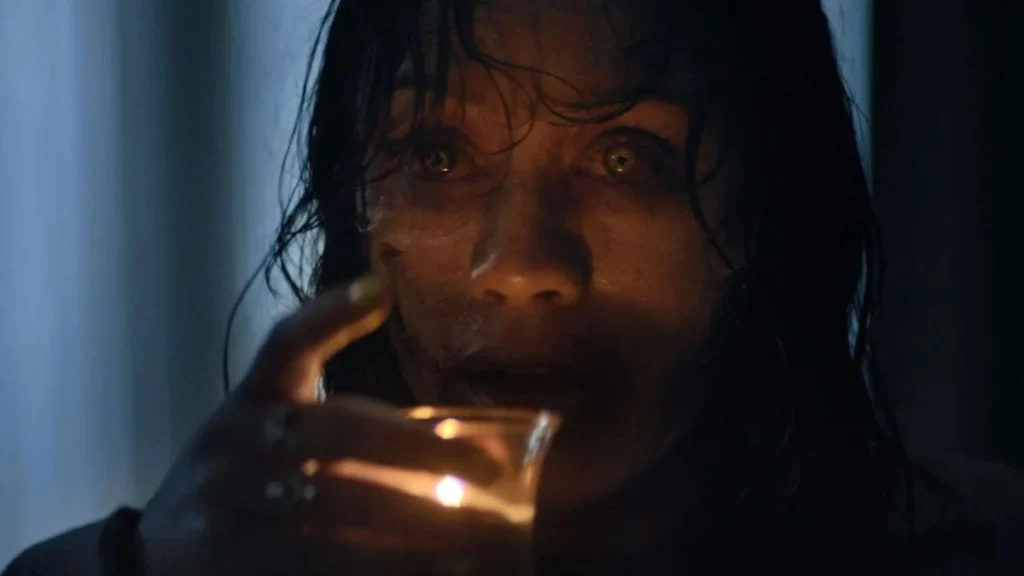
The primary antagonist emerges in the form of Sandy, a neighbor played by Kelsey Pribilski. Initially, Sandy’s presence is characterized by an unsettling invasiveness – window-peeping and lingering on the property – which escalates into a disturbing fixation. Her behavior morphs from irritatingly intrusive to outright homicidal as she begins to project her deceased mother onto Sarah, blurring the lines of reality and fueling her violent intent. This neighborly menace firmly establishes the film within the subgenre of domestic thrillers, evoking comparisons to films such as Lakeview Terrace, Arlington Road, and the classic Rear Window. The early acts of American Dollhouse appear poised to explore themes of community breakdown and the psychological impact of unchecked obsession, promising a commentary on how proximity and misguided intentions can breed dangerous outcomes.
However, the film takes a sharp and deliberate turn, eschewing societal analysis for raw, unadulterated horror. Director John Valley, also credited with the screenplay, masterfully subverts audience expectations. The narrative shifts from psychological suspense to an aggressive, exploitative style that leans heavily into extreme gore, reminiscent of the “torture porn” subgenre that experienced a surge in popularity in the mid-2000s. This deliberate pivot is highlighted by the film’s visual presentation, which, while not reaching the extreme levels of some of its inspirations, delivers a “gnarly, grotesque holiday tableau.” The effectiveness of this tonal shift is often compared to the strategic misdirection employed in films like Better Watch Out, which similarly disguised its violent intentions behind a festive facade.
The critical reception for American Dollhouse at the Overlook Film Festival has been mixed, with reviewers acknowledging its audacious ambition and graphic execution. While many praised Valley’s script for its unexpected subversion and commitment to visceral horror, some noted that the film’s pacing could be an issue. The build-up to the extreme violence, while establishing character and tension, was perceived by some as taking longer than necessary to reach its explosive payoff. The repeated confrontations between Sarah and Sandy, while showcasing the actors’ commitment, did not always generate the same level of macabre fascination as the film’s climactic sequences.
![‘American Dollhouse’ Unwraps Gruesome Christmas Carnage [Review]](https://www.dreadcentral.com/cdn-cgi/image/width=788,height=444,fit=crop,quality=90,gravity=auto,sharpen=1,metadata=none,format=auto,onerror=redirect/wp-content/uploads/2026/04/PRESS_TOP-DOWN_AMERICANDOLLHOUSE.png)
Furthermore, the performances themselves, while game, were sometimes seen as struggling with the more nuanced emotional beats of the script, particularly when the material demanded more than pure shock value. Hailley Lauren’s portrayal of Sarah, complete with a mid-film monologue addressing her substance abuse and volatile demeanor, provides some insight into her character’s internal struggles. Similarly, Tinus Seaux’s Michael represents a pragmatic counterpoint to Sarah’s emotional turmoil. Kelsey Pribilski’s Sandy, however, is the undeniable force driving the film’s horror. Her descent into violent obsession is portrayed with a chilling intensity that anchors the film’s more extreme elements.
Despite these criticisms, the film’s success lies in its unapologetic embrace of extreme horror. The narrative’s deliberate departure from its initial thriller setup is seen as a strength by many, with Valley lauded for prioritizing the creation of a maximally disturbing experience over exploring subtler thematic threads. The film’s willingness to delve into graphic violence, even extending to the inclusion of the family dog in its macabre scenarios, positions it as a bold statement within the contemporary horror landscape. This approach has been met with enthusiasm by fans of visceral, no-holds-barred horror, who see American Dollhouse as a welcome addition to the growing subgenre of extreme holiday horror.
The film’s thematic resonance, while perhaps not as overtly intellectual as some festival entries, lies in its direct assault on the viewer’s senses. It taps into a primal fear, amplified by the unsettling juxtaposition of Christmas traditions with extreme violence. This contrast is a deliberate choice, designed to maximize shock and discomfort, transforming what could have been a standard domestic thriller into a holiday-themed nightmare. The film’s producers, Roosevelt Film Lab, have a history of supporting independent horror projects, and American Dollhouse appears to align with their penchant for genre-bending and boundary-pushing content.
![‘American Dollhouse’ Unwraps Gruesome Christmas Carnage [Review]](https://www.dreadcentral.com/cdn-cgi/image/width=788,height=591,fit=crop,quality=90,gravity=auto,sharpen=1,metadata=none,format=auto,onerror=redirect/wp-content/uploads/2026/04/PRESS_EYE_AMERICANDOLLHOUSE.png)
Looking ahead, American Dollhouse is positioned to be a divisive but memorable entry in the horror canon. Its success at the Overlook Film Festival suggests a strong reception within the dedicated horror festival circuit. The film’s explicit comparison to Inside, a critically acclaimed French extreme horror film known for its brutal narrative and relentless tension, indicates that American Dollhouse is aiming for a similar level of impact. While it may not achieve the same critical endurance as its inspirations, its ability to deliver a potent dose of festive gore ensures it will be a talking point for horror aficionados. The film’s concluding statement, “John Valley sure knows how to deck the halls,” serves as a fitting, albeit darkly humorous, summation of its holiday-themed carnage. The screening at the Overlook Film Festival marks a significant milestone in the film’s release trajectory, potentially leading to wider distribution and further critical discussion. As the film continues its festival run, its impact on the landscape of contemporary holiday horror is yet to be fully determined, but its commitment to delivering a gruesome, unforgettable experience is undeniable.