Jonah Hill, an actor whose career has traversed significant stylistic and thematic shifts, has once again captured public attention with the release of Outcome, a new feature film he directs, co-writes, and co-stars in. The film, which features Hill in a notable physical transformation, arrives at a critical juncture for the actor, drawing uncomfortable parallels between its narrative exploration of celebrity vulnerability and the recent controversies that have impacted Hill’s own public persona. This meta-commentary, intentional or not, positions Outcome as more than just a cinematic offering; it becomes a lens through which to examine the complex interplay of art, artist, and the relentless scrutiny of the digital age.
A Career Defined by Reinvention: From Comedy Prodigy to Acclaimed Auteur
Jonah Hill’s journey through Hollywood is a testament to an artist consistently defying categorization. Audiences first encountered him in the mid-2000s, carving out a niche as the "smart, schlubby comedy guy" in a series of highly successful Judd Apatow-produced films. His roles in The 40-Year-Old Virgin (2005) and Knocked Up (2007) established him as a comedic force, adept at delivering memorable lines and embodying relatable, often awkward, characters. However, it was his co-starring role in 2007’s Superbad, a raunchy teen comedy that grossed over $170 million worldwide against a modest budget, that cemented his status as a breakout star. The film, which became a cultural touchstone for a generation, showcased Hill’s ability to balance broad humor with genuine heart, endearing him to a wide audience.
The subsequent years saw Hill continue his comedic dominance with films like Get Him to the Greek (2010) and the critically acclaimed 21 Jump Street (2012) and its sequel 22 Jump Street (2014), where his dynamic with Channing Tatum proved to be a box office powerhouse, collectively earning over $500 million globally. Yet, even amidst this comedic success, a subtle shift was occurring. Hill began to strategically pivot, signaling an ambition beyond the confines of slapstick.
This ambition materialized dramatically with his 2011 performance in Bennett Miller’s sports drama Moneyball. Playing Peter Brand, a brilliant, numbers-obsessed Yale economics graduate who helps revolutionize baseball scouting, Hill delivered a nuanced, understated performance that earned him his first Academy Award nomination for Best Supporting Actor. This role was a pivotal moment, signaling to both the industry and audiences that Hill possessed a formidable dramatic range previously unexplored. Just three years later, he solidified this dramatic credibility with a transformative role in Martin Scorsese’s The Wolf of Wall Street (2013). As Donnie Azoff, the flamboyant and morally corrupt business partner to Leonardo DiCaprio’s Jordan Belfort, Hill delivered a performance of unbridled intensity and dark humor, earning him a second Oscar nomination. Collaborating with a titan like Scorsese not only further validated his dramatic prowess but also hinted at a deeper engagement with the craft of filmmaking.
The evolution continued with his directorial debut, Mid90s, released in 2018. The coming-of-age film, which Hill also wrote, garnered critical praise for its authentic portrayal of a skateboarding subculture in 1990s Los Angeles. It showcased a mature artistic vision, moving him further into the realm of a multi-hyphenate creative force. Hill’s frequent appearances as host on Saturday Night Live serve as a public chronicle of these career metamorphoses. His first hosting gig in 2008 coincided with his Superbad fame; by his third in 2014, he was joined by DiCaprio, fresh off The Wolf of Wall Street. By 2018, when he was inducted into the prestigious Five-Timers’ Club alongside comedic legends like Tina Fey and Candice Bergen, he was promoting Mid90s, marking another distinct phase in his journey. This consistent reinvention has made Hill one of Hollywood’s more unpredictable and compelling figures.
"Outcome": A Deep Dive into Celebrity Anxiety and Cancel Culture
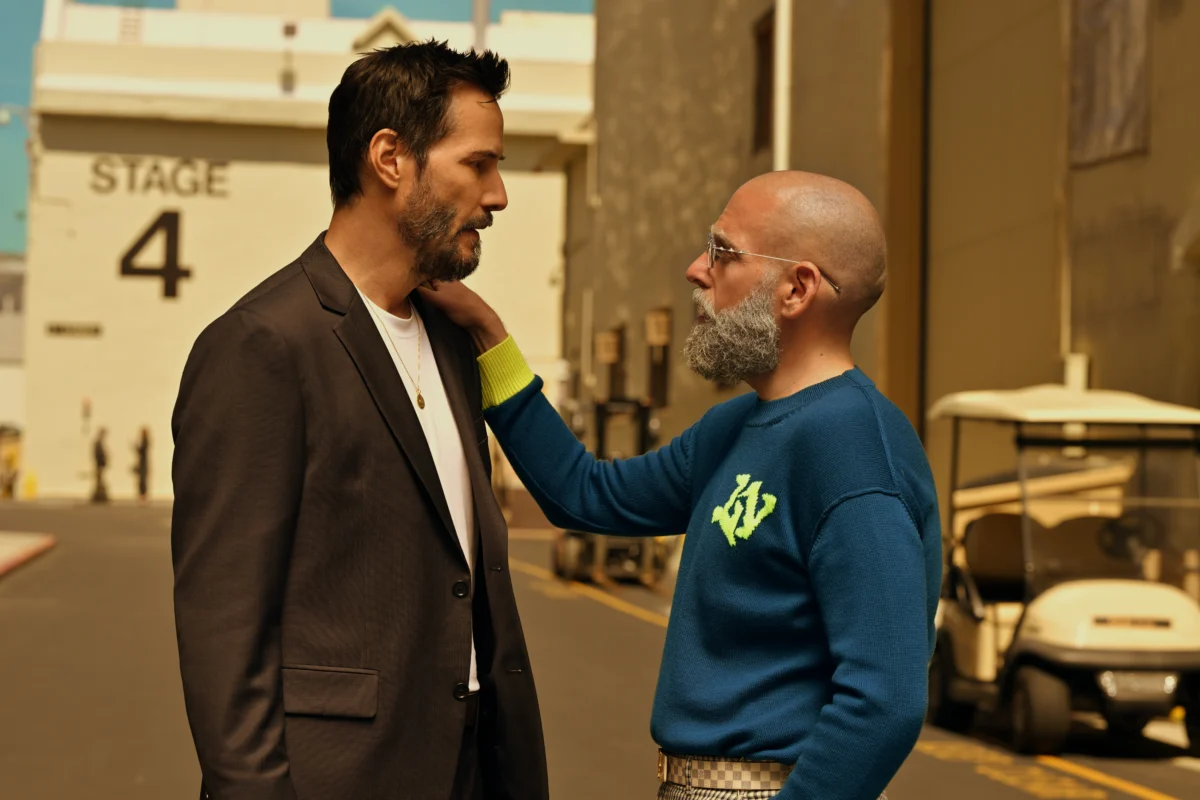
Outcome, which sees Hill take on directing, co-writing, and co-starring duties, arrives with a premise deeply intertwined with contemporary anxieties surrounding public image and accountability. The film centers on Reef Hawk (Keanu Reeves), a world-renowned movie star with two Oscars, whose meticulously curated public image is built on a foundation of five years of sobriety from a destructive heroin addiction—a secret thankfully shielded from the adoring public. Reef’s carefully constructed life is threatened when a mysterious videotape, purportedly containing damaging material, surfaces. This potential scandal propels him into a desperate apology tour, aimed at making amends and uncovering the source of the tape before it can unravel his career.

Hill plays Ira, Reef’s outlandish crisis attorney, a character marked by a striking physical transformation: bald with a bushy gray beard, visually embodying the unconventional and often morally ambiguous world of crisis management. Cameron Diaz and Matt Bomer feature as Reef’s devoted high-school friends, while Susan Lucci appears as his mother, and, notably, Martin Scorsese makes a cameo as Reef’s first manager. This ensemble cast, a mix of seasoned veterans and unexpected appearances, underscores the film’s ambition to comment on the broader ecosystem of Hollywood and celebrity.
The film’s central conflict, the fear of "cancellation," positions Outcome squarely within a burgeoning genre of media that grapples with the internet-era phenomenon of public shaming and professional ostracization. "Cancel culture," broadly defined as the withdrawal of support for public figures or companies after they have done or said something objectionable, has become a pervasive concern in entertainment. Outcome attempts to dissect this phenomenon, exploring themes of reputation management, the struggle for redemption, and the blurred lines between public and private personas.
However, the film’s commentary on these themes has elicited mixed reactions. While it touches on the anxieties of being a public figure in an era of constant surveillance, some critics have found its comedic choices "obnoxious" and its social commentary "thuddingly obvious." For instance, a scene where a character notes that being anti-Semitic no longer impedes success, immediately followed by a shot of a large portrait of Kanye West, has been highlighted as an example of the film’s sometimes heavy-handed approach. This particular reference, while aimed at contemporary discourse, has been critiqued for its perceived glibness in addressing serious issues, especially given recent real-world events that have challenged the notion of unfettered success despite such controversies.
The Uncomfortable Echoes: Hill’s Public Scrutiny and the Film’s Narrative
The release of Outcome is rendered particularly poignant by the timing of recent developments in Jonah Hill’s personal and public life, creating an undeniable meta-narrative. Since 2016, Hill has significantly reduced his on-screen appearances, featuring in only five live-action films, Outcome included. This period of relative retreat from the public eye was punctuated by two significant events that profoundly impacted his public image.
In 2022, Hill made headlines by announcing a decision to step back from public-facing interviews and promotional tours for his projects, citing a long-standing battle with anxiety. In a statement, he explained that "the way I manage my anxiety is by avoiding situations that exacerbate it." This announcement was framed as a courageous act of self-care and mental health advocacy, earning him widespread support. Shortly thereafter, he released Stutz, a Netflix documentary that offered an unusually intimate look into his therapeutic relationship with his therapist, Phil Stutz. The film was initially lauded as a groundbreaking, honest exploration of mental health, vulnerability, and the journey toward self-acceptance, further cementing Hill’s image as a thoughtful, evolving artist.
However, this narrative took a dramatic turn in mid-2023 when Hill’s ex-girlfriend, professional surfer Sarah Brady, publicly accused him of emotional abuse and controlling behavior. Brady shared a series of private text messages and Instagram stories, alleging that Hill had imposed strict "boundaries" that amounted to misogynistic and manipulative control over her friendships, professional choices, and even her appearance (e.g., "if you need to surf with men, don’t post pictures of it"). These accusations ignited a fierce public debate about "therapy-speak," weaponized boundaries, and the nature of emotional abuse in relationships, especially when involving public figures. The allegations profoundly "damaged Hill’s public persona," transforming his previously celebrated openness about mental health into a subject of intense scrutiny and criticism.
It is against this backdrop that Outcome is virtually impossible to view without drawing direct parallels between Hill’s personal experiences and the film’s protagonist, Reef Hawk. Reef’s intense preoccupation with public perception, his fear of "cancellation," and his desperate attempts to control a narrative mirror, for many, the public image crisis Hill himself navigated. The film’s setup, with its focus on a celebrity terrified of being exposed for past misdeeds and an unwillingness to "behave decently," invites an uncomfortable comparison to the allegations leveled against Hill.
In an interview published this week with Martin Scorsese, Hill himself acknowledged the broader resonance of the film’s themes: "Not many people can relate to a movie star, but the way I view it is, we’ve all turned ourselves into scorched, middle-aged movie stars by putting our lives up for judgment on social media every second of every day. You go through the same exact feelings being Tom Cruise as you do being a mom in Salt Lake City putting her kids up online for public judgment." This statement, while attempting to universalize the experience of public scrutiny, simultaneously underscores the very specific anxieties that seem to animate Outcome and, arguably, Hill’s own recent creative output.

The Argument of "Outcome": Misdeeds vs. Perception
One of the core arguments Outcome appears to advance is that the intense stress and anxiety associated with public judgment and the fear of "cancellation" can be as damaging, if not more so, than the actual misdeeds themselves. In the film, the mysterious tape that threatens Reef Hawk’s career ultimately turns out to contain material that is, if not entirely innocuous, then "relatively minor in the grand scheme of things." This narrative arc suggests that the "much ado about nothing" surrounding potential exposure is the true antagonist, rather than the content of the tape itself. Hill, through the film, seems to be experimenting with an argument that excessive worrying about how others perceive you is "almost as bad, if not just as bad, as what would make anyone want to cancel any celebrity."
However, this proposition has been met with skepticism. Critics have largely dismissed the idea that "the desperate push to punish those for their misdeeds is almost as bad as the misdeeds themselves" as "ridiculous." This perspective highlights a fundamental disagreement: while the emotional toll of public scrutiny is undeniable, equating it to the harm caused by actual misconduct often feels like an attempt to deflect accountability. The film’s message, therefore, risks being perceived as an "egregious self-defense" rather than a nuanced exploration of a complex issue.
A visual cue within the film further complicates this argument. In one scene, Ira and Reef engage in a heart-to-heart discussion, with a massive portrait of Kevin Spacey ominously looming in the background. This glib visual gag serves as a stark reminder of the real-world consequences of severe misconduct. While the term "canceled" is often debated and few public figures truly disappear entirely, Spacey’s career trajectory following multiple sexual assault allegations represents one of the most definitive examples of professional ostracization in the #MeToo era. The inclusion of Spacey’s image, while perhaps intended as satirical, inadvertently undermines Outcome‘s central premise by highlighting the vast difference between "minor" indiscretions and genuinely harmful behavior that demands severe repercussions.
Broader Implications and the Road Ahead
Despite the controversies and the critiques of Outcome‘s thematic messaging, Jonah Hill remains a prominent figure in Hollywood. His ability to direct, co-write, and co-star in a "slick-looking low-stakes comedy-drama with a massive cast and the backing of one of the biggest technology companies in the world" (Apple TV+) suggests that, whatever "cancellation" means in the abstract, it has not fundamentally derailed his career. This reality stands in contrast to the film’s anxieties, demonstrating the resilience of certain celebrity careers even in the face of public outcry.
The film’s impressive ensemble, which allows Keanu Reeves to interact with a diverse array of performers, from Diaz and Bomer to Lucci and Scorsese, provides moments of genuine engagement, suggesting that Outcome is not entirely without artistic merit beyond its contentious central thesis. However, its lasting impact will likely be intertwined with the ongoing public discourse around Hill himself.
As Hill prepares for another comedy, Cut Off, set to open this summer, the trajectory of his career continues to evolve. From the goofy dude in Accepted (2006) quipping about his "wiener" to an Oscar-nominated actor, acclaimed director, and now a filmmaker grappling with the intricacies of public perception and personal accountability, Hill’s artistic journey is undeniably complex. Outcome serves as a fascinating, if sometimes frustrating, artifact of this journey, reflecting both the anxieties of a celebrity navigating the digital age and the broader societal struggle to reconcile artistic output with the personal conduct of its creators. The film, much like its creator, is a product of its time, prompting audiences to consider not just the art on screen, but the artist behind it, and the ever-shifting standards by which both are judged.