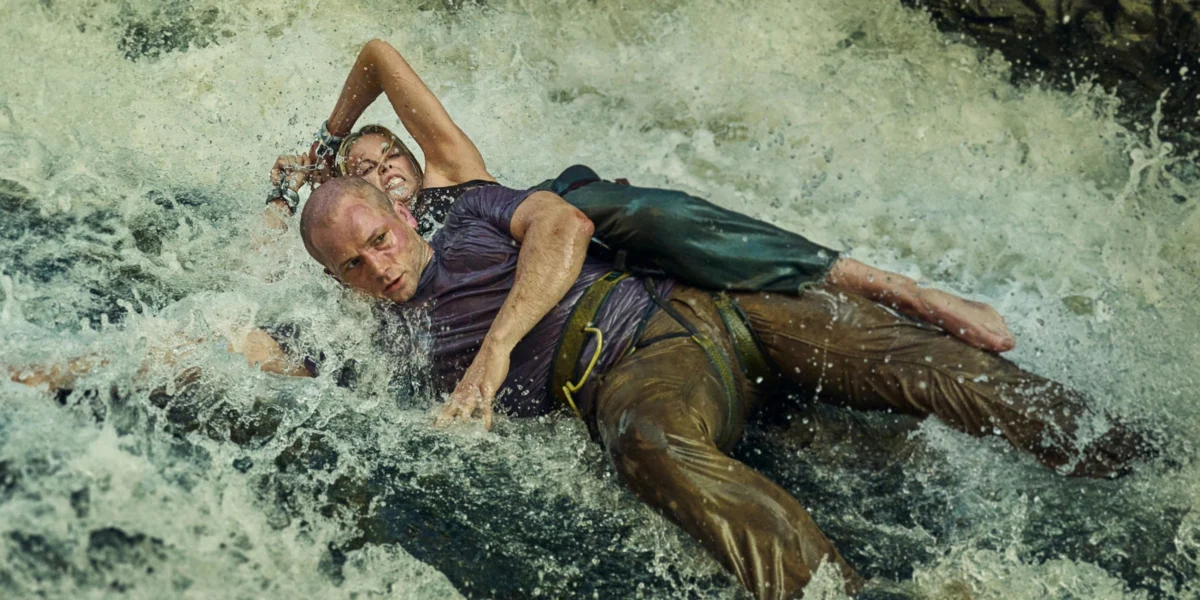
Apex is a high-stakes survival thriller that marks a significant entry into the subgenre of man-versus-nature and man-versus-man cinema. Directed by Baltasar Kormákur and written by Jeremy Robbins, the film serves as a grueling examination of human resilience, grief, and the primal instinct for self-preservation. Featuring a powerhouse cast led by Academy Award winner Charlize Theron, Taron Egerton, and Eric Bana, the production leverages the harsh, indifferent beauty of the Australian wilderness to tell a story that is as much about internal psychological warfare as it is about physical endurance. With a running time of 96 minutes, the film operates at a brisk, often punishing pace, aiming to translate the vastness of its setting into an intimate, claustrophobic nightmare.
Narrative Overview and Chronological Structure
The narrative of Apex is structured around two distinct timeframes, bridging a personal tragedy with a desperate fight for survival. The film opens with a visceral prologue set on a treacherous mountain face. Sasha (Charlize Theron) and her partner, Tommy (Eric Bana), are depicted in a state of extreme physical and metaphorical suspension. As experienced climbers, they are testing their limits against a sheer rock wall, but the scene quickly shifts from a display of technical prowess to one of catastrophe. A storm-triggered rockslide disrupts their ascent, leaving Tommy dangling precariously. In a moment that serves as the emotional foundation of the film, Sasha’s physical strength fails her. Despite her refusal to yield, the sheer physics of the situation result in Tommy’s fatal fall—a failure that Sasha carries as a profound psychological burden.
The story resumes five months later. Sasha, now deeply entrenched in a cycle of grief and seeking a form of ascetic catharsis, travels through the Australian Outback in a converted van. Her journey leads her to a remote national park, where she intends to navigate the rapids, perhaps as a way to confront the indifference of nature that claimed her partner. It is here that the film transitions from a meditation on loss into a "most dangerous game" scenario.
Sasha’s path crosses with Ben (Taron Egerton), an individual whose initial charm masks a predatory nature. The encounter escalates rapidly as Ben’s true intentions are revealed: he is a ritualistic hunter who has eschewed traditional game in favor of human prey. The remainder of the film follows a chronological descent into violence, as Sasha is forced to utilize her climbing skills and survival instincts to evade Ben through dense forests, dark canyons, and turbulent river systems.
Production Background and Directorial Vision
Baltasar Kormákur, the Icelandic filmmaker behind Apex, has established a reputation for directing high-intensity survival dramas. His previous works, including Everest (2015), Adrift (2018), and The Deep (2012), demonstrate a recurring fascination with characters pushed to their absolute limits by environmental extremes. In Apex, Kormákur attempts to ground this survivalist tension in a more localized, character-driven thriller.
The production utilized the Australian landscape not merely as a setting but as a silent antagonist. The cinematography initially highlights the "brutal, indifferent majesty" of the Outback, utilizing wide shots to render Sasha as a solitary, vulnerable figure within a vast verdant haystack. However, as the plot intensifies, the visual language shifts. Kormákur employs a more kinetic, "dizzying" camera style and a specific color palette—characterized by a sickly yellow-green filter—intended to heighten the sense of unease and disorientation. This stylistic choice reflects the protagonist’s deteriorating mental state and the increasingly hallucinatory nature of the hunt.
Cast Analysis and Physical Performance Requirements
The success of a survival thriller often rests on the physical commitment of its leads, and Apex relies heavily on the established screen presence of Charlize Theron. Over the past decade, Theron has transitioned into a titan of action cinema, known for roles that demand significant physical transformation and stunt work. Her filmography—including Atomic Blonde, The Old Guard, and her iconic turn as Imperator Furiosa in Mad Max: Fury Road—suggests a preference for "battle-hardened" characters who possess both grit and emotional depth. In Apex, Theron portrays Sasha not as a hollow archetype, but as a woman whose external struggle against a predator is a direct reflection of her internal struggle with guilt.
Taron Egerton provides a stark contrast to Theron’s grounded performance. Known for his versatile roles in the Kingsman franchise and his Oscar-nominated turn in Rocketman, Egerton here explores a darker, more unsettling energy. His character, Ben, is described as moving with "simian agility," using bird-like screeches to signal his presence. This performance choice moves the character away from a standard slasher-movie villain and toward something more animalistic and ritualistic.
Eric Bana, while appearing primarily in the film’s prologue and through Sasha’s memories, provides the necessary emotional weight. His presence serves as the "emotional anchor," ensuring that the audience understands the stakes of Sasha’s survival are not just about staying alive, but about finding a reason to continue living after a devastating loss.
Technical Execution and Genre Innovation
Apex distinguishes itself from other survival thrillers through its inventive use of environmental set pieces. While many films in this genre focus on desert or mountain environments, Apex places a heavy emphasis on water as a primary hazard. The sequences involving river rapids require a high degree of technical coordination, forcing the protagonist to navigate the crushing power of the water while simultaneously avoiding an armed pursuer.
The screenplay by Jeremy Robbins attempts to weave psychological nuance into the "hunter vs. hunted" trope. The revelation that Ben’s actions are part of a "ritual" adds a layer of cultish macabre to the proceedings. However, some industry analysts and critics have noted that the film’s pivot into "weirdness" occasionally clashes with the survivalist realism established in the first act. The lack of an extensive backstory for the antagonist has been cited as a point of contention, suggesting that the film prioritizes the kinetic energy of the chase over a deep dive into the villain’s psyche.
Supporting Data: The Rise of the Survival Thriller in the Streaming Era
The release of Apex on major streaming platforms like Netflix follows a broader industry trend of investing in high-concept, star-driven genre films. Survival thrillers have proven to be highly "sticky" content for streaming services, often performing well in global viewership metrics due to their universal themes and visual storytelling, which require less cultural translation than dialogue-heavy dramas.
Recent data indicates that films centered on "man-versus-wild" scenarios have seen a resurgence in popularity. For example, Netflix’s Society of the Snow and various "limited location" thrillers have garnered significant awards attention and high completion rates. Apex fits into this strategy by pairing a world-class action star (Theron) with a director (Kormákur) who has a proven track record in the genre. This combination aims to capture both the "prestige" audience and the "genre" audience.
Industry Reactions and Critical Consensus
Initial reactions to Apex have been polarized but generally respect the craft involved. Many film historians note that the "Most Dangerous Game" trope—originally popularized by Richard Connell’s 1924 short story—remains a staple of cinema because it offers a pure distillation of conflict. In the case of Apex, the consensus highlights the physical mastery of Theron and Egerton.
Critics have pointed out that while the film may struggle with certain narrative "stumbles," such as the jarring shift in visual filters and the underdeveloped motivations of the villain, it is saved by its sheer kinetic energy. The allegory of Sasha climbing a mountain face without gear in the final act is frequently cited as a poignant moment of closure. It symbolizes her transition from a victim of circumstance to a woman who has finally conquered the guilt of "letting go."
Broader Implications and Genre Legacy
Apex contributes to the evolving discourse on female-led action cinema. By focusing on a character whose strength is derived from her history as an athlete and her experience with grief, the film avoids the "invincible hero" trope. Sasha is depicted as vulnerable, physically exhausted, and prone to error, which heightens the tension and makes her eventual triumphs feel earned rather than scripted.
Furthermore, the film’s use of the Australian Outback reinforces the region’s status as a premier location for "Land-as-Character" storytelling. Following in the footsteps of films like Wake in Fright or The Nightingale, Apex utilizes the environment to suggest a world that is ancient, uncaring, and fundamentally transformative.
As the film industry continues to navigate the balance between theatrical releases and streaming exclusives, Apex serves as a case study in how high-production-value genre films can maintain a sense of cinematic scale on the small screen. While it may not "reach the summit" of being a perfect thriller, its commitment to physical performance and its exploration of the intersection between survival and psychological healing ensure its place in the contemporary canon of survival cinema. The collaboration between Kormákur, Robbins, and Theron results in a film that, despite its flaws, remains a testament to the enduring power of the human will when pushed to its absolute apex.