The 2008 film adaptation of John Patrick Shanley’s Pulitzer Prize-winning play, Doubt: A Parable, remains a significant milestone in modern American cinema, serving as a masterclass in performance-driven drama and thematic ambiguity. Originally debuting on the Broadway stage in 2004, the story was transitioned to the screen by Shanley himself, who took on the dual roles of screenwriter and director. Set in 1964 at the St. Nicholas Church School in the Bronx, the narrative explores a volatile confrontation between tradition and progress, institutional authority and individual suspicion, and the elusive nature of absolute truth. As part of a broader retrospective on the cinematic achievements of 2008, the film continues to be scrutinized for its technical precision, its quartet of Academy Award-nominated performances, and its enduring relevance in discussions regarding institutional accountability and moral certainty.
The Genesis and Transition of a Modern Classic
The journey of Doubt began long before its cinematic release. John Patrick Shanley wrote the stage play "Doubt: A Parable" during a period of intense national reflection in the early 2000s, though he set the action in the mid-1960s—a time of profound transition for the Roman Catholic Church following the Second Vatican Council (Vatican II). The play was a critical and commercial phenomenon, winning the 2005 Pulitzer Prize for Drama and the Tony Award for Best Play.
When Miramax Films greenlit the adaptation, the primary challenge lay in expanding a minimalist, four-character stage production into a visually engaging feature film without sacrificing the claustrophobic tension that defined the original work. Shanley maintained the core structure of the play but utilized the Bronx locations to ground the story in a specific, lived-in reality. The production was bolstered by a significant budget and a technical crew of the highest caliber, including legendary cinematographer Roger Deakins and composer Howard Shore. This transition allowed the narrative to move beyond the school’s offices and into the classrooms, the gardens, and the surrounding neighborhood, providing a broader canvas for the ideological battle at the heart of the story.
Narrative Architecture and Thematic Foundations
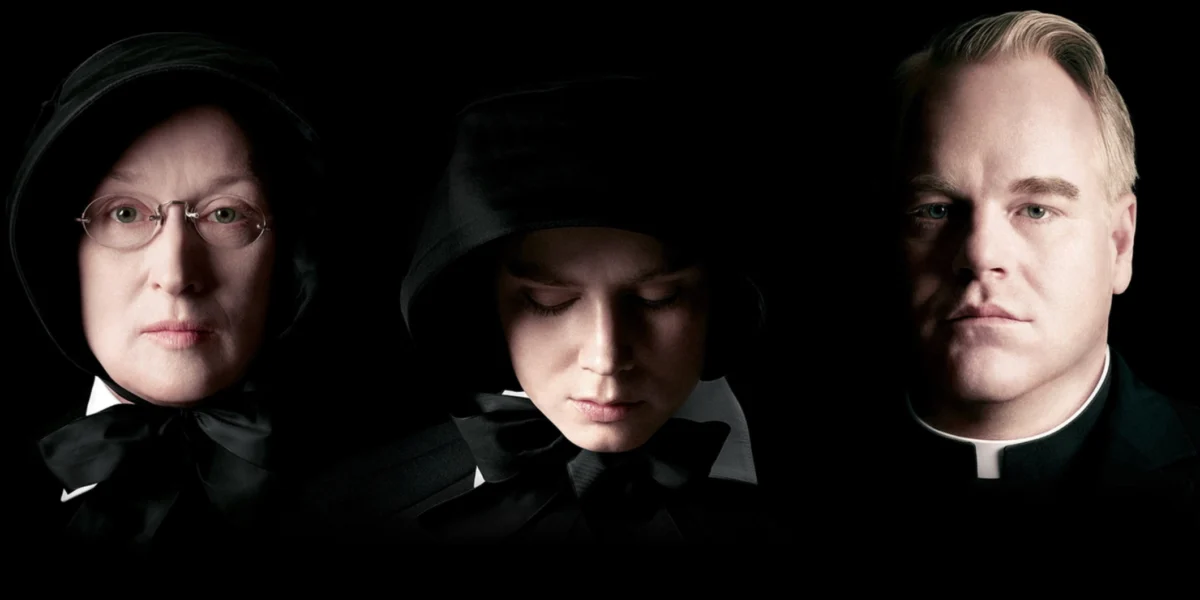
The plot of Doubt centers on Sister Aloysius Beauvier (Meryl Streep), the rigid and traditionalist principal of St. Nicholas School, who becomes convinced that the popular and charismatic Father Flynn (Philip Seymour Hoffman) has engaged in an inappropriate relationship with the school’s first African American student, Donald Miller. Sister Aloysius’s suspicion is sparked by an observation made by the young and idealistic Sister James (Amy Adams), who reports that Father Flynn met privately with the boy and that the child appeared distressed afterward.
The film meticulously balances several heavy themes:
- Tradition vs. Change: Sister Aloysius represents the old guard, valuing discipline, fear, and strict adherence to dogma. Father Flynn represents a modernizing force, advocating for a more compassionate, approachable, and integrated church.
- Certainty vs. Suspicion: The title itself points to the film’s central thesis. Sister Aloysius operates with a "moral certainty" that requires no hard evidence, while Father Flynn defends himself by highlighting the destructive nature of gossip and the fallibility of human judgment.
- Institutional Power: The film examines the hierarchy of the Catholic Church in the 1960s, specifically how the patriarchal structure limited the power of nuns to challenge the actions of priests.
By refusing to provide a definitive answer regarding Father Flynn’s guilt or innocence, Shanley forces the audience into a state of "doubt," mirroring the experience of the characters and challenging the viewer’s own biases and perceptions of justice.
A Rare Feat in Acting: The Four Oscar-Nominated Performances
One of the most remarkable aspects of Doubt is its success during the 81st Academy Awards. It is one of the few films in history to receive nominations for its entire principal cast: Meryl Streep for Best Actress, Philip Seymour Hoffman for Best Supporting Actor, Amy Adams for Best Supporting Actress, and Viola Davis for Best Supporting Actress.
Meryl Streep as Sister Aloysius Beauvier
Streep’s portrayal of the formidable principal is a study in controlled intensity. She delivers a performance that avoids the caricature of the "mean nun," instead presenting a woman who views her severity as a necessary shield for the children under her care. Streep’s use of physical mannerisms—the adjusted spectacles, the stern posture, and the sharp, rhythmic delivery of dialogue—creates a character that is both terrifying and deeply principled in her own worldview.
Philip Seymour Hoffman as Father Flynn
The late Philip Seymour Hoffman provided a brilliant counterweight to Streep. His Father Flynn is warm, articulate, and seemingly progressive. Hoffman’s performance is carefully calibrated to maintain the film’s central mystery; he plays the character with enough sincerity to earn the audience’s sympathy, yet with flashes of defensiveness that keep the seeds of doubt planted. His "sermon on gossip" remains one of the most cited monologues in 21st-century film.
Amy Adams as Sister James
Amy Adams serves as the audience’s surrogate, caught between the two warring figures. Her Sister James is characterized by a genuine love for teaching and a desire to believe the best in people. Adams portrays the character’s loss of innocence with a heartbreaking vulnerability, illustrating how the conflict between her superiors forces her to abandon her natural optimism for a more cynical reality.

Viola Davis as Mrs. Miller
Despite having only one major scene—a ten-minute conversation with Sister Aloysius in a wind-swept park—Viola Davis’s performance is often cited as the emotional climax of the film. As the mother of the boy at the center of the controversy, Davis delivers a complex reaction that shifts the moral ground of the movie. She reveals the devastating trade-offs a mother might make to protect her child from a more immediate threat (in this case, an abusive father and a prejudiced society), even if it means ignoring a potential secondary threat. This performance catapulted Davis into the top tier of Hollywood talent.
Visual Language and Technical Execution
The collaboration between John Patrick Shanley and cinematographer Roger Deakins was instrumental in elevating the film’s psychological tension. Deakins, known for his masterful use of light and shadow, employed several techniques to mirror the internal states of the characters.
The film makes frequent use of "Dutch angles"—tilting the camera to create a sense of unease and disorientation. These shots often coincide with Sister Aloysius’s growing obsession or Father Flynn’s moments of pressure, visually signaling that the moral foundation of their world is shifting. The color palette is deliberately muted, dominated by the black and white of the clerical habits and the gray, wintry skies of New York. This starkness emphasizes the lack of "gray areas" in Sister Aloysius’s mind, even as the narrative itself dwells entirely within them.
The sound design and score also play critical roles. Howard Shore’s music is sparse, allowing the dialogue—the "parable" of the title—to take center stage. The sound of wind, creaking floorboards, and the distant echoes of the schoolyard contribute to an atmosphere of isolation and surveillance.
Awards Season and Critical Reception
Released in December 2008, Doubt was met with widespread critical acclaim. On the review aggregator Rotten Tomatoes, the film holds a high approval rating, with critics praising the screenplay’s intellectual rigor and the powerhouse acting. Roger Ebert awarded the film four stars, noting that "the performances are at the highest level" and that the film "does not provide the easy satisfaction of a resolution."
In addition to its four acting nominations at the 81st Academy Awards, Shanley received a nomination for Best Adapted Screenplay. At the Screen Actors Guild (SAG) Awards, the film received five nominations, with Meryl Streep winning Outstanding Performance by a Female Actor in a Leading Role. Despite the heavy competition in 2008—a year that included Slumdog Millionaire, The Curious Case of Benjamin Button, and The Dark Knight—Doubt secured its place as the definitive "actor’s movie" of the season.
Financially, the film was a success for Miramax, grossing over $50 million worldwide against a production budget of approximately $20 million. Its performance was particularly strong in urban markets and among older demographics, proving that dialogue-heavy, adult-oriented dramas could still find a significant audience in a landscape increasingly dominated by franchise cinema.
Chronology of Production and Release
- May 2004: "Doubt: A Parable" premieres Off-Broadway at the Manhattan Theatre Club.
- March 2005: The play transfers to Broadway, opening at the Walter Kerr Theatre.
- April 2005: The play wins the Pulitzer Prize for Drama.
- June 2005: The play wins four Tony Awards, including Best Play.
- 2007: Development for the film begins with Miramax Films; Meryl Streep and Philip Seymour Hoffman are cast.
- December 1, 2007: Principal photography commences in the Bronx, including locations at the College of Mount Saint Vincent and Bedford-Stuyvesant, Brooklyn.
- December 12, 2008: The film receives a limited theatrical release in the United States.
- December 25, 2008: The film expands to a wide release.
- January 22, 2009: The Academy of Motion Picture Arts and Sciences announces five nominations for Doubt.
- February 22, 2009: The film concludes its primary awards run at the 81st Oscar ceremony.
Broader Impact and Lasting Implications
The legacy of Doubt extends beyond its awards and box office figures. It is frequently utilized in academic settings to discuss the ethics of suspicion and the psychology of belief. In the years following its release, the film’s themes of clerical misconduct took on even greater weight as the real-world Catholic Church grappled with systemic scandals. While the film is set in 1964, its exploration of how institutions protect themselves and how whistleblowers are often marginalized remains a contemporary concern.
Furthermore, the film’s conclusion—a breakdown of Sister Aloysius’s iron-clad resolve—serves as a poignant reminder of the human cost of ideological warfare. Her final cry, "I have such doubts!", serves not as a confession of error, but as a realization that the pursuit of truth often leaves one in a wilderness of uncertainty.
As the film reaches its 16-year anniversary, it stands as a testament to the power of the "well-made play" when translated to the screen with care. It reinforced Meryl Streep’s status as a generational talent, provided one of the most complex roles of Philip Seymour Hoffman’s career, and introduced the world to the immense capabilities of Viola Davis. In an era of cinema often characterized by spectacle, Doubt remains a vital example of the enduring power of the human voice and the complexities of the human conscience.