When the original film adaptation of Lauren Weisberger’s novel The Devil Wears Prada debuted in 2006, it captured a specific, crystalline moment in cultural history. It was an era where the gatekeepers of style and information held an almost monarchical authority. At the center of this universe was Runway magazine, a thinly veiled stand-in for Vogue, led by the formidable Miranda Priestly. In 2006, the influence of a single editor-in-chief could dictate the inventory of global department stores and the career trajectories of thousands. Two decades later, the landscape has undergone a seismic shift, and the recently released sequel, The Devil Wears Prada 2, serves as a biting, bittersweet satire of an industry grappling with its own obsolescence.
While the first film was a celebration of the "glossy" era’s peak, the sequel functions as a cinematic post-mortem for the traditional media model. The film navigates the treacherous transition from print dominance to digital desperation, framing the struggle of its protagonists against a backdrop of budget cuts, viral scandals, and the encroaching influence of Silicon Valley. For those within the media industry, the film is less a fantasy and more a reflection of a tumultuous two-decade reality.
A Chronology of Media Disruption: 2006 to 2026
To understand the weight of the narrative in The Devil Wears Prada 2, one must look at the technological and economic timeline that separates the two films. When the original was released in June 2006, the digital revolution was in its infancy. Facebook had not yet opened its doors to the general public, remaining exclusive to high school and college students. Twitter was a fledgling startup only two months old, and the concept of an "influencer" as a professional career path did not exist. At that time, the primary source of media "buzz" came from blogs like Gawker, which focused their attention on the very legacy media titans—like Anna Wintour—that the film parodied.
By the time the sequel picks up the story, the power dynamics have flipped. Between 2006 and 2026, the newspaper and magazine industry saw a catastrophic decline in print advertising revenue, which plummeted by more than 70% according to industry data. The rise of programmatic advertising and the dominance of the "duopoly"—Google and Meta—stripped legacy publishers of their primary income streams. This economic reality is the engine of the sequel’s plot, replacing the high-fashion glamour of the first film with the cold, hard mathematics of digital engagement and corporate "rightsizing."
The Plot: From Gatekeeping to Groveling
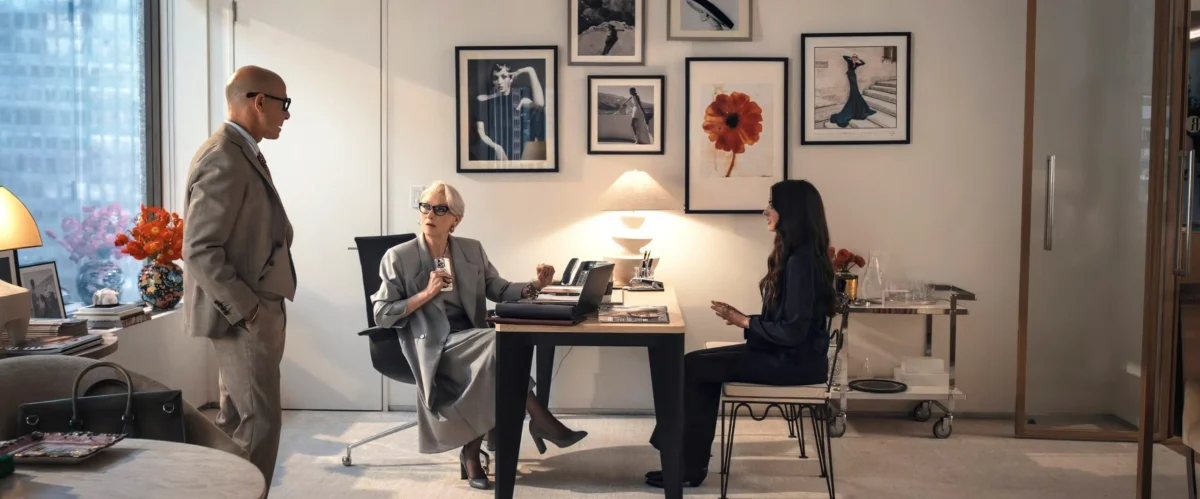
In the original film, Miranda Priestly (Meryl Streep) was the undisputed arbiter of taste. Her power was absolute; she did not negotiate with advertisers, she dictated to them. However, The Devil Wears Prada 2 punctures this aura of invincibility in its opening act. The film depicts a weakened Runway magazine, no longer the sole authority in fashion. In a pivotal scene, Priestly is forced to visit the headquarters of a major fashion advertiser to negotiate a "make-good" agreement. The leverage has shifted; the brand is no longer grateful to be in Runway’s pages; instead, the magazine is fighting to prove it still has a relevant audience.
This loss of control is further illustrated by a public relations crisis sparked by TikTok influencers. In a nod to the democratization of media, the film shows how a single viral video exposing shoddy reporting in Runway can do more damage to the brand’s reputation than any rival publication ever could. The film captures the exhaustion of modern journalism, where "white whale" interviews are sidelined by the constant demand for "engagement metrics." In one of the film’s more cynical moments, Priestly declares a feature story a success not because of its prose, but because it was "pinned" to the top of the magazine’s social media accounts.

The Economic Reality of "Rightsizing"
The sequel moves beyond the internal politics of a fashion magazine to address the broader corporate malaise affecting the media industry. The film opens with a sequence that will feel painfully familiar to many journalists: a local newspaper is abruptly shuttered by its corporate owners to facilitate a tax write-down. The journalists, including Andrea "Andy" Sachs (Anne Hathaway), find out they have lost their jobs via text message while attending an awards ceremony.
This scene sets the stage for the entry of "efficiency consultants"—modeled after firms like McKinsey & Company or the Boston Consulting Group. These consultants, frequently reminding Priestly of their Harvard Business School pedigrees, are brought in to "rightsize" Elias-Clarke, the parent company of Runway. The resulting cuts are depicted with a mix of humor and horror. The features budget is slashed, and in a scene that highlights the loss of executive perk culture, Priestly is forced to walk through the economy cabin of a commercial flight.
Supporting data from the Bureau of Labor Statistics highlights the reality behind this satire: newsroom employment in the United States dropped by over 50% between 2008 and 2020. The Devil Wears Prada 2 leans into this grim statistic, showing long-tenured staffers like Nigel Kipling (Stanley Tucci) resigned to the fact that their institutional knowledge is now viewed as a liability on a balance sheet.
Billionaire Benefactors and the Vanity Ownership Model
A major narrative arc in the film involves the character of Benji Barnes (Justin Theroux), a buff tech billionaire whose mannerisms and laugh are clearly inspired by Amazon founder Jeff Bezos. Barnes expresses interest in acquiring Runway as a gift for his significant other, reflecting a real-world trend of "vanity ownership" in the media sector.
Over the last decade, several high-profile publications have been purchased by tech billionaires: Jeff Bezos bought The Washington Post in 2013, Marc Benioff acquired Time in 2018, and Laurene Powell Jobs took a majority stake in The Atlantic in 2017. The film explores the central tension of this model: does a wealthy benefactor provide the "runway" (pun intended) for quality journalism to thrive, or do they eventually succumb to the same cost-cutting pressures as corporate conglomerates?
The film’s dialogue between Priestly and Sachs regarding editorial independence under a billionaire owner mirrors the real-life anxieties of staff at legacy institutions. While some titles, like The Atlantic, have found a sustainable path under this model, others have faced significant friction between ownership and the newsroom.
Industry Parallels and Cameos
The film is saturated with "inside baseball" references that anchor it in the real world of New York media. The subplot of Miranda Priestly vying for the title of Chief Content Officer of Elias-Clarke is a direct parallel to Anna Wintour’s 2020 appointment as Chief Content Officer for Condé Nast global. This elevation of an editor to a corporate executive role is presented as a survival tactic—a way to consolidate power as the traditional editor-in-chief role loses its luster.

The film’s authenticity is bolstered by a series of cameos from media figures who are well-known within the "A-list" of journalism but perhaps less so to the general public. While Donatella Versace and Lady Gaga provide the expected fashion star power, appearances by Tina Brown, Kara Swisher, and Molly Jong-Fast signal that the filmmakers were aiming for a specific, media-literate audience.
At the film’s New York premiere, the presence of real-world power players added a layer of meta-commentary. Anna Wintour herself was in attendance, seen conversing with former Disney CEO Bob Iger. Their presence underscores the film’s central theme: the intersection of old-world prestige and new-world corporate consolidation.
Broader Impact and Implications
Critics have noted that while The Devil Wears Prada 2 is a satire, it occasionally struggles with its own relationship to wealth. David Rooney’s review for The Hollywood Reporter points out that the film’s glorification of Sachs’ luxury lifestyle—specifically her high-end apartment—feels disconnected from the reality of a modern journalist’s salary. However, this dissonance may be intentional, highlighting the widening gap between the "media elite" and the rank-and-file workers who are increasingly being squeezed out of the industry.
Ultimately, the film joins a long lineage of cinema that chronicles the evolution of the press, from the heroic heights of All the President’s Men and Spotlight to the cynical corporate maneuvering of Network. The Devil Wears Prada 2 suggests that while the "devil" may still wear high-end fashion, she is now fighting for survival in an ecosystem that no longer respects her authority.
The film concludes on an ambiguous note regarding the future of Runway. It leaves the audience wondering whether the magazine will evolve into a resilient digital-first brand or become another casualty of the relentless "pivot to video" and AI-generated content era. In doing so, it provides a vivid, if exaggerated, snapshot of an industry at a crossroads, mourning its past while nervously eyeing its digital future.