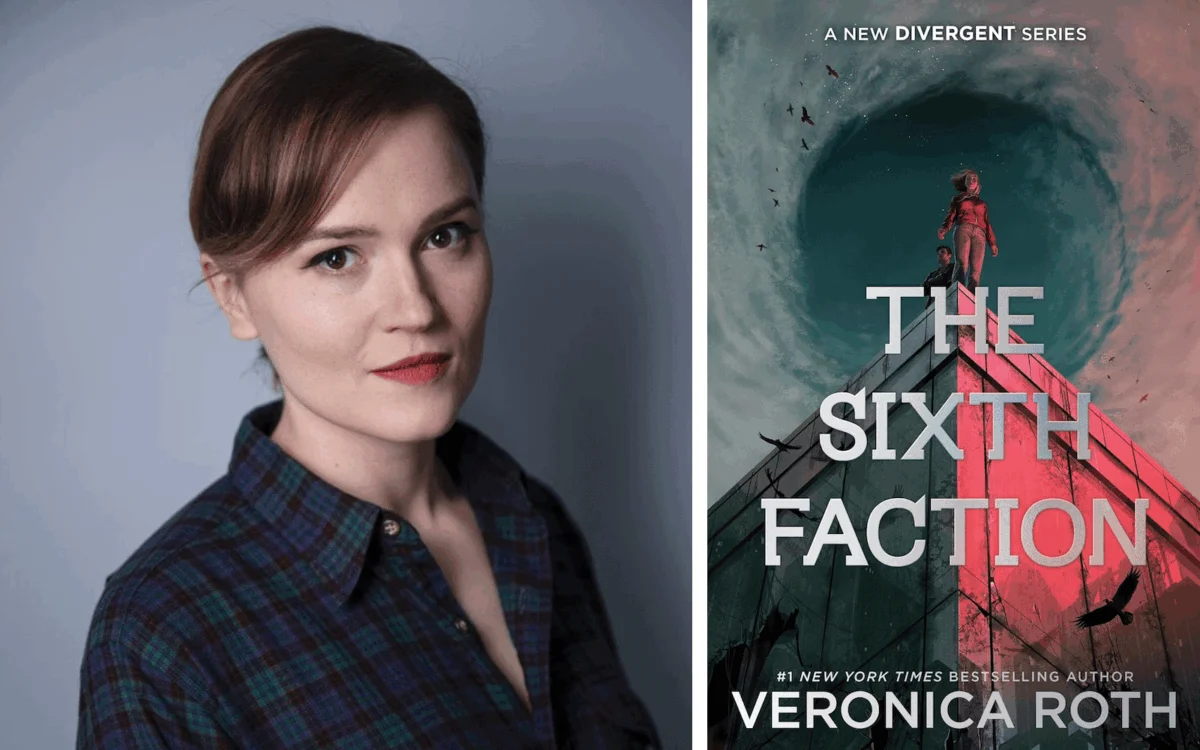
The literary world is abuzz following the much-anticipated reveal of Veronica Roth’s The Sixth Faction at BookCon 2026. This announcement marks a significant return for the author to the Young Adult dystopian universe that propelled her career and captivated millions worldwide, coming thirteen years after the publication of the third and ostensibly final installment of the Divergent series. However, The Sixth Faction is not a direct continuation of the original saga. Instead, it heralds the commencement of a two-book series that reimagines the Divergent universe through an alternate reality lens, posing a pivotal question: "What if Beatrice Prior didn’t choose to join the Dauntless faction?"
This exploration of alternate timelines, where a single choice can ripple into vastly different outcomes, forms the conceptual core of the project. Roth’s decision to revisit her breakout work, a series she has openly acknowledged wrestling with even as she cherishes its legacy, offers her a unique opportunity to address lingering "What if?" scenarios that have occupied her creative mind for over a decade. This endeavor is not solely about exploring a butterfly effect; it’s also about refining her relationship with a universe that has indelibly shaped her professional identity.
In a recent exclusive interview, Roth discussed the genesis of The Sixth Faction, her evolving perspective on the Divergent series, and the profound experience of finding renewed joy in a body of work that has also been a source of self-critique.
A Decade in the Making: The Genesis of an Alternate Reality
The revelation of The Sixth Faction at BookCon 2026, a premier event for book industry professionals, authors, and avid readers, underscores the enduring appeal of the Divergent franchise. BookCon, typically held in major convention centers, draws thousands, and announcements of this magnitude often dominate industry discussions for months. The timing of Roth’s return, thirteen years after Allegiant (2013), suggests a carefully considered strategy to re-engage with her fanbase and explore new creative avenues within a familiar landscape.
Roth’s decision to opt for an alternate universe re-imagining rather than a direct sequel or prequel is a deliberate choice, driven by a desire to forge a new creative path and mend her personal relationship with the series. "I think it goes back to the motivation behind writing them," Roth explained. "I had, over the course of 15 years, taken in so much negativity, even though there was a lot of positivity surrounding the series. Because of my particular psychology, I really retained a lot of the negative parts. When I realized that 15 years later, Divergent was still selling really well, I also realized that I was not going to be able to ignore it in my life. I needed to improve my relationship to it."
Reimagining Canon: Influences and Intentions
The concept of revisiting and altering established fictional universes is not unprecedented in literature. Roth cited examples such as Orson Scott Card’s Ender’s Game series, specifically the alternate perspective offered by Bean’s POV, and Stephenie Meyer’s Midnight Sun, which retells Twilight from Edward Cullen’s viewpoint. While these examples primarily focus on shifting perspectives within the existing canon, Roth’s approach in The Sixth Faction ventures further by fundamentally altering a core premise of the original narrative.
"The idea of a sequel or a prequel or an alternate point of view or something like that, it still very much feels like a continuation of what I did before," Roth stated. "What I needed to do for myself was to make it feel new. I also thought that this was a fun and playful experiment because it’s just something that we see a little less often. I’m not the first person to play with their own canon, obviously. It felt like a way to appreciate what I loved about the original while still allowing myself to build something that felt new."
This approach allows Roth to deconstruct and reconstruct her narrative without the burden of adhering strictly to the established plot points, offering a potentially less risky, yet profoundly rewarding, creative space. The inherent risk, Roth admitted, lay in the emotional territory of revisiting a work that has evoked complex feelings. "Emotionally, it was risky because it was returning to this thing that I have developed complicated feelings about. So that part felt a little unsettling. Am I going to enjoy this? Am I going to find joy in this project?"
The Reward of Rebuilding
The act of creation, Roth emphasized, was instrumental in shifting her perspective. "The reward was great, though, because I think it really did do what I hoped it would, which is that it helped me to appreciate what I did well in the old series instead of only seeing what I was critical of. Obviously I still have criticisms of my past work, but it was very unbalanced the way that I was looking at it, so this has really helped me with that."
This process of "rebuilding or building something new" became the catalyst for rediscovering her passion for the Divergent world. Roth shared that releasing early scenes from this reimagined version on her newsletter served as a low-stakes test, confirming that the project held genuine creative promise. "It was just like, ‘I’m just going to try this.’ This is low stakes, and if it feels good, then maybe this project is something that I can do. Then, it was about going back and actually making something that helped me to feel the joy. That’s how I’ve always worked. I like to make things, so that’s why I’m a writer."
Refining the Foundation: World-Building and Character Development
Roth’s growth as a writer since the Divergent series is evident in her approach to world-building and characterization in The Sixth Faction. While preserving the core strengths of the original—its focus on character relationships and emotional instincts—she aimed to create a more stable and cohesive world. "I think that having more stable rules that undergird your story helps readers go on an emotional journey with the characters. They feel like there’s something stable beneath them. That’s kind of what I worked on with the world-building. It’s not so noticeable, I think, but for me, it felt sturdier than the original."
This is a critical point for any author revisiting a beloved, yet perhaps flawed, universe. The original Divergent series, while lauded for its emotional resonance, sometimes faced criticism for its fantastical elements and less rigorous world-building. By focusing on a more robust foundation, Roth seeks to enhance the reader’s immersion and emotional investment.

Her personal and professional evolution as a writer has also informed these new works. "Every book since then was trying to shore up those weaknesses as a writer and to become stronger. Have a better toolset, basically." However, she cautioned against approaching such a project with a defensive posture. "You can’t go into a work like Divergent, which is supposed to be fun and adventurous, and for young people, and think, ‘I’m going to make this smart, I’m going to make this prove myself to people.’ That would be a posture of defense. I don’t think you can make something good out of that defensive posture."
A More Intimate Conversation
Roth’s known preference for emotionally resonant, character-driven narratives is a key element in The Sixth Faction. She believes the new books offer a more intimate portrayal of the characters and their dynamics. "They’re much more focused on these people and their dynamic together. And The Sixth Faction feels like a conspiracy thriller in some ways, whereas the original was more like a sort of traditional chosen one narrative. This focus is a little tighter, I think, on people, what they’re doing, and the lies that they’re telling to each other."
This shift in genre focus from a traditional dystopian "chosen one" narrative to a conspiracy thriller suggests a more intricate plot, perhaps with a greater emphasis on interpersonal relationships and internal conflicts. Roth also noted that the duology format necessitated a streamlining of plot elements compared to the original trilogy, a challenge she embraced from the outset.
Balancing Expectations and Artistic Integrity
Navigating reader expectations while staying true to her artistic vision is a perennial challenge for established authors. Roth’s approach for The Sixth Faction was to prioritize her own creative satisfaction. "Because this project is primarily for me and for course-correcting my relationship to Divergent. I focused very much on what would please me. Obviously I care about my readers and they got me here, so I’m not looking to disappoint them. I think what will please them most is to tell the strongest story possible and the one with the most integrity."
She firmly rejects the notion of "fixing" or "updating" her past work, viewing the new series as a distinct entity with its own artistic merit. "It is not my goal to correct mistakes. I don’t think I could have written it if I thought about it that way because that would’ve been kind of soul crushing. So my intention is to write something new just to make something fun, be playful, be experimental, and experience joy."
Inevitable Moments and Character Authenticity
Roth acknowledged that establishing the rules for an alternate timeline involved making deliberate choices about which elements were immutable. "Mostly my rules were about character. Even though they’re in different situations and are making different choices and growing in different directions, sometimes they have to feel true to the person that I first described in the original series." This character-driven approach ensures that even in a divergent reality, the core essence of the characters remains recognizable. She also hinted at "smaller, cheekier moments" that might serve as nods to the original series, adding an element of playful self-awareness.
Regarding her personal connection to the characters, Roth noted that she doesn’t see a significant part of herself in Tris, with the exception of a shared tendency towards self-criticism. She found it more fulfilling to write about characters who possess qualities she herself lacks, such as Tris’s boldness and impulsivity.
When asked if any character in the new series reflects her more closely, Roth explained that all characters are born from their choices rather than direct autobiographical representation. However, she highlighted a transformative event early in The Sixth Faction for Tris that mirrors the current socio-political climate. "Something happens early in the story that opens her eyes to more of what’s actually going on in the world around her. I think that disillusionment ends up changing the character most of any of the other choices that she makes. She still feels like Tris, but she’s Tris with her eyes open. I think that is not based on any person, but it feels true to what it must be like to be 16 right now. This is a hard world that we’re living in and they’re aware of all of it." This suggests a thematic resonance with contemporary issues, adding a layer of relevance for younger readers.
Engaging New Generations and the Art of Revision
Roth expressed optimism about how new readers, particularly those unfamiliar with the original Divergent series, might engage with The Sixth Faction. She believes the books can stand on their own, offering multiple entry points into the universe. "You could not read the original, that’s fine. Just read this. Or you could read the original and then read this or the reverse. I think any way you do it offers some interesting insights."
She also plans to engage with young readers through school visits, a practice she cherished from her early career. Her core message for aspiring writers and readers alike is the importance of embracing a nuanced relationship with their work: "What I’d love to talk to them about is feeling free to look at your old work and love it while being critical of it at the same time." This sentiment, she believes, is crucial in an era of rapid technological advancement and evolving creative processes, emphasizing that "being able to reapproach your old writing is an important skill that we all need to develop."
The Sixth Faction is slated for release on October 6, 2026, by HarperCollins, promising a fresh yet familiar journey back into a world that continues to capture the imagination.