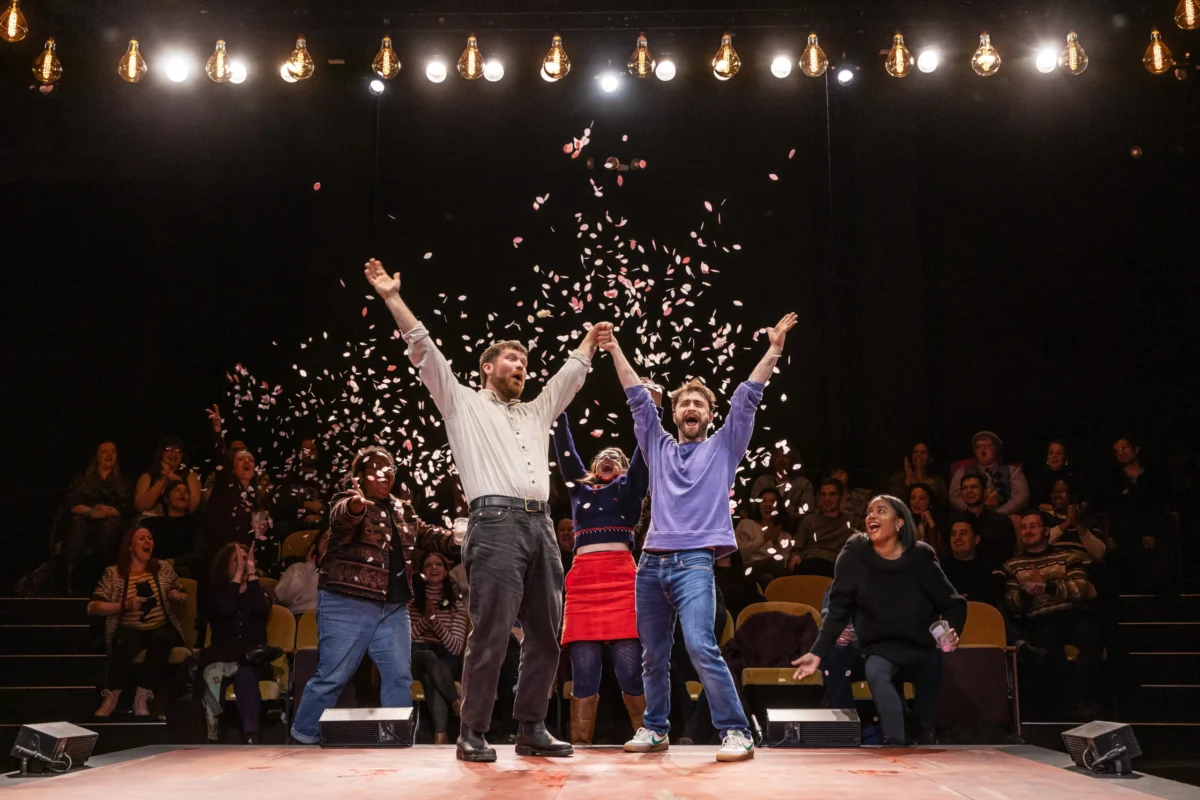
The Broadway production of Every Brilliant Thing, starring Tony Award winner Daniel Radcliffe, has officially recouped its $5.75 million capitalization, marking a significant financial milestone in the 2025-2026 theatrical season. This achievement places the production in an elite category, as it is only the third commercial project out of more than two dozen to announce full recoupment this season. The production, which opened at the Hudson Theatre on March 12, reached this profitable status in less than eight weeks, a pace that industry analysts describe as exceptionally rare for a non-musical play.
The financial success of the revival is attributed to a combination of high-profile star power, strategic scheduling, and a lean operating model. For the week ending May 3, the production recorded its highest weekly gross to date, bringing in $1.7 million. This surge in revenue pushed the show past its initial investment threshold, securing its position as a commercial triumph during a season characterized by fluctuating box office returns and high production costs across the Broadway landscape.
The Financial Architecture of Every Brilliant Thing
The $5.75 million capitalization for Every Brilliant Thing represents a relatively modest investment compared to the massive budgets required for contemporary Broadway musicals, which often exceed $15 million to $25 million. However, for a solo performance or a play with minimal staging, $5.75 million remains a substantial sum that requires consistent high-capacity attendance to recover. The production’s ability to recoup in under two months is a testament to its aggressive pricing strategy and the drawing power of its lead actor.
Throughout the month of April and early May, Every Brilliant Thing commanded the highest average ticket price in the industry. By leveraging "premium pricing" models during peak performance windows, the production was able to maximize revenue from the Hudson Theatre’s approximately 970 seats. The show’s low weekly "nut"—the industry term for operating costs—further accelerated the path to profitability. Unlike large-scale productions with extensive casts, orchestras, and complex technical requirements, Every Brilliant Thing benefits from a minimalist set and a single-performer format, allowing a larger percentage of the weekly box office gross to be directed toward paying back investors.
Chronology of a Broadway Success
The journey of Every Brilliant Thing to the Hudson Theatre began with a strategic announcement in late 2024, positioning Daniel Radcliffe’s return to the stage as a centerpiece of the spring season. Radcliffe, who has built a formidable reputation on Broadway through roles in Equus, How to Succeed in Business Without Really Trying, and his recent Tony-winning turn in Merrily We Roll Along, served as the primary catalyst for early ticket sales.
- January 2025: Pre-sales opened to record-breaking demand, with American Express cardholders and theater club members exhausting early inventories within forty-eight hours.
- February 24, 2025: Previews began at the Hudson Theatre. The production immediately began playing to standing-room-only crowds.
- March 12, 2025: The production officially opened to critical acclaim. Critics praised Radcliffe’s immersive performance and the play’s unique interactive format.
- April 2025: The production maintained a streak of grossing over $1.5 million per week, consistently operating at over 100% capacity (including standing room).
- May 3, 2025: The production officially surpassed its $5.75 million capitalization mark following a $1.7 million week.
- May 6, 2025: Daniel Radcliffe received a Tony Award nomination for Best Performance by an Actor in a Leading Role in a Play, further boosting the show’s profile.
Comparative Performance in the 2025-2026 Season
The success of Every Brilliant Thing is particularly notable when viewed against the broader context of the 2025-2026 Broadway season. To date, only two other commercial productions have announced recoupment: the revival of Samuel Beckett’s Waiting for Godot, starring Keanu Reeves and Alex Winter, and the revival of Yasmina Reza’s Art, featuring Neil Patrick Harris, Bobby Cannavale, and James Corden.
Both Waiting for Godot and Art relied on "event casting" to drive short-term, high-intensity ticket sales. These productions operated as limited engagements, a trend that has become increasingly popular as a method to mitigate financial risk. While those shows have since concluded their runs, Every Brilliant Thing has managed to achieve recoupment while still in the midst of its scheduled performances, providing its investors with a period of pure profit before the production concludes.
The high failure rate of Broadway shows—traditionally cited as nearly 80% of productions failing to return their initial investment—underscores the magnitude of this win. In a season where several high-budget musicals and celebrity-led dramas have struggled to find an audience, the efficiency of Every Brilliant Thing serves as a blueprint for future commercial theatrical ventures.
Artistic Context and Audience Interaction
Written by Duncan Macmillan with Jonny Donahoe, Every Brilliant Thing is a play that explores the complexities of mental health, depression, and the resilience of the human spirit. The narrative follows a character who, as a child, begins a list of everything worth living for to cheer up his chronically depressed mother. As the character grows, the list evolves from "ice cream" and "water fights" to more mature observations about life and love.
The Broadway production has been lauded for its immersive nature. Radcliffe begins the experience during the pre-show, moving through the aisles and engaging with theatergoers. During the performance, he enlists audience members to play various roles—such as a veterinarian, a father, or a lecturer—and asks them to read items from the list aloud. This level of intimacy and unpredictability has created a "must-see" atmosphere, as no two performances are identical. This interactive element has not only driven positive word-of-mouth but has also encouraged repeat attendance, a rarity for a non-musical play.
The Transition: From Radcliffe to Hargitay
As the production prepares for its final weeks, it faces a significant transition. Daniel Radcliffe is scheduled to play his final performance on May 24, 2025. Following his departure, the production will welcome Emmy Award winner Mariska Hargitay, who will take over the role starting May 26.
Hargitay, best known for her long-running role as Olivia Benson on Law & Order: Special Victims Unit, brings a different but equally potent form of star power to the Hudson Theatre. Her engagement is scheduled to run through June 28, 2025. This transition strategy—replacing one major star with another—is designed to sustain the show’s momentum and ensure that the post-recoupment period remains highly profitable.
Industry analysts will be watching the "Hargitay weeks" closely to determine if the brand of the play and the strength of the new lead can maintain the record-breaking average ticket prices established during Radcliffe’s tenure. Early reports suggest that ticket sales for Hargitay’s run are already robust, indicating that the production’s financial health is likely to remain strong through its closing date.
Broader Implications for the Broadway Industry
The recoupment of Every Brilliant Thing offers several key takeaways for the Broadway community. First, it reaffirms the "star vehicle" as the most reliable driver of commercial success in the current economic climate. While original plays without household names often struggle to find footing, a well-placed star in a compelling, low-overhead production remains a winning formula for investors.
Second, the success of the show highlights the growing importance of the Hudson Theatre as a premier venue for limited-run, star-driven plays. Since its reopening and renovation, the Hudson has hosted several high-grossing productions, benefiting from its intimate feel and prime location.
Finally, the achievement of Every Brilliant Thing suggests that audiences are increasingly drawn to "experience-based" theater. In an era where digital entertainment is ubiquitous, the live, unpredictable, and participatory nature of this production offers something that cannot be replicated on screen. The ability to charge premium prices for a solo show indicates that theatergoers are willing to pay a significant premium for intimacy and a direct connection with a performer.
As the 2025-2026 season moves toward the Tony Awards, Every Brilliant Thing stands as a rare example of both critical and commercial harmony. Its success provides a much-needed boost to the Broadway economy and sets a high bar for the productions that will follow in the next theatrical cycle. For the producers and investors of Every Brilliant Thing, the list of "brilliant things" now undoubtedly includes a $5.75 million return on investment.