In a tranquil corner of a refined Left Bank boutique hotel, the legendary Catherine Deneuve, an undeniable emblem of French cinematic artistry, holds court, her composure as captivating as her storied career. Accompanying her, not as a mere accessory but as a constant, watchful presence, is Jack, her pointy-eared Shiba Inu. "Not Jacques, Jack!" she clarifies with a gentle firmness, as the canine stands sentinel, his gaze fixed on her, a discreet, furry guardian. Deneuve, ever the professional, notes, "I usually have him on set with me. He is always very good." This intimate setting, adorned with her tasteful Louis Vuitton handbag casually resting on a chaise lounge, provides a rare glimpse into the private world of an actress whose public persona has shaped and reflected French culture for over six decades. As she punctuates her thoughtful responses with occasional puffs from her vape – "I did quit smoking for a while, even did hypnosis, but I started again," she muses, waving the device. "This, however, is not smoking. It’s nothing." – the scene underscores a blend of casual elegance and an almost regal presence, an audience with a figure often likened to cinematic royalty.
A Living Emblem: Deneuve’s National Significance
Deneuve is more than just an actress; she is, quite literally, the face of France. In 1989, commemorating the bicentennial of the French Revolution, her likeness was chosen as the image of Marianne, the national emblem embodying liberty and reason. This distinction cemented her status as an icon, transcending the boundaries of film to become a cultural touchstone. Her screen persona, remarkably diverse and often contradictory, mirrors the complexities of French identity itself. She effortlessly transitions from the sweet, romantic idealism of Geneviève in Jacques Demy’s enchanting 1964 musical The Umbrellas of Cherbourg to the chilling, sexually repressed Carole Ledoux, whose psyche unravels into homicidal madness in Roman Polanski’s psychological thriller Repulsion (1965). Two years later, she redefined sensuality as Sévérine, the haute-bourgeois housewife leading a double life as an S&M submissive in Luis Buñuel’s surreal masterpiece Belle de Jour (1967). Later in her career, she embraced self-parody and camp, notably in Tony Scott’s lesbian vampire thriller The Hunger (1983) and François Ozon’s whimsical murder mystery musical 8 Women (2002), showcasing an unparalleled versatility.
This ability to embody characters that are at once liberated and conservative, radical and restrained, has made Deneuve the quintessential embodiment of French cinema. Her filmography, spanning over 130 titles, is a profound exploration of human nature, particularly female desire and societal constraints. She has navigated genres from poignant dramas to dark comedies, thrillers, and musicals, consistently challenging expectations and defying categorization. Her enduring presence, her unwavering commitment to challenging roles, and her distinct artistic sensibility have ensured her status not merely as a legend of the Croisette, but as the legend, a living testament to the power and allure of French film.
Cannes: The Tapestry of a Legendary Career
The Cannes Film Festival has served as a recurring stage, a crucial throughline in Catherine Deneuve’s illustrious career, where her legend was first forged and continually reaffirmed. Her Cannes story began with a true coronation in 1964. The Umbrellas of Cherbourg, her inaugural lead role, captivated critics and audiences alike, ultimately winning the coveted Palme d’Or. This triumph instantly transformed the then-20-year-old ingenue into an international star, launching her into the global spotlight. "We knew [the film] was special when we were shooting it," she recalls. "The story was very different, and the film was entirely sung. Everything had to be recorded before shooting, so we had to learn the whole film in advance. It was a very special experience." For Deneuve, who was at the very dawn of her career, the magnitude of the Palme d’Or win felt "unreal" because she "didn’t fully understand it yet." This early success set a precedent for a career deeply intertwined with the prestigious festival.
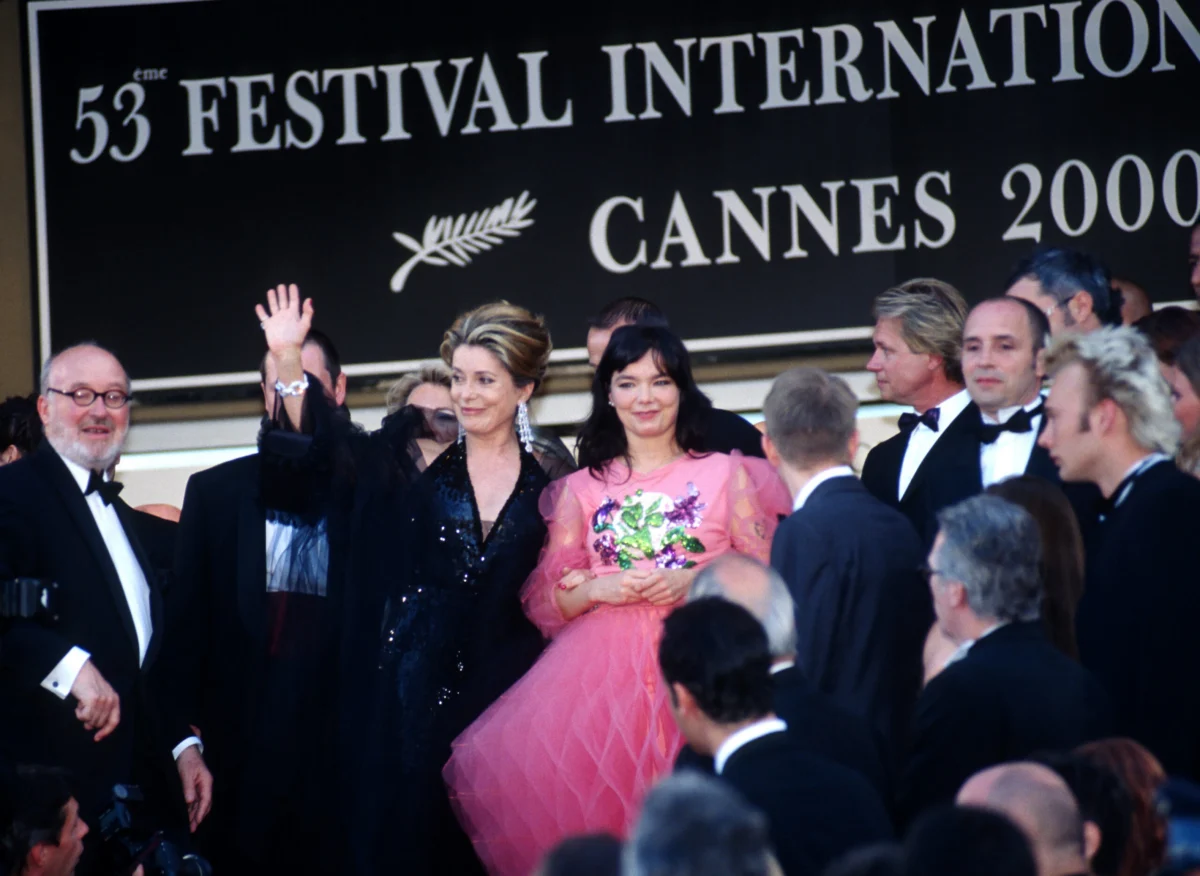
Decades later, Cannes continued to mark significant moments. In 2000, Deneuve returned to the festival with Lars von Trier’s provocative musical drama Dancer in the Dark, in which she co-starred with Icelandic musician Björk. The film went on to win the Palme d’Or, a moment that resonated deeply with Deneuve. "The moment I especially remember from Cannes is when [Lars von Trier’s] Dancer in the Dark won the Palme d’Or. That recognition, that stayed with me," she recounts, highlighting the lasting impact of such accolades.
Beyond her roles on screen, Deneuve has also contributed to the festival’s legacy as a juror. Her participation in the 1994 jury, alongside figures like Clint Eastwood, proved particularly memorable and, at the time, highly divisive. The jury’s decision to award the Palme d’Or to Quentin Tarantino’s groundbreaking Pulp Fiction sparked immediate controversy and cemented its place in cinematic history. "Oh, the reaction in the theater! People were shouting, they were so angry. It was such a new kind of film that some didn’t understand it," Deneuve remembers, vividly recalling the tumultuous premiere. Despite the public uproar, she notes, "inside the jury, there was not much conflict. Clint Eastwood, though, didn’t talk much. He knew what he decided, but he didn’t explain it much to the others." This pivotal moment underscored Deneuve’s role in anointing a new generation of independent cinema, a choice that proved as defining as it was contested. Her myriad appearances at Cannes, both as an actor and a juror, underscore its significance as a constant thread woven through the rich tapestry of her career.
The Working Actor: Current Projects and Philosophy
Deneuve returns to Cannes not as a retrospective figure celebrated solely for past glories, but as a working actor, actively contributing to contemporary cinema. This year, she has two films in official competition, a testament to her enduring relevance and appeal. She features in the ensemble drama Parallel Tales, directed by two-time Oscar winner Asghar Farhadi, known for his critically acclaimed works like A Separation and A Salesman. Her second film is Gentle Monster, an offering from Austrian director Marie Kreutzer, whose previous work Corsage garnered international praise. In Gentle Monster, Deneuve portrays the mother of Léa Seydoux’s character, creating an intriguing generational link between two prominent French actresses.
Despite the prestige associated with these projects and their acclaimed directors, Deneuve remains remarkably modest about her contributions. "Oh, they are very small roles," she states. Yet, her philosophy on acting, even in minor capacities, is profound and rigorous. "But even a small role must be necessary. When a role is small, I always ask myself: ‘If this character were removed from the script, would it matter?’ If not, then it isn’t very interesting." This discerning approach highlights her commitment to the narrative and the overall artistic integrity of a film, rather than simply seeking screen time.

Her interest extends particularly to collaborations with emerging talent. "I’m also of course interested in the director, especially if they are young and the way they speak about the film has energy, something open and new. Then I want to be part of it," she explains. This willingness to embrace new visions and support fresh voices within the industry demonstrates her forward-looking perspective, ensuring that her extensive experience continues to enrich diverse cinematic projects. It underscores her role not just as an icon, but as an active participant in the ongoing evolution of film.
The "Ice Queen" and the Paradox of Portrayal
The image of Catherine Deneuve as the "ice queen" of French cinema is one of her most enduring and, arguably, most complex legacies. This moniker largely originated from her transformative performances in the mid-1960s, a stark departure from her earlier, more innocent roles. Just a year after the romantic transparency of The Umbrellas of Cherbourg, Deneuve plunged into the dark, violent, and psychologically intense world of Roman Polanski’s Repulsion (1965). Her portrayal of Carole Ledoux, a young woman descending into madness and murderous psychosis, showcased an unreadable froideur that startled audiences and critics alike.
However, it was her performance two years later in Luis Buñuel’s Belle de Jour (1967) that truly cemented this image. As Sévérine Serizy, a frigid haute-bourgeois housewife who secretly moonlights as a prostitute in an S&M brothel, Deneuve navigated themes of sexual repression, fantasy, and liberation with an enigmatic grace. The film, groundbreaking for its time, depicted female sexuality in a manner that was both provocative and deeply psychological. For a modern audience, the premise and its depiction of female desire can still seem almost inconceivable, yet Deneuve’s performance imbued Sévérine with an interiority that prevented her from becoming a mere object of male gaze.
Deneuve herself acknowledges the challenging nature of these roles. She admits some Belle de Jour scenes "were difficult. I wasn’t ready to do everything exactly as written." She also notes Buñuel’s directorial style: "Luis Buñuel didn’t explain much to actors, so at the beginning, it was complicated. But the film went well, and after that we did another film together [Tristana], which was wonderful." The success of these films turned her into a bona fide sex symbol, an image further amplified by her two Playboy pictorials in 1963 and 1965, the latter famously shot by her future husband, David Bailey.
Yet, here lies another paradox in Deneuve’s public image: the actress who helped define the language of sexual liberation on screen rarely bared it all herself. She maintains a clear artistic boundary. "I’m not a big fan of nudity in films," she muses. "When you are naked, you are no longer quite a character — you are just a person, a body. It’s difficult to stay in the story of a character." This stance reveals a thoughtful consideration of performance and character immersion, distinguishing between the symbolic portrayal of sexuality and explicit exposure, reinforcing her image as a nuanced artist rather than merely a provocative figure.
Navigating the Cultural Currents: Politics and Principles
The public image of Catherine Deneuve is characterized by a similar tension between progressive and, at times, seemingly reactionary stances, reflecting the complexities of French cultural discourse. Off-screen, Deneuve has largely been a dependable voice for progressive causes. She was a signatory of the influential 1971 "Manifesto of the 343," a courageous public declaration by women who admitted to having illegal abortions, advocating for reproductive rights in France. She has also been a vocal petitioner against the death penalty, a stance reflecting her commitment to human rights. More recently, at Cannes last year, she used her platform to condemn the killing of Palestinian photojournalist Fatima Hassouna, demonstrating her consistent engagement with global humanitarian issues.
However, the petition that garnered the most international attention and controversy was her 2018 open letter published in Le Monde. This letter, co-signed by over 100 prominent French women, chastised the #MeToo movement as a "witch hunt" that had gone too far, arguing it threatened sexual freedom and risked a new puritanism. The letter sparked a fierce debate globally, with many accusing Deneuve and her co-signatories of downplaying sexual harassment and assault. While she later issued an apology to victims and distanced herself from those who had "found it strategic to support me," the incident left a lasting impression. For many, this letter, combined with her steadfast refusal to distance herself from controversial figures like Roman Polanski and her long-time friend Gérard Depardieu (who was convicted in 2025 of sexually assaulting two women on a film set), solidified her position, for some, in the reactionary camp.
When asked about the lasting impact of #MeToo, Deneuve offers a circumspect and cautious response, reflecting the ongoing societal debate. "It’s very complicated. Sometimes accusations come many years later, which raises questions. People must be very careful. It has made everyone more aware, more cautious. I’m very careful [what I say]." Her comments highlight the nuances and complexities of the movement’s long-term effects, particularly concerning due process and the statute of limitations for accusations, topics that remain highly contentious in France and beyond. This measured approach, while sometimes criticized, is characteristic of Deneuve’s refusal to conform to simplistic narratives, even when it places her at odds with prevailing cultural tides.
Reflections on Collaborations and Missed Opportunities
Throughout her illustrious career, Catherine Deneuve has graced the screen alongside an incomparable roster of international stars, each collaboration adding another facet to her cinematic legacy. When asked to name her best screen partner from a list that includes luminaries such as Marcello Mastroianni, Jack Lemmon, Burt Reynolds, Daniel Auteuil, and Michel Piccoli, she barely hesitates before declaring, "Gérard Depardieu. Because he is completely present. With some actors, you feel they are not fully listening. With him, everything is alive in the moment." This choice, while potentially controversial given Depardieu’s recent legal troubles, speaks to her artistic appreciation for an actor’s immediate and immersive presence in a scene, prioritizing the craft above all else. Their numerous collaborations, including The Last Metro (1980), Une époque formidable… (1991), and Potiche (2010), showcased a dynamic and often electric on-screen chemistry that resonated deeply with audiences and critics.

Beyond her fruitful partnerships, Deneuve also harbors a few professional regrets and missed opportunities. She would have liked to work with the legendary director Alfred Hitchcock. "We had a project. It was a sort of spy movie. It was a fine script, so I met him, but then nothing happened," she recalls wistfully. The thought of a Deneuve-Hitchcock collaboration, combining her enigmatic allure with his mastery of suspense, remains one of cinema’s tantalizing "what ifs."
Her forays into American cinema, though fewer than some of her peers, left a positive impression. "I had a very good experience working with Jack Lemmon [on her first Hollywood movie, 1969’s The April Fools]," she notes. Later, she collaborated with Burt Reynolds in 1975’s Hustle. "Then I did the film with Burt Reynolds, which I liked very much. He was a wonderful actor and such a nice man." Her earlier, famously wry assessment of Reynolds — "very funny… for an American" — reflects her characteristic wit and perhaps a playful nod to cultural differences. These experiences, though limited, demonstrate her adaptability and comfort across different cinematic landscapes, even as her heart and primary focus remained firmly rooted in European, particularly French, filmmaking.
The Evolving Craft: From Celluloid to Digital
As an artist whose career spans over six decades, Catherine Deneuve has witnessed profound transformations in the filmmaking process. One of her most poignant reflections concerns the shift from celluloid to digital cinema, a transition that, for her, signifies a loss of a particular kind of magic and collective experience. "I used to like watching dailies — discussing scenes afterward. You see some things that you wouldn’t notice when you are shooting," she notes, a hint of wistfulness in her voice. The practice of reviewing dailies, the raw footage shot each day, was a communal ritual in the analog era, allowing the cast and crew to gather, assess, and refine their work collectively. It fostered a shared understanding and a sense of camaraderie that Deneuve clearly cherishes.
The digital revolution, while offering undeniable efficiencies and creative possibilities, has, in her view, altered the very fabric of the filmmaking experience. "[Now] directors watch monitors instead of being directly involved in the scene. That has disappeared. Everything is faster now, less collective." This observation highlights a fundamental change in directorial presence and interaction on set. With directors often positioned behind monitors, viewing the action remotely, Deneuve perceives a disconnect from the immediate, visceral energy of the performance. The immediacy and intimacy of the traditional set, where directors and actors shared a more direct physical and emotional space, has, for her, diminished.
This shift, she implies, has broader implications for the collaborative nature of filmmaking. The faster pace, driven by digital technology, leaves less room for reflection, discussion, and the organic development of ideas that once characterized the set. For Deneuve, who began her career in an era where film stock was precious and every take counted, the current environment feels less about collective creation and more about individual monitoring and accelerated production. Her perspective serves as a valuable commentary from a veteran who has navigated both worlds, offering insight into how technological advancements can subtly reshape the artistic process and human interaction within it.
An Undying Love for Cinema
Despite the many changes she has witnessed and the occasional frustrations she voices about the modern filmmaking process, what remains undiminished for the 82-year-old actress is her profound and enduring love for cinema itself. Her passion for the art form extends beyond her own participation to the simple, communal act of movie-watching. "I still love going to the cinema — being in a theater with people, feeling that shared atmosphere," she affirms. This sentiment speaks to the timeless appeal of the cinematic experience, a collective enchantment that transcends individual screens and streaming platforms.
More importantly, her zeal for making films continues to drive her. "And I still love making films. I try to choose only what I truly want to do. It’s not just work — it’s something I love." This declaration encapsulates the essence of her longevity and her continued relevance. At a stage in her career where many might consider retirement, Deneuve remains selective and engaged, prioritizing projects that genuinely ignite her artistic curiosity. Her choices are guided by an intrinsic love for the craft, a desire to explore new narratives, and a commitment to collaborating with inspiring talents, regardless of the role’s size.
As the interview concludes, outside the hotel, the Parisian rhythm continues its steady hum. Deneuve gathers her belongings, and Jack, ever attentive, rises gracefully with her. Her parting words resonate with a quiet gratitude and profound satisfaction: "It’s a great luck to have a life like this." It is a life not merely lived, but profoundly shaped by and dedicated to the art of cinema, a journey that continues to unfold with characteristic elegance and an unyielding spirit. Her enduring presence, her unwavering convictions, and her timeless artistry ensure that Catherine Deneuve remains, unequivocally, an icon for the ages.