Abramorama has officially released the trailer for the upcoming documentary film Flag Day, a cinematic exploration of American identity centered on a singular Midwestern tradition. Directed by the veteran filmmaking duo Andrew and Melissa Shea, collectively known as Shea & Shea, the film is scheduled for a theatrical rollout beginning June 12, 2026. The timing of the release is strategically aligned with the national observance of Flag Day on June 14, providing a cultural anchor for a film that examines the complexities of community and patriotism in the modern United States.
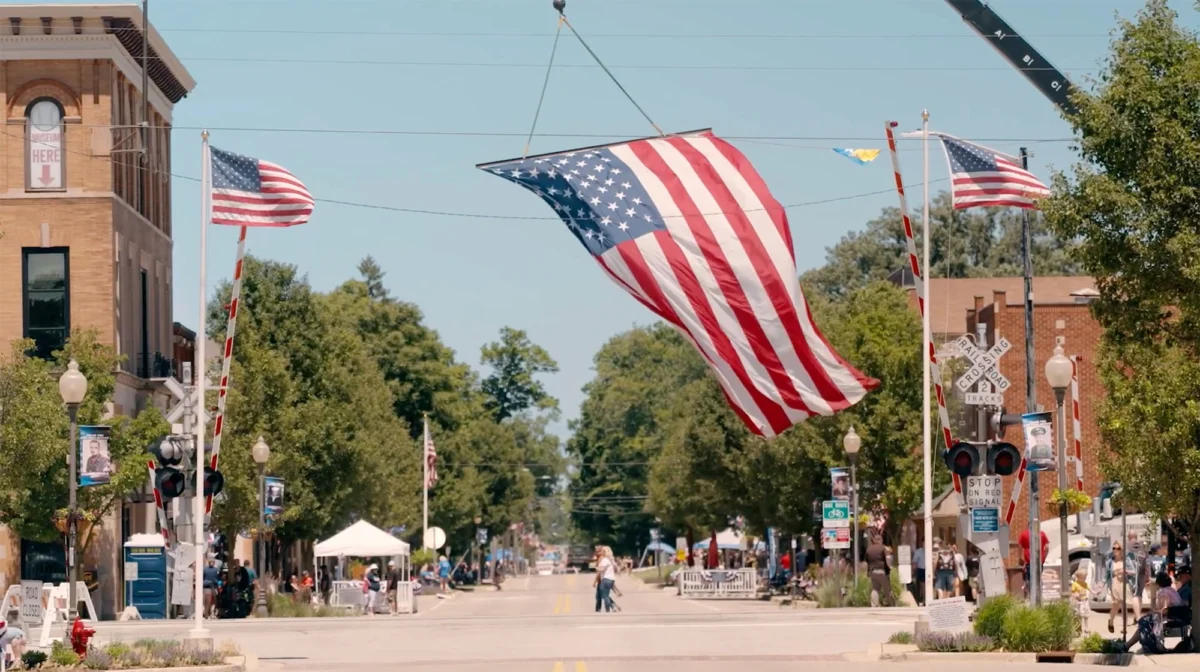
The documentary focuses on the small farming community of Three Oaks, Michigan. Located in Berrien County, approximately 70 miles east of Chicago, Three Oaks has gained national recognition for hosting what is widely considered the largest Flag Day parade in the country. By utilizing a cinema verité approach, the Sheas aim to provide an unfiltered look at the residents, volunteers, and visitors who converge annually to celebrate a symbol that carries diverse and often conflicting meanings in a polarized political climate.
The Cultural Significance of Three Oaks, Michigan
Three Oaks serves as more than just a backdrop for the film; it is the central character of the narrative. With a population of roughly 1,400 residents, the village represents a cross-section of rural American life. The Three Oaks Flag Day parade has been a staple of the region since 1952, evolving from a local tribute into a massive three-day festival that attracts thousands of spectators from across the Midwest.
The documentary captures the logistical and emotional labor required to sustain such an event. From local business owners preparing for the influx of tourists to the meticulous planning of marching bands and veteran organizations, the film highlights how a shared ritual can provide a sense of continuity. However, the filmmakers do not shy away from the tensions inherent in such gatherings. As the community prepares for the parade, the film observes how personal beliefs and national narratives intersect, often revealing the "hard truths" of the American experience mentioned in the directors’ statement.

Production Background and Cinematic Style
Andrew and Melissa Shea bring a wealth of experience in observational storytelling to Flag Day. Their previous collaborations include acclaimed titles such as Portrait of Wally, which examined the legal battle over a Nazi-looted painting, and Wrestling Alligators, a profile of a Seminole tribe leader. Their move toward a community-centric documentary marks a continuation of their interest in how historical and social forces shape individual lives.
The cinematography, handled by Margaret Byrne, emphasizes the observational nature of the project. Byrne, known for her work on Raising Bertie, utilizes a ground-level perspective that prioritizes the lived experience of the subjects over talking-head interviews or voiceover narration. This stylistic choice is intended to immerse the viewer in the rhythm of Three Oaks, capturing moments of humor, conflict, and grace without editorializing.
According to the directors, the project was born out of a desire to practice "radical listening." In an era where digital discourse often replaces face-to-face interaction, the Sheas sought to document a community coming together physically around a shared tradition. Their goal was to investigate what these rituals reveal about the current state of the American social fabric and whether the bonds of local community are strong enough to withstand broader national divisions.
Historical Context and the Evolution of Flag Day
To understand the resonance of the documentary, it is necessary to consider the history of the holiday it depicts. Flag Day commemorates the adoption of the flag of the United States on June 14, 1777, by resolution of the Second Continental Congress. While it is not a federal holiday in the same vein as Independence Day or Memorial Day, its observance has been a significant part of the American civic calendar for over a century.
The push for a national Flag Day began in the late 19th century, led largely by educators and patriotic organizations. President Woodrow Wilson issued a proclamation establishing Flag Day as a national event in 1916, and in 1949, President Harry S. Truman signed an Act of Congress designating June 14 of each year as National Flag Day.

In the context of the 2026 release, the film arrives during the lead-up to the United States Sestercentennial—the 250th anniversary of the signing of the Declaration of Independence. This timing adds a layer of historical weight to the documentary, as the nation reflects on two and a half centuries of governance and identity. Flag Day serves as a precursor to these broader celebrations, focusing on the grassroots level of patriotic expression.
Chronology of the Documentary Project
The development and release of Flag Day followed a precise timeline designed to maximize its impact during the summer of 2026:
- Production Phase (2024–2025): The Sheas and their crew spent extensive time in Three Oaks, documenting multiple parade cycles and the year-round preparations led by the Three Oaks Flag Day Committee.
- Post-Production (Late 2025 – Early 2026): Editing focused on weaving together the diverse narratives of veterans, local officials, and marching band members to create a cohesive verité portrait.
- Trailer Release (April 22, 2026): Abramorama launched the official trailer and poster, initiating the marketing campaign for the theatrical run.
- Theatrical Premiere (June 12, 2026): The film opens in select theaters, primarily in major markets and regions with strong ties to the subject matter.
- National Observance (June 14, 2026): The film’s first weekend in theaters coincides with the 2026 Flag Day, providing a topical hook for audiences.
Analysis of Themes: Ritual, Identity, and Belonging
Flag Day navigates the delicate balance between nostalgia and contemporary reality. For many in Three Oaks, the parade is an exercise in memory—a way to honor past generations and maintain a sense of small-town stability. For others, the event is a reflection of the tensions of the present, where the flag itself can be a point of contention regarding what it means to be a "true" American.
The documentary examines how these tensions manifest in civic life. It highlights the role of the volunteer, the veteran, and the student, showing how each participant brings their own aspirations to the parade. By focusing on a diverse cross-section of townspeople, the film asks whether these shared rituals are enough to bind a polarized population together or if they merely mask deeper fractures.
Industry analysts suggest that Flag Day fits into a growing trend of "empathy-driven" documentaries that seek to bridge the urban-rural divide. Rather than focusing on political pundits or national figures, the film centers on the "ground-level portrait of civic life," offering a nuanced view of Middle America that avoids common stereotypes.

Distribution and Strategic Reach
Abramorama, the distributor behind the release, has a long history of handling documentaries with social and cultural significance. Their strategy for Flag Day involves a targeted theatrical release followed by community screenings and educational outreach. Given the film’s focus on a specific Michigan community, a strong performance is expected in the Great Lakes region, though the universal themes of identity and tradition are intended to appeal to a national audience.
The film’s official website and social media channels are being utilized to encourage community dialogue. By partnering with local organizations and historical societies, the distribution team aims to turn the film’s release into a series of town-hall-style events where viewers can discuss the themes of the documentary in relation to their own communities.
Broader Implications for Civic Discourse
As the United States continues to navigate a period of significant social and political transition, Flag Day offers a timely reflection on the symbols that define the nation. The film suggests that while the flag remains a potent icon of unity, the strength of the country lies not in the symbol itself, but in the communities that gather beneath it.
The documentary serves as a record of a specific moment in American history—a snapshot of a small town striving to maintain its traditions amidst a changing world. By documenting the "humor, conflict, and grace" of the Three Oaks community, the Sheas have created a work that is both a tribute to a local custom and a broader inquiry into the nature of belonging in the 21st century.
Flag Day is more than a chronicle of a parade; it is an examination of the invisible threads that hold a community together. As it heads into theaters this June, it invites audiences to look beyond the spectacle of the celebration and consider the human stories that form the foundation of the American experience. With its observational style and focus on local ritual, the film provides a humble but necessary reminder of the complexities of national identity.