The long-running NBC sketch comedy series Saturday Night Live returned for its May 2 broadcast with a high-profile political cold open that introduced actor and comedian Aziz Ansari as the show’s portrayal of FBI Director-designate Kash Patel. The segment, titled “Hegseth and Patel Iran Press Briefing Cold Open,” utilized a press conference format to lampoon the ongoing controversies and public statements surrounding prominent figures in the second Trump administration. The sketch featured a combination of established cast members and guest stars, highlighting the program’s continued reliance on celebrity cameos to depict high-ranking political officials.
The cold open commenced with Ashley Padilla portraying White House Press Secretary Karoline Leavitt. In a nod to real-world events, the character announced her impending maternity leave before handing the podium over to Colin Jost, who appeared in a rare sketch role as Secretary of Defense Pete Hegseth. The satirical briefing aimed to address escalating international tensions while simultaneously mocking the personal backgrounds and public gaffes of the nominees.
The Portrayal of Pete Hegseth and the Scriptural Controversy
Colin Jost’s portrayal of Pete Hegseth focused heavily on recent reports regarding the nominee’s public statements and his history as a Fox News host. A central theme of the sketch was a recent incident in which the real-world Hegseth was criticized for allegedly reciting a fictionalized Bible verse during a public appearance—a verse famously popularized by the 1994 Quentin Tarantino film Pulp Fiction.
In the sketch, a reporter questioned the fictional Hegseth on whether he was aware that the verse he quoted was not actually found in Christian scripture. Jost, maintaining a stoic and defiant demeanor, responded by suggesting that the verse might eventually be integrated into the canon. The dialogue further leaned into Hegseth’s public image regarding his religious and military-themed tattoos. "I’m not going to apologize because I wear my religion on my sleeve, literally," Jost’s Hegseth remarked, before claiming to have a tattoo of a religious figure engaged in a physical altercation with late-night host Jimmy Kimmel.
The satire extended to Hegseth’s perceived hyper-masculine rhetoric regarding military operations. When asked about the duration of a hypothetical conflict, Jost’s character utilized a provocative metaphor involving gender dynamics, concluding that a war ends only "when the man is done." This line of dialogue was designed to parody the unconventional and often aggressive communication style associated with the administration’s military leadership choices.
Aziz Ansari’s Debut as Kash Patel
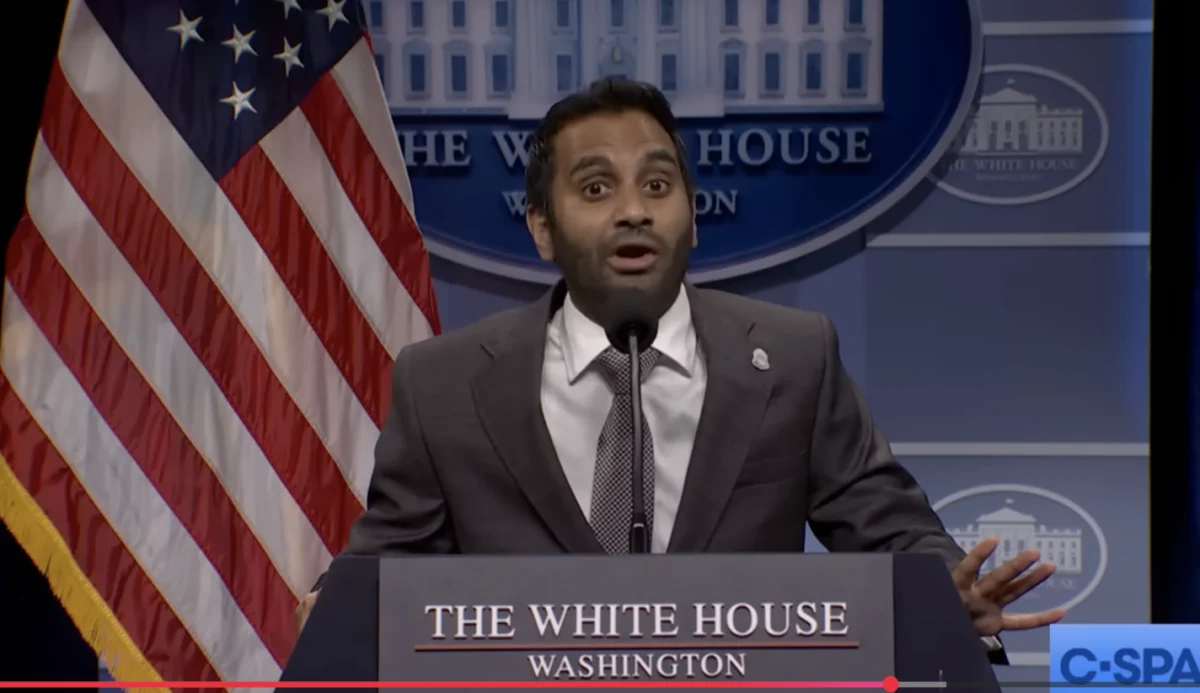
The highlight of the cold open was the unexpected appearance of Aziz Ansari, marking his first major return to the Saturday Night Live stage since hosting the program in January 2017. Ansari took the podium as Kash Patel, the controversial pick for the Director of the Federal Bureau of Investigation. Patel, a former National Security Council official and vocal supporter of Donald Trump, has been a frequent subject of media scrutiny due to his promises to radically reorganize the FBI and the Department of Justice.
Ansari’s performance leaned into a self-deprecating yet arrogant persona. His opening remarks mocked the perceived inefficiency of the intelligence community by suggesting the agency was "six weeks away" from locating Osama bin Laden—a figure who was killed in a 2011 military operation. The humor was predicated on the idea of a government agency operating with outdated or irrelevant objectives under new leadership.
Furthermore, the sketch addressed Patel’s heritage in a satirical manner. Ansari’s Patel described himself as a "trailblazer," humorously claiming to be the first person of Indian descent to struggle with professional competence. "Everyone says Indian people are smart, hardworking, incredibly intelligent," the character stated. "I prove without a shadow of a doubt that we can be just as incapable and incompetent as the whites." This commentary served as a satirical subversion of the "model minority" myth, a recurring theme in Ansari’s own stand-up comedy and television work.
Allegations of Misconduct and Lifestyle Satire
The cold open dedicated a significant portion of its runtime to addressing reports regarding the personal conduct and lifestyle of the nominees. Ansari’s Patel addressed rumors of alcohol consumption and the misuse of government resources with a series of "denials" that functioned as admissions of absurd behavior.
Specifically, the sketch referenced the "Kash-tini," described as a 40-ounce travel mug filled with dry vermouth and lemon peels. This was a direct jab at allegations regarding unprofessional behavior within the transition team. The character also denied using taxpayer-funded private jets to visit multiple Buffalo Wild Wings locations to conduct "taste tests," and refuted claims that he had stood on furniture at the Tao Nightclub in Las Vegas offering to share nuclear codes with patrons.
These jokes reflect a broader trend in Saturday Night Live’s political commentary, which often focuses on the perceived "frat-boy" culture or lack of traditional decorum within certain political circles. By exaggerating these reports, the show highlights the friction between traditional institutional standards and the more populist, unconventional styles of the incoming administration.
Background and Real-World Context
To understand the impact of the May 2 cold open, it is essential to consider the real-world political climate surrounding the subjects. Kash Patel’s nomination for FBI Director has been one of the most polarizing appointments of the transition period. Patel has frequently criticized the "deep state" and has authored books and appeared on podcasts advocating for the closure of the FBI’s headquarters in Washington, D.C. His critics argue that his appointment is an attempt to weaponize the bureau for political purposes, while his supporters see him as a necessary reformer.
Similarly, Pete Hegseth’s nomination for Secretary of Defense was met with significant debate. As a former National Guard officer and television personality, Hegseth’s lack of traditional high-level administrative or military command experience became a central point of contention during the confirmation process. The SNL sketch capitalized on this by portraying him as a figure more concerned with cultural grievances and media optics than traditional defense policy.
The inclusion of Karoline Leavitt in the sketch also mirrors her rise as a prominent face of the administration. As one of the youngest Press Secretaries in history, her portrayal on SNL emphasizes the administration’s focus on youth and media-savviness, even as the show mocks the difficult nature of her role in defending controversial nominees.
Chronology of SNL’s Political Satire in the Current Season
The May 2 episode falls within a pivotal season for Saturday Night Live, which has seen a resurgence in viewership driven by the high-stakes political environment. The season has followed a specific chronological pattern of political engagement:
- The Campaign Phase: Early episodes focused on the primary and general elections, featuring Maya Rudolph as Kamala Harris and James Austin Johnson as Donald Trump.
- The Post-Election Transition: Following the election, the show shifted its focus to the "cabinet reveal" phase, introducing new impressions of appointees like Matt Gaetz, Robert F. Kennedy Jr., and Elon Musk.
- The Confirmation Era: The May 2 cold open represents the "confirmation era" of the season, where the show scrutinizes the specific backgrounds and controversies of individuals facing Senate hearings or public scrutiny.
The casting of Aziz Ansari follows the show’s established strategy of using "heavy hitters" for specific roles. This tradition dates back to the use of Alec Baldwin as Donald Trump, Melissa McCarthy as Sean Spicer, and Larry David as Bernie Sanders. By bringing in a recognizable star like Ansari, the show ensures that the portrayal of Kash Patel gains viral traction and remains a central part of the cultural conversation.
Broader Implications and Analysis
The use of satire in programs like Saturday Night Live serves as a barometer for public sentiment and a tool for political critique. By focusing on the perceived absurdity of the nominees’ statements and backgrounds, the show provides a platform for dissent that resonates with a broad audience. However, critics of the program often argue that such portrayals can also humanize or trivialize serious political issues, turning significant policy shifts into mere fodder for entertainment.
In the case of the Patel and Hegseth portrayals, the show highlights a specific tension in American governance: the clash between institutional norms and anti-establishment fervor. The jokes regarding "Kash-tinis" and "Pulp Fiction" verses are not merely about the individuals themselves, but about the perceived decline of traditional expertise in favor of loyalty and media presence.
From a media perspective, the surprise debut of Aziz Ansari was a strategic success for NBC. The appearance generated immediate social media engagement and high traffic for the show’s digital platforms. For Ansari, the role provides a high-visibility return to the mainstream spotlight, allowing him to flex his satirical muscles in a way that aligns with his previous work on Parks and Recreation and Master of None.
Official Responses and Public Reaction
While official responses from the Trump transition team regarding Saturday Night Live sketches are rarely formal, the individuals portrayed often react via social media. In the past, Donald Trump has frequently critiqued the show on his Truth Social platform, labeling it "unfunny" and "biased." As of the morning following the broadcast, neither Patel nor Hegseth had issued a formal statement, though supporters of the nominees often characterize such sketches as evidence of "coastal elite" bias.
Public reaction on social media was largely divided along partisan lines. Supporters of the show praised Ansari’s comedic timing and the "spot-on" parody of the nominees’ public personas. Conversely, critics argued that the show continues to recycle the same comedic tropes and fails to offer substantive critique beyond personal insults.
Regardless of the political divide, the "Hegseth and Patel Iran Press Briefing Cold Open" stands as a significant moment in the show’s 50th season. It reinforces Saturday Night Live’s role as a primary source of political satire in the United States, capable of shaping the public image of the nation’s most powerful figures through the lens of comedy. As the confirmation processes for these nominees continue, it is likely that the show will continue to refine these impressions, reflecting the evolving narratives of the current administration.