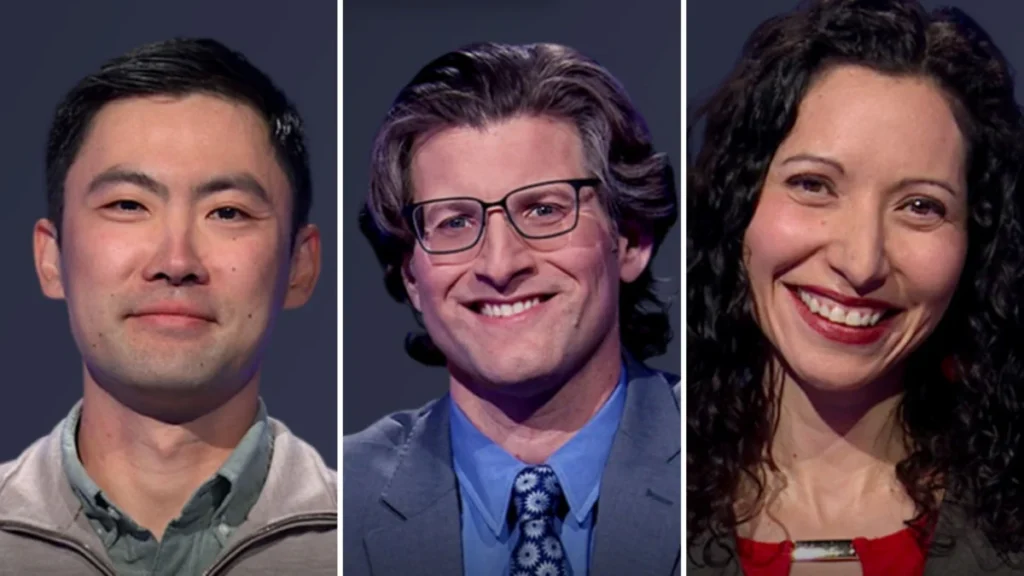
Jamie Ding, the prolific Jeopardy! champion from Lawrenceville, New Jersey, reached a significant milestone on April 23, securing his 30th consecutive victory in what fans and commentators are already hailing as one of the most competitive matches in the show’s storied history. Entering the game with a cumulative total of $793,602, Ding faced formidable opposition from Patrick Nolan, an actuary from Wheaton, Illinois, and Leighanna Mixter, an attorney from Fresno, California. The resulting half-hour of television featured high-risk wagering, aggressive lead changes, and a demonstration of the intellectual stamina that has propelled Ding into the upper echelon of the program’s all-time greats.
The Elite 30-Game Milestone in Jeopardy! History
With his 30th win, Jamie Ding joins an incredibly exclusive group of "ultra-champions." In the four-decade history of the current syndicated version of the show, only a handful of contestants have surpassed the 30-game mark. This elite tier includes legendary figures such as Ken Jennings (74 wins), Amy Schneider (40 wins), Matt Amodio (38 wins), and James Holzhauer (32 wins). Ding’s ascent into this category cements his legacy as a dominant force in modern trivia, characterized by a blend of deep knowledge across diverse subjects and a sophisticated understanding of game theory.
Ding, who identifies as a bureaucrat and is currently a law student, has maintained a remarkably consistent performance throughout his run. His ability to remain composed under pressure was tested more than ever during the April 23 episode, as his opponents displayed a level of play rarely seen in standard "syndicated" episodes.
Detailed Chronology of a High-Stakes Match
The game began with Ding asserting his dominance almost immediately. He found the first Daily Double on the very first clue of the "Jeopardy!" round. The category was "America, 1750-1800," and the clue read: "In 1789, Gov. George Clinton named as New York’s Attorney General this man who 15 years later could have used an attorney himself." Ding correctly identified the figure as Aaron Burr, wagering the maximum allotted $1,000 for a single-clue lead.
However, the momentum shifted quickly. By the fourth clue, Patrick Nolan, whose background as an actuary likely contributed to his comfort with risk and probability, took the lead. The first half of the round became a tactical tug-of-war. By the first commercial break (15 clues in), Ding held a narrow lead of $5,600 to Nolan’s $4,000. While Leighanna Mixter struggled early on, briefly dipping into negative territory, she eventually found her footing, ending the first round with $200. The round concluded with Ding at $7,600 and Nolan close behind at $6,400.
Double Jeopardy: The Battle of the "True Daily Doubles"
The intensity escalated during the Double Jeopardy! round. Nolan surged ahead on the ninth clue, reaching $11,600 to Ding’s $11,200. The turning point for Nolan occurred on clue ten in the category "Teeny Tiny Countries." Finding the Daily Double, Nolan opted for a "True Daily Double," wagering his entire $11,600. Host Ken Jennings noted the gravity of the move, stating, "Whoa! Not a teeny tiny wager then." Nolan correctly identified San Marino, doubling his score to $23,200 and momentarily stunning the champion.
Ding, however, responded with a characteristic display of strategic aggression. Just three clues later, in the category "Art For Art’s Sake," Ding found the final Daily Double. Trailing Nolan with $13,200, Ding matched Nolan’s boldness by wagering his entire bankroll. The clue focused on Seattle’s Chihuly Garden and Glass: "The Glasshouse in Seattle is a one-of-a-kind structure holding a 100-foot sculpture by this artist." Ding correctly answered "Who is Chihuly?" (referring to glass artist Dale Chihuly), reclaiming the lead with $26,400.
The remainder of the round was a neck-and-neck sprint. At the conclusion of Double Jeopardy!, Ding stood at $30,800, Nolan at $28,000, and Mixter at $5,400. The narrow $2,800 gap between the top two players meant that Final Jeopardy! would be the ultimate deciding factor.
Final Jeopardy! and the Polio Vaccine Breakthrough
The category for Final Jeopardy! was "The 1950s." The clue provided was: "The announcement declaring this safe & effective was made April 12, 1955, the 10th anniversary of the death of a famous American."
This clue required contestants to connect historical dates and medical milestones. April 12, 1955, was the day the Salk polio vaccine was declared safe and effective following massive field trials. The date was chosen specifically because it was the 10th anniversary of the death of President Franklin D. Roosevelt, who had famously battled polio and founded the National Foundation for Infantile Paralysis (now the March of Dimes).
Leighanna Mixter initially wrote "What is nuclear power?" but crossed it out to provide the correct response: "Polio vax." She wagered $5,000, bringing her total to $10,400. Patrick Nolan, unfortunately, missed the mark, writing "What is penicillin?" His $10,000 wager dropped his final total to $18,000.
Jamie Ding correctly identified the vaccine, and his wagering strategy reflected his confidence. He wagered $25,201, a move designed to cover a potential double-up by Nolan while ensuring a massive payday. Ding finished the game with $56,001, bringing his 30-day total to a staggering $849,603.
Statistical Breakdown and Performance Analysis
Ding’s 30th win was statistically significant not just for the milestone, but for the sheer volume of points on the board. A combined pre-Final Jeopardy! total of $64,200 between the three contestants represents an exceptionally high-scoring game, indicative of a high "combined Coryat" score (the total score if no wagers were made).
- Jamie Ding’s 30-Day Average: Approximately $28,320 per game.
- Wagering Efficiency: Ding’s use of the "True Daily Double" in this match demonstrates a shift in his late-game strategy, moving from conservative lead-protection to high-ceiling accumulation, a hallmark of top-tier champions like James Holzhauer.
- Clue Accuracy: Throughout his run, Ding has maintained a correct-response rate estimated at over 90%, a metric that places him among the most accurate players in the show’s history.
Public and Critical Reception
The reaction from the Jeopardy! community was immediate and overwhelmingly positive. Host Ken Jennings, who holds the record for the longest winning streak, called the match "What a game!" following the Final Jeopardy! reveal.
On social media platforms and dedicated forums like Reddit, fans characterized the episode as a "Game of the Year" contender. The consensus among viewers was that Patrick Nolan’s performance was of such high caliber that he should be considered for a "Second Chance" tournament, a format recently introduced by producers to bring back high-performing non-winners. One fan noted, "It’s 100% a crime if Patrick’s not invited for a second chance," highlighting the rarity of seeing a champion like Ding pushed so close to defeat.
Broader Implications for the Jeopardy! Season
Jamie Ding’s continued success has significant implications for the upcoming post-season tournaments. His 30 wins guarantee him a top seed in the next Tournament of Champions (ToC). Furthermore, his earnings and longevity make him a lock for the prestigious Jeopardy! Masters tournament, where he will likely face off against the likes of James Holzhauer and Victoria Groce.
Ding’s run comes at a time when the show has seen a resurgence in "super-champions," a phenomenon some analysts attribute to the increased availability of study tools and the "Holzhauer effect," where contestants are more willing to hunt for Daily Doubles and wager aggressively.
Conclusion and Future Outlook
As Jamie Ding moves toward his 31st game, the question is no longer whether he is a great player, but where he will ultimately land on the "Mount Rushmore" of Jeopardy! legends. With nearly $850,000 in winnings, he is fast approaching the $1 million mark in regular-season earnings, a feat achieved by only four other players in the show’s history.
The April 23 match served as a reminder of the drama that the format can produce when three high-level intellectuals are pitted against one another. For Ding, it was a test of nerves; for Nolan, it was a display of "what could have been"; and for the viewers, it was a masterclass in the game that continues to be a staple of American television culture. Ding will return for his 31st game to face two new challengers, carrying the momentum of a win that many are calling an all-time classic.