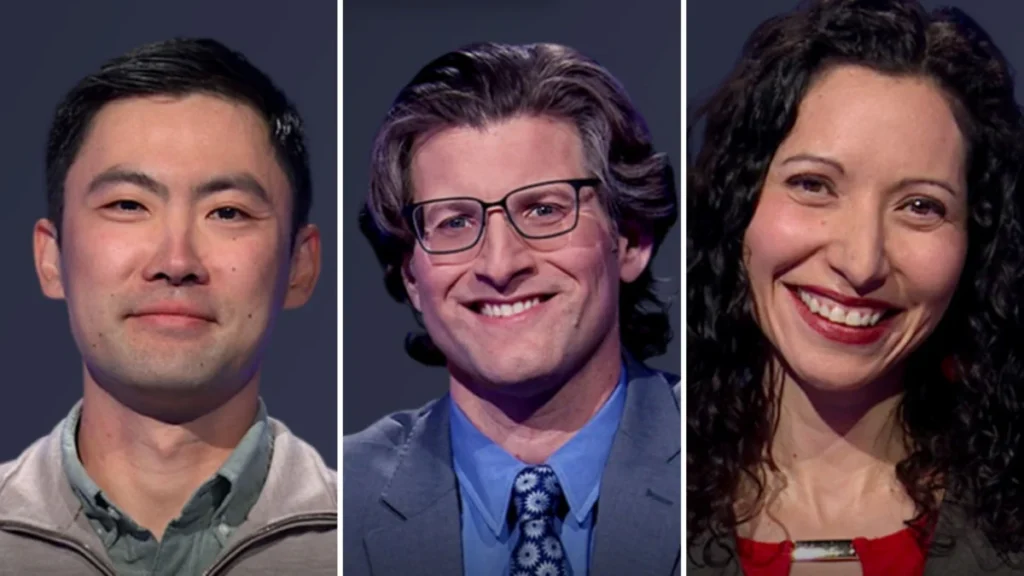
After a remarkable display of intellectual stamina and broad-based knowledge, Jamie Ding’s historic tenure on the long-running syndicated game show Jeopardy! has come to an end. Following a 31-game winning streak that captivated audiences across North America, the Lawrenceville, New Jersey, native saw his run conclude on April 27, 2026. Ding, a law student and government bureaucrat, finished his tenure with a cumulative total of $885,605, cementing his place as one of the most successful contestants in the program’s six-decade history. His departure marks the end of an era for the current season, leaving a legacy of strategic wagering and an uncanny ability to recall obscure facts under the pressure of the bright studio lights.
The final game, which aired in late April, saw Ding face off against Greg Shahade, a notable chess master from Philadelphia, Pennsylvania. Despite a valiant effort, Ding was unable to overcome Shahade’s momentum, ultimately finishing in second place for the episode. While the loss ended his daily presence on the show, the $2,000 second-place prize brought his final earnings to a figure just shy of the $900,000 milestone. In the wake of his exit, Ding engaged in an extensive debrief with Jeopardy! executive producer Sarah Whitcomb-Foss, reflecting on the psychological and physical toll of maintaining a multi-week winning streak while balancing professional and academic responsibilities.
The Dynamics of a Historic Streak
To appreciate the magnitude of Ding’s achievement, one must consider the logistical and mental hurdles inherent in the Jeopardy! production cycle. The show typically films five episodes per day, meaning a champion like Ding must maintain peak cognitive performance for hours on end, often playing a "week’s worth" of television in a single afternoon. For Ding, who won 31 games, this translated to over six full days of filming, spread across several weeks of production. This grueling schedule often leads to "champion fatigue," a phenomenon where the cumulative stress of the buzzer and the constant need for rapid-fire recall begins to erode even the most disciplined mind.
During his conversation with Whitcomb-Foss on the Jeopardy! Substack, Ding admitted that the conclusion of his run brought a sense of closure that was as much a relief as it was a disappointment. He likened the experience to baseball, noting that the game theoretically has no clock and could proceed indefinitely as long as the player continues to perform. However, he acknowledged that the human element eventually becomes the limiting factor. The "certainty" of the loss allowed him to finally step away from the high-stakes environment and return to a semblance of a normal life in New Jersey.
Statistical Standing and All-Time Rankings
Ding’s 31-game streak places him in an elite echelon of contestants. In the history of the show, only a handful of players have crossed the 20-game threshold, and even fewer have surpassed 30. His performance invites immediate comparison to legendary "Super Champions" such as Ken Jennings, whose 74-game streak remains the gold standard; Amy Schneider, who secured 40 wins; Matt Amodio, with 38; and James Holzhauer, whose aggressive wagering style led to 32 wins and significantly higher single-game totals.
While Ding did not surpass Holzhauer’s 32-game count, his $885,605 total ranks him among the top five all-time highest earners in regular-season play. His average winnings per game hovered around $28,500, a testament to his consistency and his ability to find and capitalize on Daily Doubles. Unlike some champions who rely on high-risk gambling strategies, Ding’s path to victory was often characterized by a methodical "sticky memory" and a steady command of the board, which allowed him to build insurmountable leads—often referred to as "runaways"—before entering the Final Jeopardy! round.
The Final Match: Analysis of the Loss to Greg Shahade
The game that ended Ding’s streak was not a case of a champion failing, but rather a challenger excelling. Greg Shahade, the contestant who eventually unseated Ding, brought a unique set of skills to the podium. As a professional chess master, Shahade is accustomed to high-pressure environments that require strategic foresight and rapid decision-making. These traits translated effectively to the Jeopardy! stage, where buzzer timing and category management are paramount.
Ding characterized the final game as "fun for everyone," noting that if he had to lose, he was glad it was to a "strong player." The match was competitive from the opening clues, with Shahade challenging Ding’s dominance in the Double Jeopardy! round. The defeat highlights the inherent volatility of the game; no matter how knowledgeable a champion is, a single missed Daily Double or a fast-fingered opponent can change the trajectory of the series. Ding’s grace in defeat was noted by producers and fans alike, as he expressed gratitude for the "gift" of every game he was able to play.
Academic and Professional Balancing Act
Perhaps the most impressive aspect of Ding’s run was his ability to compete while simultaneously pursuing a law degree and maintaining a full-time job in the public sector. Unlike some professional trivia players who spend months or even years specifically training for the show using flashcards and data-driven study methods, Ding relied on what he described as a "sticky memory." This innate ability to retain information through casual reading and everyday learning allowed him to remain competitive without the luxury of a dedicated study regimen.
He admitted to Whitcomb-Foss that his schedule left little room for "proper studying." Between his duties as a bureaucrat and his academic requirements as a student, Ding’s preparation was largely passive. He credited his success to a lifelong habit of curiosity—learning something new every day through his normal routine. However, looking forward to future competitions, Ding acknowledged that he would likely need to "hunker down" and engage in more rigorous preparation to compete against the elite-level players he will face in tournament play.
Future Prospects: Tournament of Champions and Masters
The conclusion of Ding’s regular-season run is merely the end of the first chapter of his Jeopardy! career. By winning 31 games, he has guaranteed himself a spot in the next Tournament of Champions (TOC). The TOC is an annual event that brings together the most successful players from the previous season to compete for a $250,000 grand prize and the prestige of being named the best of the best. Given his high win count, Ding will enter the tournament as a heavy favorite and a top seed.
Furthermore, there is significant speculation regarding Ding’s involvement in the Jeopardy! Masters tournament. This elite competition, which airs in primetime on ABC, features the top-tier players in the show’s history, such as James Holzhauer and Victoria Groce. While the Masters field is typically reserved for the top three finishers of the previous Masters season and the winner of the TOC, Ding’s 31-game streak makes him a prime candidate for a producer’s invitation or a spot earned through tournament victory. Ding expressed a sense of calm regarding these future appearances, noting that knowing he would eventually return helped him manage the stress of his final regular-season games.
Cultural Impact and Regional Pride
Ding’s success has resonated deeply in his home state of New Jersey. Throughout his run, he frequently mentioned his roots in Lawrenceville, and his victory has been celebrated as a point of local pride. Ding remarked that he hoped he "did Jersey proud," and he expressed a modest excitement at the prospect of being recognized by fans in public. The "Super Champion" phenomenon has a documented effect on local viewership, often leading to ratings spikes in the contestants’ hometown markets as residents tune in to support one of their own.
Beyond the local impact, Ding’s run contributes to the ongoing "Super Champ" era of Jeopardy!, a period marked by more frequent long-term streaks since the show removed the five-game limit in 2003. These long runs serve to build a narrative arc that keeps viewers engaged over several weeks, creating a "must-watch" atmosphere as the champion approaches historic milestones.
Conclusion and Broader Implications
The reign of Jamie Ding represents a significant moment in the modern history of Jeopardy!. His $885,605 in winnings and 31 victories place him among the giants of the game, proving that a combination of innate curiosity, mental resilience, and a "sticky memory" can still dominate in an era where many contestants rely on data-driven preparation.
As Ding returns to his law studies and his career in Lawrenceville, the Jeopardy! community looks forward to his return in the Tournament of Champions. His departure leaves the champion’s lectern open for a new contender, but the standard he set over 31 games will remain a benchmark for future contestants. For now, Ding can enjoy a well-earned respite, secure in the knowledge that his name is permanently etched into the record books of America’s favorite quiz show. Jeopardy! continues to air weekdays, with fans eagerly awaiting the next great streak that might challenge the records recently established by this New Jersey standout.