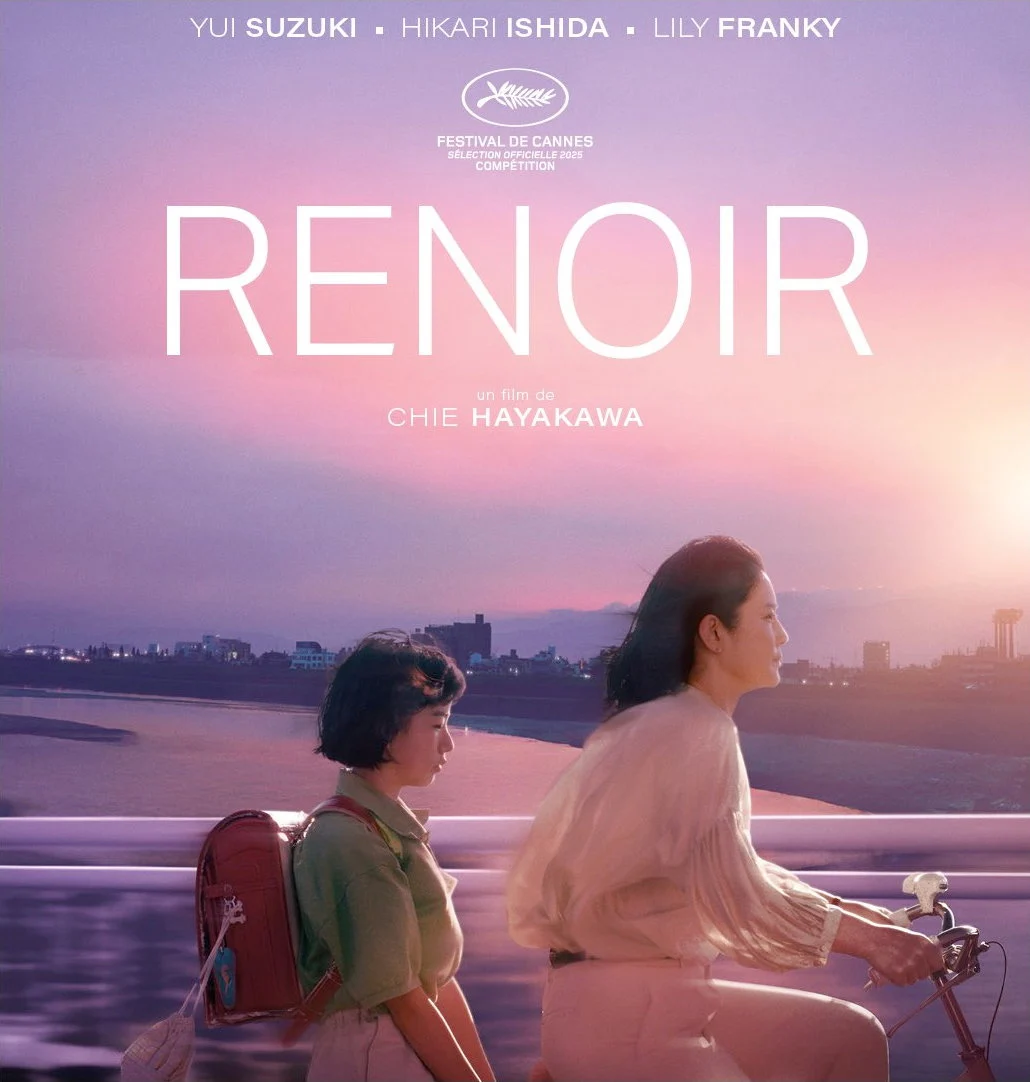
The North American distribution company Film Movement has officially unveiled the US trailer for Renoir, the latest feature from visionary Japanese director Chie Hayakawa. Following its high-profile debut in the Main Competition at the 2025 Cannes Film Festival, the film has garnered significant international attention for its delicate handling of grief, childhood isolation, and the intersection of reality and the supernatural. Set to arrive in select US theaters on May 29, 2026, Renoir marks Hayakawa’s sophomore effort following her critically lauded 2022 debut, Plan 75. The trailer release signals a strategic push by Film Movement to bring high-caliber East Asian auteur cinema to American audiences during the competitive summer movie season.
A Poetic Exploration of Childhood and Grief
Set against the backdrop of Tokyo in 1987, Renoir follows the internal and external journey of 11-year-old Fuki, portrayed by newcomer Yui Suzuki. The narrative finds Fuki at a crossroads of domestic instability and existential curiosity. While her father remains confined to a hospital bed battling a terminal illness, her mother, played by Hikari Ishida, is consumed by the exhausting demands of full-time employment and the emotional toll of her husband’s impending absence.
Left to navigate the sweltering summer holidays largely on her own, Fuki retreats into a world of esoteric interests. She becomes obsessed with the concept of telepathy and the "mysteries of the universe," a fascination that serves as a psychological shield against the harsh realities of her father’s decline. This curiosity leads her to a mysterious telephone hotline—a relic of the pre-digital era—where her search for connection inadvertently places her in a position of significant personal risk. The film is described as an "exceptionally poetic" drama that uses the lens of a child to examine how the young process the concept of mortality and the unknown.
Directorial Vision and Autobiographical Origins
Chie Hayakawa has been open about the deeply personal roots of Renoir. In press statements surrounding the film’s festival run, Hayakawa revealed that the project was born from a desire to revisit her own childhood memories. The director’s father passed away when she was young, and the film functions as a cinematic reclamation of that period.

The title itself, Renoir, is derived from a specific gift Hayakawa received from her father: a reproduction of a painting by the French Impressionist master Pierre-Auguste Renoir. This painting becomes a central motif in the film, representing a singular point of beauty and permanence in a world defined by transition and loss. By grounding the narrative in the year 1987, Hayakawa captures a specific cultural moment in Japan—a time just before the digital revolution, where mystery still lingered in the shadows of urban life and the "supernatural" felt accessible through the analog technology of the era.
A Stellar Ensemble of Japanese Talent
While the film rests heavily on the shoulders of young Yui Suzuki, who has been praised for a performance that balances vulnerability with an eerie sense of detachment, the supporting cast features some of the most respected names in contemporary Japanese cinema.
Lily Franky, a regular collaborator of Hirokazu Kore-eda and a mainstay of internationally recognized Japanese dramas like Shoplifters, brings a grounded presence to the production. He is joined by Hikari Ishida, Yuumi Kawai, and Ayumu Nakajima. Yuumi Kawai, in particular, has seen a meteoric rise in the Japanese film industry over the last three years, known for her ability to inhabit complex, often troubled characters. The ensemble is rounded out by Ryota Bando and Hana Hope, providing a multi-generational perspective on the film’s central themes of family and memory.
Historical and Cultural Context: Tokyo 1987
The choice of 1987 as the film’s setting provides a rich cultural tapestry for Hayakawa’s story. In the late 1980s, Japan was at the height of its "bubble economy," a period of unprecedented financial growth and urban development. However, Renoir shifts the focus away from the neon-soaked excess of the Ginza district, focusing instead on the quiet, often claustrophobic suburbs.
For an 11-year-old in 1987, the world was expanding through television and telephone lines, yet remained physically small. The film utilizes this specific timeframe to explore the "occult boom" that fascinated Japanese youth during the 80s—a period where magazines and late-night television were frequently dedicated to psychics, UFOs, and telepathy. By placing Fuki within this cultural zeitgeist, Hayakawa illustrates how a child’s imagination can be both a refuge and a labyrinth.

Critical Reception and Festival Pedigree
Since its premiere at the 78th Cannes Film Festival in 2025, Renoir has maintained a strong critical standing. It currently holds an 88% approval rating on the review aggregator Rotten Tomatoes, with critics highlighting Hayakawa’s "restrained yet emotionally resonant" direction.
While some reviews have been described as "mixed," many of the more critical takes focus on the film’s deliberate pacing and its refusal to provide easy answers regarding its supernatural elements. However, for enthusiasts of "slow cinema" and the contemplative style of the Japanese New Wave, the film is being hailed as a masterpiece of atmosphere. The consensus suggests that Renoir is a significant evolution for Hayakawa, moving from the social-political commentary of Plan 75 toward a more lyrical, character-driven mode of storytelling.
Production and Global Distribution
The film is a co-production involving several international entities, reflecting the increasingly global nature of prestige Japanese cinema. Producers include Eiko Mizuno-Gray and Jason Gray of Loaded Films, Keisuke Konishi, Christophe Bruncher, and Fran Borgia. This collaborative effort ensured the film had the resources to capture the period-accurate aesthetics of 1980s Tokyo while maintaining the intimacy of an independent drama.
Film Movement, the US distributor, has a long-standing reputation for championing foreign-language films that might otherwise struggle to find a footprint in the North American market. Their acquisition of Renoir follows a trend of increasing interest in Japanese directors like Ryusuke Hamaguchi and Koji Fukada. By scheduling a May 29, 2026 release, Film Movement is positioning Renoir as a sophisticated alternative to the traditional Hollywood summer blockbusters, targeting urban arthouse circuits and university towns.
Technical Artistry and Visual Language
Visually, Renoir is reported to evoke the soft, dappled light characteristic of the Impressionist painter for whom it is named. The cinematography focuses on the tactile details of 1987—the texture of old wallpaper, the hum of a cathode-ray tube television, and the hazy heat of a Tokyo summer. This aesthetic choice serves to blur the lines between Fuki’s reality and her telepathic fantasies, making the "mysteries of the universe" feel as tangible as the hospital room where her father resides.

The film’s sound design is equally crucial, utilizing the silence of the suburbs and the crackle of telephone static to build tension. The "danger" Fuki faces through the hotline is conveyed not through overt violence, but through a creeping sense of psychological unease, a hallmark of Hayakawa’s directorial style.
Chronology of Development and Release
The journey of Renoir from concept to US screens has spanned several years:
- 2023: Following the success of Plan 75, Chie Hayakawa announces she is developing a semi-autobiographical script set in the 1980s.
- Early 2024: Principal photography begins in the Tokyo suburbs, with a focus on capturing authentic 1980s architecture before modern redevelopment.
- May 2025: Renoir premieres in the Main Competition at the Cannes Film Festival. It receives a standing ovation and enters the shortlist for several awards.
- Late 2025: Film Movement acquires North American distribution rights, citing the film’s "universal themes of grief and wonder."
- April 17, 2026: The official US trailer is released, generating buzz among cinephiles and fans of Japanese culture.
- May 29, 2026: The film is scheduled to open in select theaters in New York, Los Angeles, and other major markets, with a wider expansion planned for the following month.
Broader Impact and Implications
The release of Renoir comes at a time when Japanese cinema is experiencing a renewed "Golden Age" on the international stage. The success of films like Drive My Car and Monster has proven that there is a substantial audience for long-form, nuanced Japanese storytelling in the United States.
Chie Hayakawa is at the forefront of this movement. By transitioning from the high-concept premise of Plan 75—which imagined a government-sponsored euthanasia program for the elderly—to the deeply personal, nostalgic landscape of Renoir, she demonstrates a versatile range. Renoir challenges the viewer to look beyond the surface of everyday life to find the "mysteries" that lie beneath, suggesting that the most profound cosmic questions are often found in our most private moments of sorrow.
As the US release date approaches, Renoir stands as a testament to the power of memory and the enduring influence of art. Whether it is a painting by a French master or a fleeting connection over a telephone line, Hayakawa’s film argues that the things we cling to in our youth define the adults we eventually become. For American audiences, Renoir offers not just a window into 1980s Japan, but a mirror reflecting the universal experience of growing up in the shadow of loss.